
Dermatologist vs Skin Specialist in Mysore: What’s the Difference?
- Home
- Blog
- About Us
If you are searching for a skin specialist in Mysore, you may come across terms such as dermatologist, skin doctor, skin specialist, cosmetologist and aesthetic practitioner. These terms can describe different types of professionals, so the title alone does not tell you what medical training a person has.
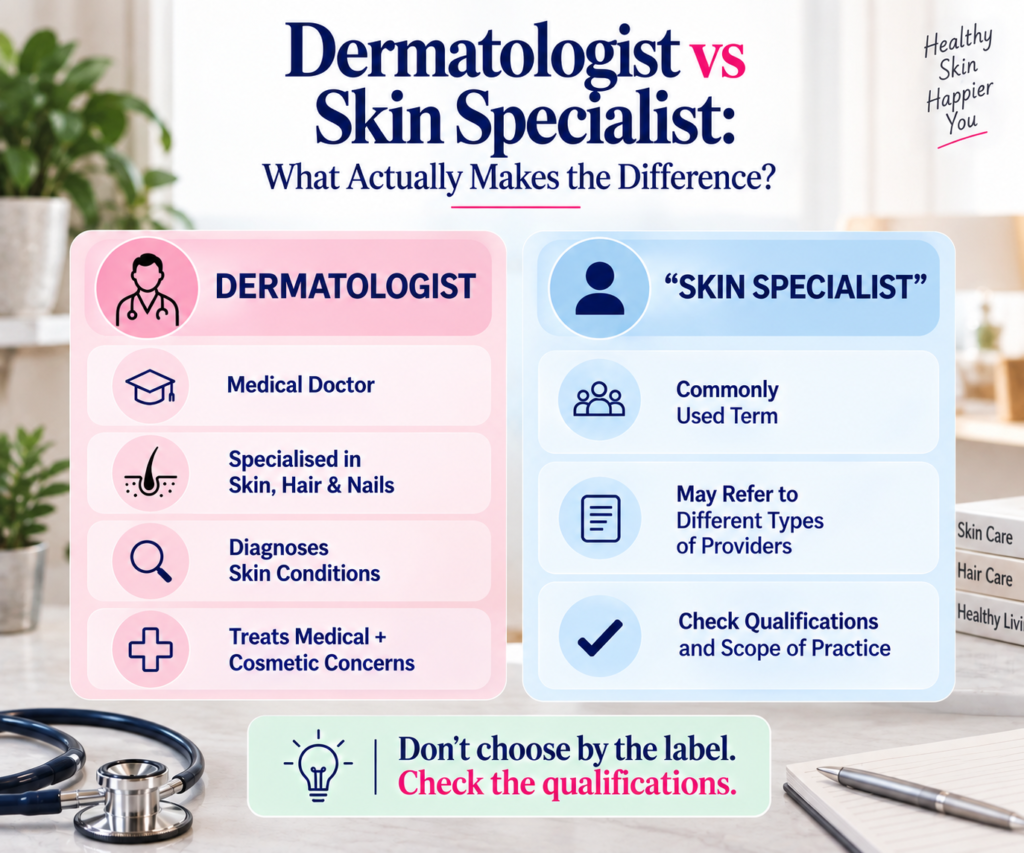
A dermatologist is a medical doctor who specialises in conditions affecting the skin, hair and nails. In India, Dermatology, Venereology and Leprosy is a recognised postgraduate medical specialty. The National Medical Commission lists MD in Dermatology, Venereology & Leprosy among its postgraduate medical qualifications.
“Skin specialist” is different. It is a commonly used public term and, depending on the context, may refer to a dermatologist or someone providing cosmetic or skin-related services. Your first step should therefore be to check the practitioner’s actual qualification and area of training.
What Is a Dermatologist?
A dermatologist is a medical doctor trained to evaluate and manage conditions involving the skin, hair and nails. The American Academy of Dermatology describes dermatologists as medical doctors who specialise in these areas.
In India, postgraduate training in Dermatology, Venereology and Leprosy includes the recognition, investigation and clinical management of dermatological conditions.
Depending on their training and clinical scope, dermatologists may assess problems such as:
- Acne
- Rashes
- Itching
- Inflammatory skin conditions
- Certain skin infections
- Pigmentation concerns
- Hair loss
- Scalp conditions
- Changes in moles or skin growths
- Other skin, hair and nail conditions
The specific services provided by an individual dermatologist depend on their training and clinical practice.
What Does “Skin Specialist” Mean?
“Skin specialist” is a phrase people commonly use when looking for help with a skin concern.
Someone searching online might use terms such as:
- Skin specialist in Mysore
- Skin doctor near me
- Skin specialist doctor
- Skin clinic in Mysore
- Doctor for acne
- Doctor for pigmentation
In everyday use, “skin specialist” may refer to a dermatologist. However, the phrase itself does not establish a particular medical qualification.
A person providing cosmetic skincare services may also be described informally as a skin specialist. That is why checking the practitioner’s credentials is more useful than relying on the wording used in an advertisement or online listing.
Is a Dermatologist the Same as a Skin Specialist?
Sometimes the terms are used to describe the same person, but they are not automatically equivalent.
If a medically qualified dermatologist describes themselves as a skin specialist, both terms may refer to that practitioner.
The phrase “skin specialist” by itself, however, does not identify a recognised medical specialty. A dermatologist has specific medical training in dermatology, while the meaning of “skin specialist” depends on the individual using the term.
When comparing practitioners, ask:
What is your medical qualification?
What is your area of specialty?
Are you medically trained to diagnose and treat the condition I am concerned about?
Those questions give you more useful information than the label “skin specialist” alone.
Dermatologist vs Skin Specialist: The Practical Difference
What to check | Dermatologist | “Skin specialist” |
Meaning | Recognised medical specialty | General term used by the public |
Medical specialty | Dermatology | Depends on the practitioner |
Medical qualification | Specific dermatology training | Must be verified |
Diagnosis of skin conditions | Within professional scope | Depends on qualifications and scope |
Hair and scalp concerns | Dermatologists can assess these | Depends on training |
Cosmetic skin concerns | Some dermatologists also provide cosmetic care | May refer to cosmetic skincare |
What should you verify? | Qualification and registration | Qualification, medical training and scope |
The important distinction is that “skin specialist” is not a qualification by itself. The person’s actual education, registration and scope of practice are what matter.
What Conditions Can a Dermatologist Treat?
Dermatologists manage a broad range of skin, hair and nail concerns. The American Academy of Dermatology provides information covering conditions such as acne, eczema, psoriasis, rosacea, hair loss and skin cancer.
Acne and Acne Scars
Persistent acne may need medical assessment, particularly when it is painful, recurring or leaving pigmentation and scars.
A dermatologist can assess the type and severity of acne, previous treatment and the presence of pigmentation or scarring before discussing appropriate management.
Rashes and Itching
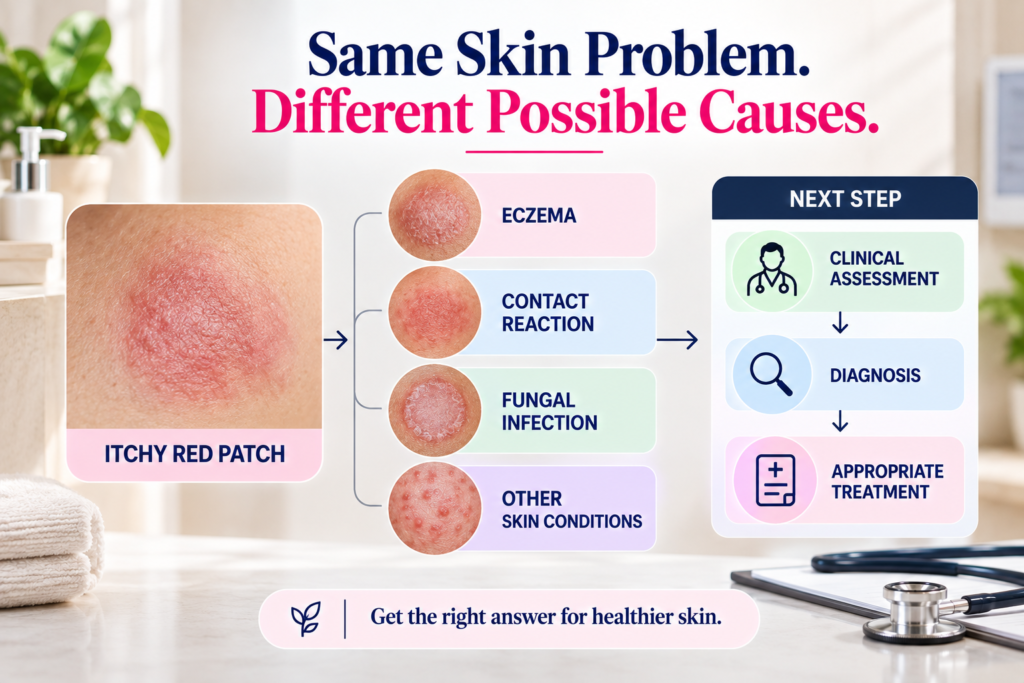
A recurring rash can have several possible causes. A dermatologist can examine the affected skin and decide whether further evaluation or treatment is appropriate.
Persistent itching also deserves attention when the cause is unclear or the symptom is interfering with everyday activities.
Pigmentation
Dark or light patches can develop for different reasons. New, persistent, changing or unexplained pigmentation may require professional assessment.
The aim is to determine what is causing the change before deciding whether treatment is appropriate.
Hair Loss
Hair loss can have several causes. Identifying the pattern, timing and possible contributing factors is useful before choosing treatment.
APTA Clinic’s supplied information also lists trichology services for hair and scalp concerns, including hair loss and scalp conditions.
Scalp Conditions
Persistent dandruff, itching, scaling, inflammation or other scalp changes may need professional assessment, especially when they are associated with hair loss or do not improve with basic care.
Changing Moles or Skin Growths
A new or changing mole or skin growth should be assessed rather than diagnosed from an online photograph.
Changes in size, shape, colour or other features may warrant professional evaluation.
Medical Dermatology vs Cosmetic Skin Treatments
Dermatology can involve both medical and cosmetic care, which is another reason the terminology can become confusing.
Medical dermatology focuses on diagnosing and managing skin, hair and nail conditions.
Cosmetic dermatology deals with concerns related to appearance, such as certain pigmentation, skin texture and signs of ageing.
The two areas can overlap, but a cosmetic skin service is not automatically the same as medical dermatology. APTA Clinic’s supplied information describes its dermatology department as covering medical, cosmetic and aesthetic skin-related conditions.
If you have an unexplained rash, persistent itching, sudden hair loss or a changing skin lesion, medical assessment should come before choosing a cosmetic treatment based only on appearance.
Dermatologist vs Cosmetologist vs Aesthetic Practitioner
These terms should not automatically be treated as equivalent.
Dermatologist
A dermatologist is a medical doctor specialising in dermatology and related areas of skin, hair and nail care.
Cosmetologist
A cosmetologist generally works in beauty and cosmetic care. The person’s exact training and professional scope need to be checked according to their role and jurisdiction.
Aesthetic Practitioner
“Aesthetic practitioner” is a broad term that can describe people working in cosmetic or aesthetic services. Qualifications can differ, so the practitioner’s specific credentials should be checked.
This distinction matters when you are dealing with a medical skin problem. A title such as “aesthetic practitioner” or “skin specialist” does not, on its own, tell you whether the person has the medical training required for your particular concern.
When Should You See a Dermatologist?
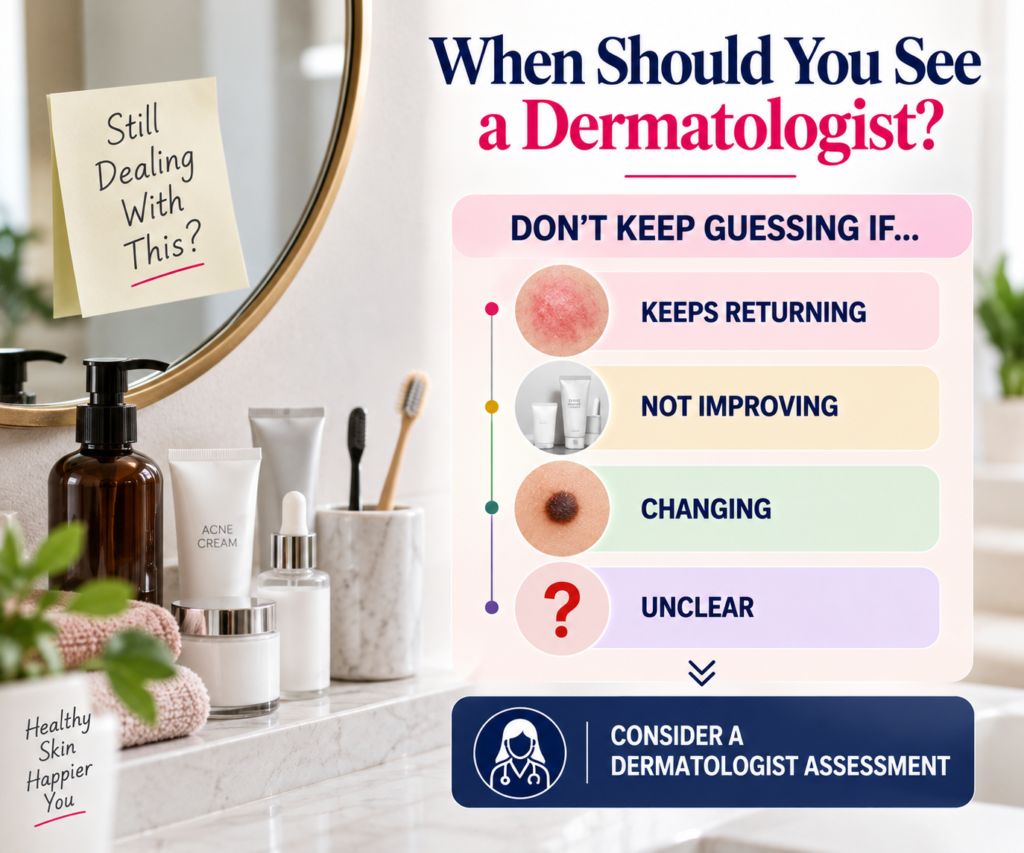
A dermatology consultation may be appropriate if you have:
- Acne that keeps returning
- Persistent itching
- Recurring rashes
- Unexplained pigmentation
- A changing mole or skin growth
- Persistent dryness, scaling or inflammation
- A suspected skin infection
- A skin lesion that does not heal
- Sudden or progressive hair loss
- Persistent scalp problems
- A skin condition that repeatedly returns
- Symptoms that interfere with sleep or daily activities
These symptoms do not automatically indicate a serious disease. The reason for seeking professional assessment is to understand the problem instead of repeatedly treating an unknown condition yourself.
When May Cosmetic Treatment Be Considered?
Some people seek professional advice because they are concerned about the appearance of their skin rather than a medical symptom.
Examples include concerns about:
- Skin texture
- Certain pigmentation concerns
- Acne marks
- Signs of ageing
- Uneven appearance
- Other cosmetic skin concerns
A consultation can help determine whether cosmetic treatment is appropriate and whether a medical issue should be addressed first.
Why Qualifications Matter When Choosing a Skin Specialist
The person assessing your skin should have training appropriate to the problem you want addressed.
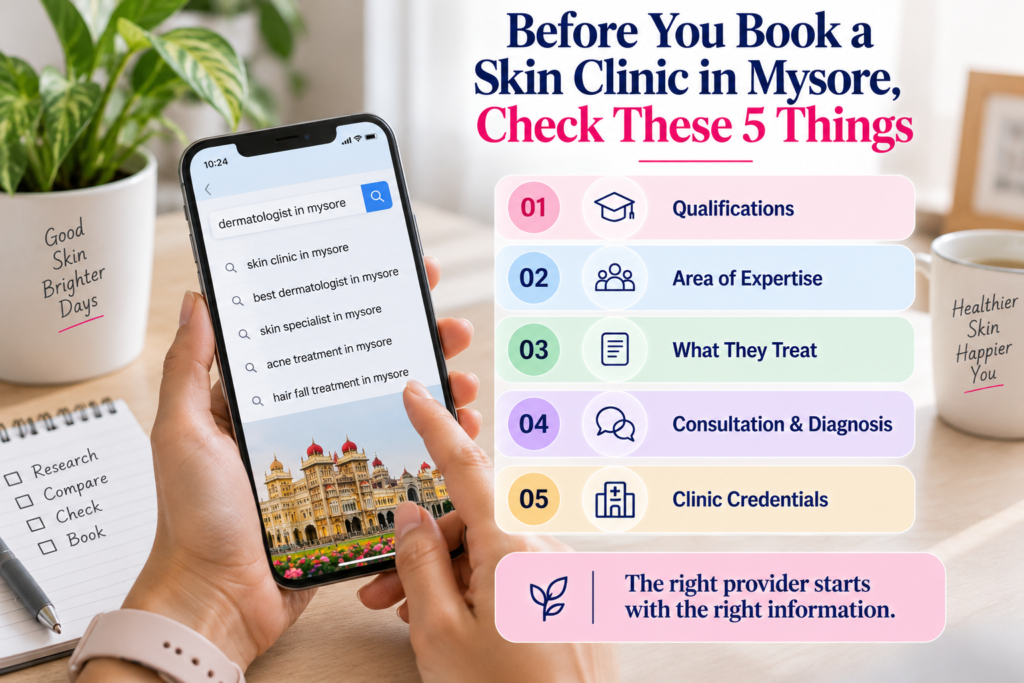
Before making an appointment, ask:
- What medical qualification do you hold?
- What is your specialty?
- Are you trained to diagnose and manage my type of concern?
- Is this primarily a medical or cosmetic issue?
- What evaluation will be performed?
- What treatment options may be appropriate?
- Would another specialist be more suitable?
The National Medical Commission’s postgraduate curriculum for Dermatology, Venereology & Leprosy includes training in recognising, investigating and clinically managing dermatological conditions.
This is why a practitioner’s actual qualifications are more informative than descriptions such as “skin expert” or “skin specialist.”
What Should You Expect During a Dermatology Consultation?
A dermatology consultation generally begins with understanding the problem.
The doctor may ask:
- When the problem began
- Whether it is improving or worsening
- Whether it has happened before
- Which treatments or products you have already tried
- Whether there are known triggers
- About other medical conditions
- About medicines or supplements
- Whether similar problems run in the family
The affected skin, hair or scalp can then be examined.
Depending on the concern, the doctor may determine that no further testing is needed or recommend additional evaluation. The exact process depends on the problem being assessed.
Why You Should Not Self-Diagnose Skin Problems
Skin symptoms can be misleading.
Two different conditions can look similar, while the same condition can appear differently in different people. Itching and pigmentation are examples of symptoms that can have several possible causes.
Online information can help you understand terminology and prepare questions, but it cannot replace a clinical examination when a problem is persistent, unexplained or worsening.
Avoid starting prescription medicines or repeatedly changing treatments based only on online information.
Questions to Ask Before Choosing a Skin Specialist in Mysore
Before booking an appointment, consider asking:
Are you a dermatologist?
If the answer is yes, ask about the practitioner’s medical qualification and specialty.
What qualifications do you have?
Look for clearly stated medical qualifications rather than relying only on marketing descriptions.
Do you treat my particular concern?
A practitioner may have a particular clinical focus, so it is reasonable to ask whether your concern falls within their scope.
Is my concern medical, cosmetic or both?
This can help you understand what type of care you may need.
Will my skin be examined before treatment?
An examination is particularly useful when the cause of a problem is unclear.
What should I expect from the consultation?
Ask about the assessment process, possible investigations and follow-up.
Do I need another specialist?
A clinician should be able to tell you when a concern falls outside their area of expertise.
Finding a Skin Specialist in Mysore
If you are looking for a skin specialist in Mysore, first identify the type of help you need.
For an unexplained or persistent skin condition, look for a medically qualified dermatologist.
For hair and scalp concerns, check whether the clinic provides appropriate dermatology or trichology assessment.
For a primarily cosmetic concern, ask who will provide the treatment and what qualifications they hold.
The supplied APTA Clinic information describes the clinic as a multi-specialty centre in Mysuru with dermatology and trichology services alongside plastic surgery, facial surgery and dental care. It identifies Dr. Swathi Anand as a Dermatologist & Aesthetician and lists locations in Krishnamurthy Puram and Vijayanagar, Mysore.
Verify current clinic locations, contact details and practitioner availability directly with the clinic before publishing or booking, as these details can change.
Choosing Between a Dermatologist and a Skin Specialist
The terms can overlap in everyday conversation, but they do not tell you the same thing about a practitioner’s training.
A dermatologist is a medically trained specialist in skin, hair and nail conditions. “Skin specialist” is a broader term, so the person’s qualifications need to be checked.
If you are choosing a skin specialist in Mysore, look at the practitioner’s actual qualification and area of training. Consider whether your concern is medical, cosmetic or both, and ask what assessment will be performed before treatment.
For a persistent, unexplained or changing skin, hair or scalp problem, professional assessment is more useful than trying to identify the condition yourself.
If you want to discuss a skin, hair or scalp concern, APTA Clinic’s supplied information lists dermatology and trichology services in Mysuru.
Frequently Asked Questions (FAQs)
Not necessarily. “Skin specialist” is a broad term that may be used for a dermatologist or for someone providing other skin-related services. A dermatologist has specific medical training in dermatology.
Dermatologists diagnose and manage conditions affecting the skin, hair and nails. Depending on their clinical scope, this can include acne, rashes, inflammatory conditions, certain infections, pigmentation, hair loss, scalp conditions and changing skin growths.
Dermatology, Venereology & Leprosy is a recognised postgraduate medical specialty. The National Medical Commission lists MD in Dermatology, Venereology & Leprosy among postgraduate medical qualifications.
The term “skin specialist” alone does not establish a person’s medical qualification or scope of practice. Check whether the practitioner is a medically qualified dermatologist or has other training appropriate to the concern you want assessed.
A dermatologist may be appropriate when acne is persistent, painful, recurrent, leaving marks or scars, or not responding to your current care. A consultation does not require acne to be severe.
Some dermatologists provide both medical and cosmetic dermatology services. The exact services depend on the practitioner’s training and clinical practice.
A dermatologist is a medical doctor specialising in dermatology. A cosmetologist generally works in beauty and cosmetic care, with training and scope depending on the professional role and jurisdiction.
“Aesthetic practitioner” is a broad description for someone working in aesthetic or cosmetic services. Qualifications can vary, so check the individual’s specific credentials before treatment.
The supplied APTA Clinic information identifies Dr. Swathi Anand as a Dermatologist & Aesthetician and states that the clinic provides dermatology services in Mysuru.
The supplied information lists locations in Krishnamurthy Puram and Vijayanagar, Mysore. Confirm the current location and appointment details directly with the clinic before visiting.