
Pigmentation and Dark Spots: What Causes Them and How Are They Treated?
- Home
- Blog
- About Us
A dark patch on the face can have several possible causes. A mark left after acne is different from pigmentation caused by melasma, repeated sun exposure or skin irritation.
Pigmentation is a broad term for changes in skin colour. Darker areas can develop after inflammation, acne or injury. Hormonal factors, sun exposure, certain medications and some pigmentary conditions can also play a role.
This is why pigmentation treatment in Mysore should start with identifying the cause. A cream, chemical peel or laser treatment may be appropriate for one type of pigmentation and unsuitable for another.
The location, appearance, duration and underlying trigger all help a dermatologist decide what needs to be treated.
What Is Skin Pigmentation?
Melanin is the pigment that gives skin its colour. It is produced by specialised cells called melanocytes.
When more melanin is produced or deposited in a particular area, that area can appear darker than the surrounding skin.
Pigmentation describes the visible change. It does not, by itself, identify the medical condition causing it.
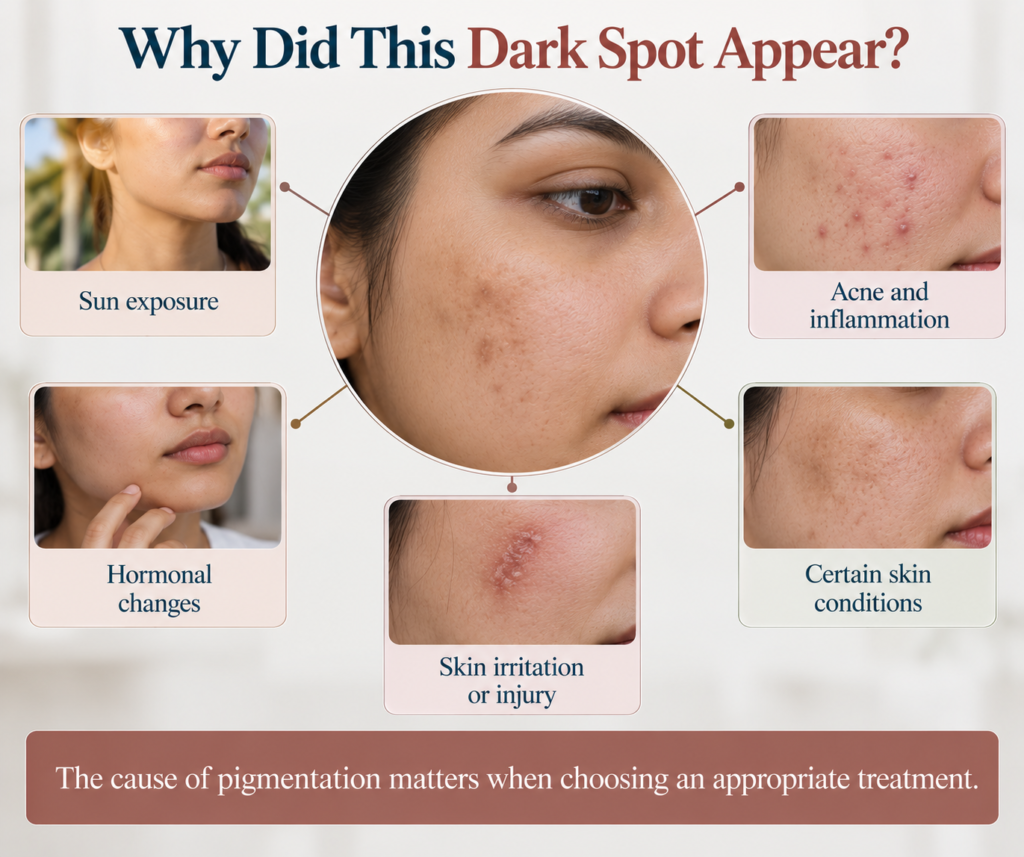
Common factors associated with darker pigmentation include:
- Sun exposure
- Acne and other inflammation
- Hormonal changes
- Melasma
- Skin irritation
- Injuries
- Certain medications
- Other pigmentary conditions
Several of these can look similar, so the cause cannot always be determined from colour alone.
What Causes Pigmentation and Dark Spots?
Sun exposure
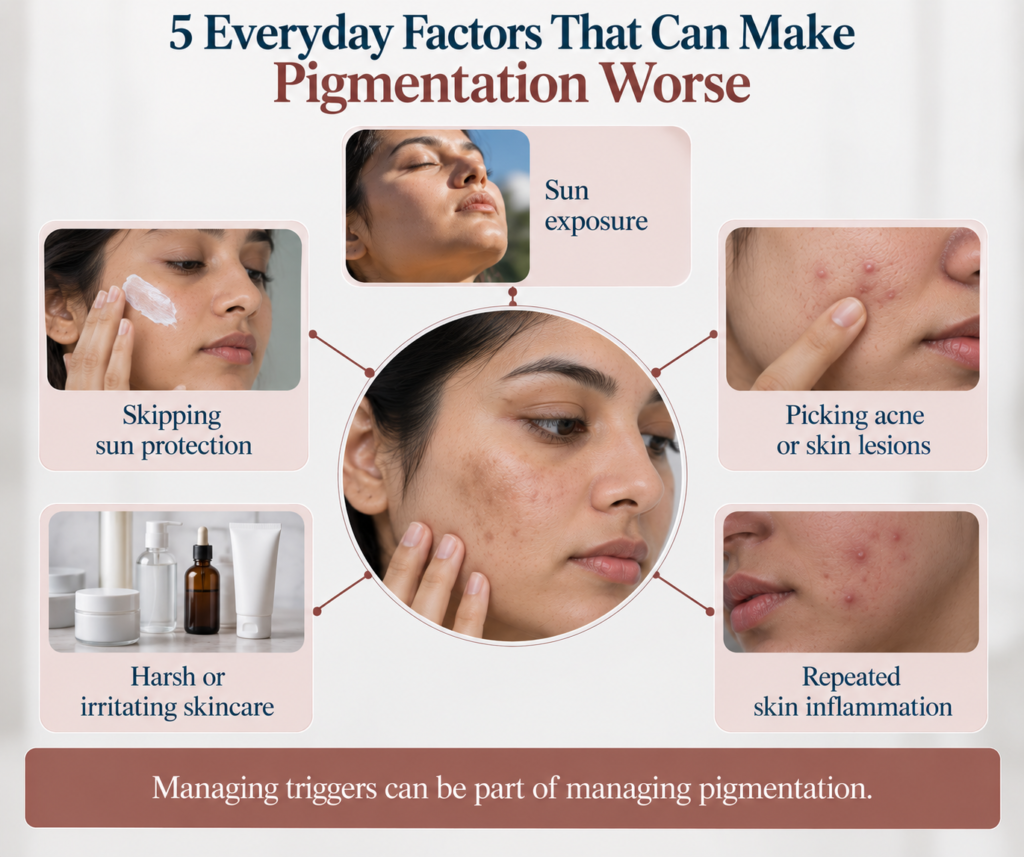
Repeated sun exposure can stimulate melanin production and make existing pigmentation more noticeable.
Sunlight can also contribute to some forms of pigmentation and can worsen melasma. Regular sun protection is therefore an important part of pigmentation management. The American Academy of Dermatology recommends broad-spectrum sunscreen with SPF 30 or higher for melasma and dark spots.
Post-acne pigmentation
A dark mark remaining after a pimple may be post-inflammatory hyperpigmentation (PIH).
Inflammation can stimulate pigment production, leaving a darker area after the acne lesion has healed. PIH can follow other inflammatory skin conditions and injuries as well.
If acne continues to cause inflammation, new areas of pigmentation can continue to develop.
Skin inflammation or irritation
Pigmentation can follow inflammatory skin conditions or irritation.
Scratching, burns, cuts and other skin injuries can also leave darker areas during the healing process. DermNet notes that post-inflammatory pigmentation develops at the site of previous inflammation or injury.
Repeated irritation from skincare products can make pigmentation more difficult to manage.
Hormonal changes
Hormonal factors can contribute to some pigmentary conditions.
Melasma is a common example. It usually appears as darker patches on the face and can be influenced by hormonal factors and sun exposure.
Melasma
Melasma causes darker patches, usually on areas of the face such as the cheeks, forehead, nose, chin or above the upper lip.
It can be persistent and may return after improvement. Treatment therefore often involves ongoing sun protection and, depending on the individual, topical medication or procedures.
Certain medications
Some medicines can cause or contribute to changes in skin pigmentation.
If you think a prescribed medication may be affecting your skin colour, discuss it with the doctor who prescribed it. Do not stop a prescribed medicine without medical advice.
Skin injuries
Cuts, burns, insect bites and other injuries can leave darker areas after healing.
How long the pigmentation remains depends on factors such as the type and depth of the injury and the individual’s skin response.
Other skin conditions
A dark patch should not automatically be assumed to be simple hyperpigmentation.
Some skin conditions can cause changes in colour, and an unexplained or changing pigmented area may need examination by a dermatologist.
Common Types of Pigmentation
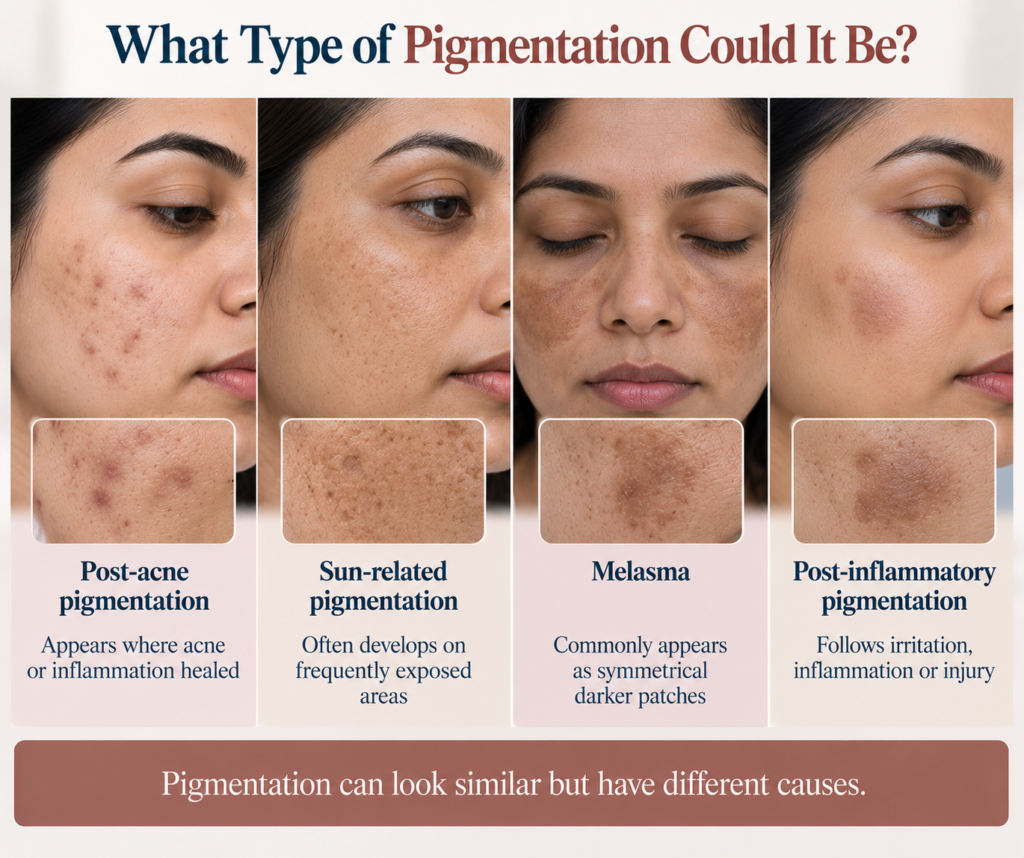
Melasma
Melasma usually appears as patches rather than isolated dark spots. It commonly affects the face and can be influenced by sunlight and hormonal factors.
Melasma can return after improvement, so long-term management may be needed.
Post-inflammatory hyperpigmentation
Post-inflammatory hyperpigmentation occurs after inflammation or injury to the skin.
Acne is one common trigger, but PIH can also follow dermatitis, infections, burns and other skin injuries. The resulting patches can range from light brown to dark brown or black.
PIH can be more noticeable and persistent in darker skin types.
Sun-related pigmentation
Long-term sun exposure can contribute to different forms of pigmentation and can make existing dark spots darker.
Sun protection is therefore relevant both during and after pigmentation treatment.
Freckles
Freckles are small areas of increased pigmentation that are influenced by genetics and sun exposure.
They are different from melasma and post-inflammatory pigmentation even though all three can appear as darker areas.
Other localised pigmentation
A single dark spot or patch can have several possible explanations.
Its location, colour, borders, history and progression can help a dermatologist determine what needs further evaluation.
Pigmentation vs Dark Spots: Are They the Same?
Not exactly.
Dark spot describes what you can see: an area that looks darker than the surrounding skin.
Pigmentation is a broader description of a change in skin colour.
A dark spot may be related to acne, inflammation, sun exposure, melasma, an injury or another skin condition.
For this reason, treating every dark spot with the same product or procedure is not appropriate.
The important question is: what is causing the pigmentation?
Can Pigmentation Go Away on Its Own?
Some pigmentation gradually becomes lighter without procedural treatment.
For example, post-inflammatory hyperpigmentation may fade after the inflammation that caused it has settled. However, the process can take months, and deeper pigmentation may take considerably longer.
Melasma behaves differently. It can persist for years and may return after improvement.
The course can depend on:
- The cause
- Depth of pigmentation
- Skin characteristics
- Continued inflammation
- Sun exposure
- Previous treatment
If new pigmentation keeps appearing, the underlying trigger needs attention as well.
When Should You See a Dermatologist for Pigmentation?
A dermatology consultation may be appropriate when:
- Pigmentation does not improve over time
- Dark spots are increasing
- Pigmentation repeatedly returns
- New pigmentation appears without an obvious explanation
- An existing pigmented area changes noticeably
- Basic skincare has not helped
- Pigmentation is accompanied by itching, scaling or inflammation
- You are unsure what type of pigmentation you have
- You are considering a chemical peel, laser treatment or another procedure
A persistent or changing pigmented spot should not automatically be treated as a cosmetic concern.
A dermatologist can first assess what the area represents and then decide whether treatment is appropriate.
How Is the Cause of Pigmentation Diagnosed?
A dermatologist may look at several parts of your history and the appearance of the skin.
Location and pattern
The distribution of pigmentation can provide useful clues.
For example, facial pigmentation with a particular pattern may suggest a different cause from a dark mark that appeared directly after acne or an injury.
Colour and appearance
The colour, borders, pattern and depth of the pigmentation can all be relevant during examination.
Duration
You may be asked when you first noticed the pigmentation and whether it has changed.
Acne, inflammation or irritation
Previous acne, rashes, irritation and skin injuries can help explain pigmentation that developed in the same area.
Sun exposure
Sun exposure can contribute to pigmentation and worsen certain pigmentary conditions, including melasma.
Hormonal factors
Depending on the situation, a dermatologist may ask about pregnancy, hormonal changes, medications or other relevant factors.
Current skincare products and medications
Irritating skincare products can contribute to pigmentation. Certain medicines may also be relevant.
Previous treatments
Tell the dermatologist about creams, prescription medicines, peels, lasers and other treatments you have already tried.
The treatment plan should follow the assessment rather than guesswork.
What Are the Treatment Options for Pigmentation?
There is no single pigmentation treatment suitable for everyone.
The approach depends on the diagnosis, skin characteristics and factors contributing to the pigmentation.
Sun protection
Sun protection is a foundation of pigmentation management.
For melasma and dark spots, the AAD recommends broad-spectrum, water-resistant sunscreen with SPF 30 or higher. Tinted sunscreens containing iron oxide can also help protect against visible light, which can worsen hyperpigmentation, particularly in darker skin tones.
Other measures include seeking shade and using sun-protective clothing when practical.
Chemical peels
Chemical peels use a chemical solution to exfoliate selected layers of the skin.
Depending on the type of peel and the condition being treated, they may be considered for certain pigmentation concerns, acne marks and uneven skin tone.
Your supplied APTA information states that its chemical peels are selected according to skin type and concern and may be used for pigmentation and post-acne marks.
A peel should therefore be selected after assessing the skin rather than simply choosing a particular strength from an online recommendation.
Topical treatments
Depending on the diagnosis, a dermatologist may recommend topical treatments containing ingredients such as azelaic acid, retinoids, hydroquinone or other pigment-modulating ingredients.
The appropriate ingredient, concentration and duration depend on the condition.
Using multiple strong pigment-lightening products without professional guidance can irritate the skin. Irritation itself can contribute to post-inflammatory pigmentation.
Laser or light-based treatments
Some laser and light-based procedures may be considered for selected pigmentation concerns.
The treatment choice depends on the type of pigmentation, skin characteristics and other clinical factors.
A procedure suitable for one pigmentary condition may not be suitable for another.
Treating underlying acne or inflammation
If pigmentation develops because of ongoing acne or another inflammatory skin condition, controlling that underlying problem can help reduce the development of new pigmentation.
For example, repeated acne inflammation can result in additional post-inflammatory hyperpigmentation.
Your supplied APTA information also describes acne-related pigmentation as part of its dermatology assessment and treatment approach.
Other dermatologist-directed treatments
Depending on the diagnosis, a dermatologist may recommend another treatment or combine approaches.
The aim is to address the specific pigmentary problem while avoiding unnecessary irritation
Why Does Sunscreen Matter in Pigmentation Treatment?
Sun exposure can make existing pigmentation darker and can contribute to new pigment changes.
This is particularly important with melasma. The AAD describes sunlight as a common trigger and recommends daily sun protection.
For pigmentation concerns, dermatologists commonly recommend:
- Broad-spectrum sunscreen
- SPF 30 or higher
- Water-resistant sunscreen when appropriate
- Reapplication at least every two hours when outdoors
- Shade and protective clothing
- Tinted sunscreen containing iron oxide when visible-light protection is relevant
Sunscreen does not replace treatment when an underlying skin condition is present. It forms part of managing the factors that can worsen pigmentation.
Can Pigmentation Come Back After Treatment?
Yes. Some pigmentary conditions can recur.
Melasma, for example, can return after improvement, particularly when triggers such as sun exposure remain present.
Post-inflammatory pigmentation can also develop again if the original trigger continues. For example, ongoing acne or repeated skin irritation can lead to new dark marks.
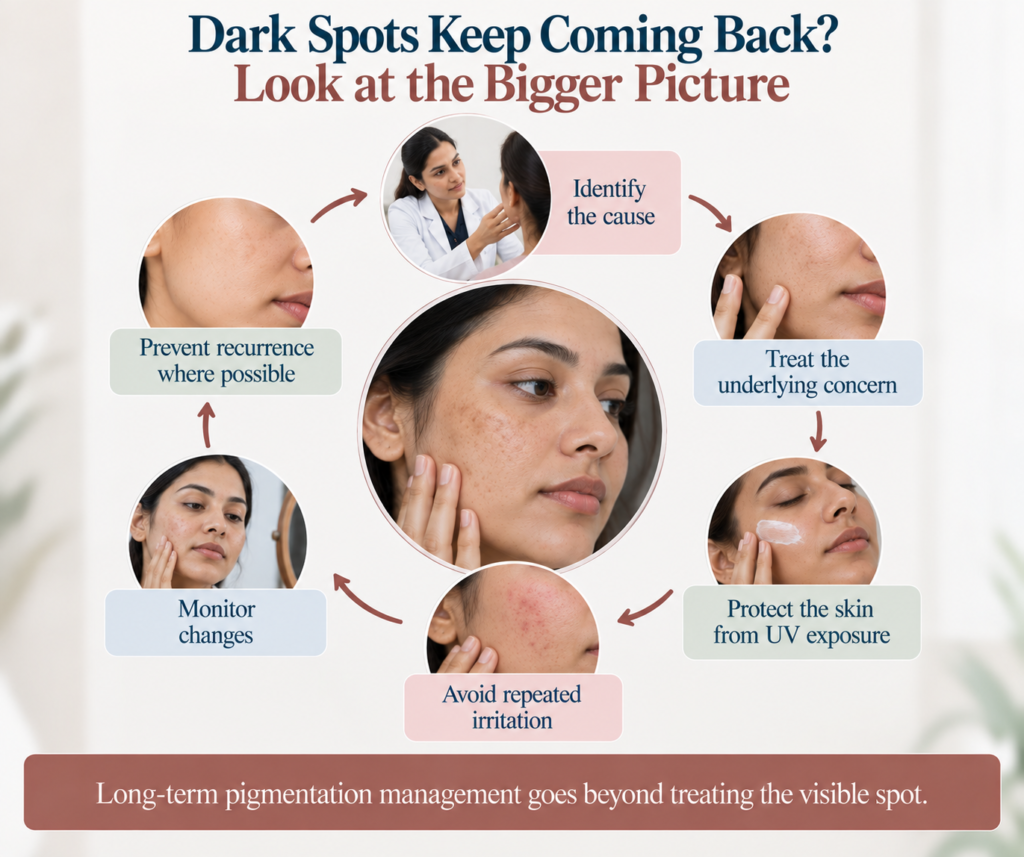
Long-term management may therefore include:
- Treating the underlying skin condition
- Protecting the skin from sunlight
- Avoiding unnecessary irritation
- Following the recommended skincare routine
- Continuing maintenance treatment when advised
How Is the Right Pigmentation Treatment Chosen?
The word “pigmentation” alone does not determine the treatment.
A dermatologist may consider:
Type of pigmentation
Melasma, post-inflammatory pigmentation, sun-related pigmentation and other pigmentary changes can require different approaches.
Cause
Addressing the factor responsible for pigmentation can help prevent new changes.
Skin type
Skin characteristics can influence how the skin responds to topical treatments and procedures.
Severity
The extent and depth of pigmentation can influence whether skincare, prescription treatment or a procedure is considered.
Location
Facial pigmentation may require a different assessment from pigmentation elsewhere on the body.
Previous treatments
Tell your dermatologist about prescription medicines, over-the-counter products, peels and procedures you have already used.
Active acne or inflammation
If inflammation is continuing, treating that problem can be part of reducing further pigmentation.
Treatment expectations
A consultation should cover what a treatment is intended to improve, how long improvement may take and whether ongoing maintenance may be necessary.
Why You Should Not Treat Every Dark Spot the Same Way
It can be tempting to buy a product or book a peel after seeing an advertisement promising brighter skin.
The problem is that a dark mark after acne is not necessarily the same condition as melasma. Pigmentation following irritation can also have a different cause.
An unexplained or changing pigmented area deserves assessment rather than automatic cosmetic treatment.
The useful starting point is to establish why the skin changed colour.
Pigmentation Treatment in Mysore: What to Expect at APTA Clinic
APTA Clinic provides dermatology care in Mysore, with published locations in Krishnamurthy Puram and Vijayanagar.
The supplied clinic information identifies Dr. Swathi Anand as a dermatologist and aesthetician and lists MBBS, DDVL and Fellowship (RGUHS) among her qualifications. It also lists chemical peels and laser treatment for pigmentation disorders among her areas of expertise.
The clinic’s published chemical-peel information describes selecting peels according to the individual’s skin type and concern.
For someone looking for pigmentation treatment in Mysore, the first consultation can help determine whether the pigmentation is related to:
- Acne or inflammation
- Sun exposure
- Melasma
- Hormonal factors
- Skin irritation
- Injury
- Another pigmentary condition
Treatment can then be discussed according to the assessment.
APTA Clinic’s supplied information lists its Mysore locations as Krishnamurthy Puram and Vijayanagar and provides the phone number +91 7411 707 555.
Clinic details should be confirmed before publication if the website information has changed.
Final Takeaway
Pigmentation is a description of a change in skin colour, not a single diagnosis.
Dark spots can follow acne, inflammation or injury. Sun exposure can make pigmentation more noticeable, while hormonal factors can contribute to melasma. Certain medications and other skin conditions can also cause colour changes.
Some pigmentation gradually fades. Other forms can persist or return.
For that reason, pigmentation treatment in Mysore should be based on identifying the cause first. Depending on the diagnosis, management may include sun protection, topical treatment, chemical peels, selected laser or light-based procedures, treatment of active acne or inflammation, or a combination of approaches.
If a dark spot is persistent, changing, recurring or unexplained, a dermatology assessment is a more useful starting point than repeatedly trying different products without knowing what caused it.
Frequently Asked Questions (FAQs)
Dark spots can develop because of sun exposure, acne-related inflammation, skin irritation, injuries, hormonal factors, melasma and certain medications. Similar-looking pigmentation can have different causes, so the underlying reason should be assessed.
No. Pigmentation is a broad term describing a change in skin colour. Hyperpigmentation generally refers to areas that have become darker because of increased or altered melanin.
Treatment depends on the cause and type of pigmentation. Depending on the diagnosis, options can include sun protection, topical treatment, chemical peels, selected laser or light-based procedures, treatment of underlying acne or inflammation, or a combination of approaches.
Pigmentation can be treated in different skin types, but the treatment needs to be selected according to the individual. Some procedures can cause irritation or additional pigmentation if used inappropriately.
Yes. Some pigmentation conditions, particularly melasma, can recur. Sun exposure and continuing hormonal or inflammatory triggers can contribute to recurrence.
Yes. Sun protection can help reduce UV-related worsening of pigmentation. For melasma and dark spots, the AAD recommends broad-spectrum SPF 30 or higher, and tinted sunscreen containing iron oxide may provide additional protection from visible light.
No. Melasma and post-inflammatory hyperpigmentation are different conditions. Melasma can be influenced by hormonal and environmental factors, while PIH develops after inflammation or injury such as acne.
Certain laser or light-based treatments may be considered for specific pigmentation concerns. They are not suitable for every type of pigmentation or every person, so assessment should come before the procedure.
The supplied APTA Clinic information lists laser treatment for pigmentation disorders among Dr. Swathi Anand’s areas of expertise. It also states that selected chemical peels may be used for pigmentation and post-acne marks.
Start by identifying the type and cause of pigmentation. A dermatologist can consider its appearance, location, duration, skin type, sun exposure, previous treatment and whether acne or inflammation is still present before recommending an approach.