Eyebrow Transplant in Mysore: Procedure, Healing Time and Expected Results
- Home
- Blog
- About Us
Thin eyebrows can be natural, but persistent gaps may also develop after repeated over-plucking, an injury or certain skin conditions. An eyebrow transplant is a surgical procedure that moves hair follicles from a donor area, usually the scalp, to parts of the eyebrows where hair is sparse or absent.
The procedure requires careful planning because eyebrow hairs grow at shallow angles and change direction across the inner brow, arch and tail. The aim is to improve coverage while creating a shape that suits the face and accounts for the characteristics of the transplanted hair.
If you are considering an eyebrow transplant in Mysore, it is useful to understand how the procedure works, who may be suitable, what recovery involves and what results you can realistically expect.
APTA Clinic lists eyebrow transplantation as a service in Mysore and describes Follicular Unit Extraction (FUE) on its published service page. Contact the clinic to confirm current availability, treatment suitability and pricing.
What Is an Eyebrow Transplant?
An eyebrow transplant involves taking hair follicles from a suitable donor area and implanting them into selected areas of one or both eyebrows. The transplanted follicles may then produce hair growth in the recipient area.
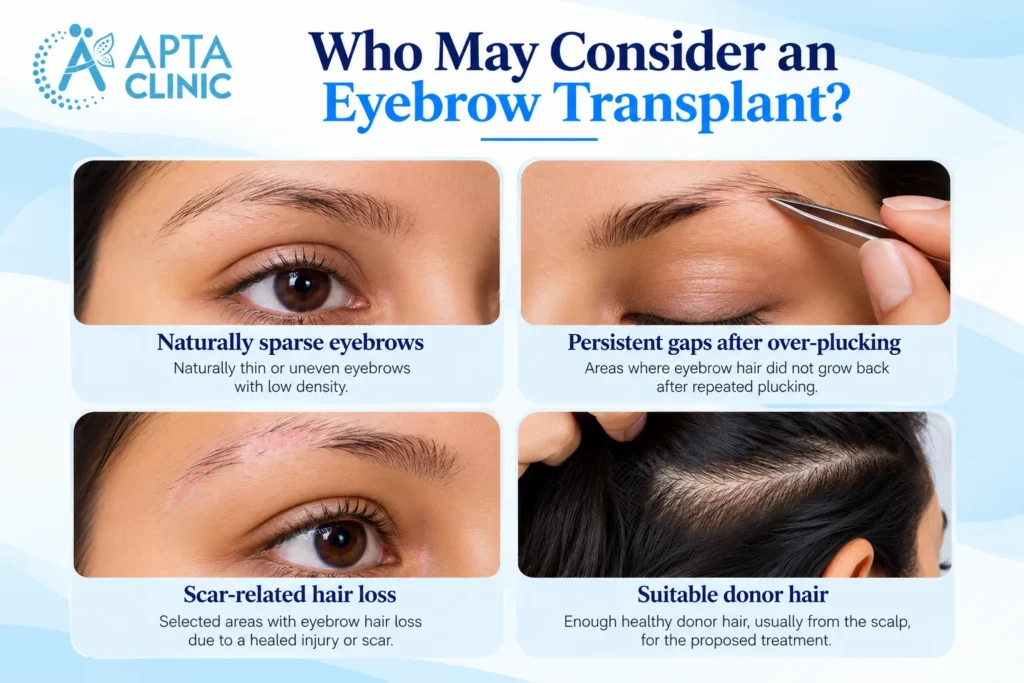
The procedure may be considered by people with naturally sparse eyebrows, persistent gaps after over-plucking, or selected areas of hair loss associated with injury or scarring.
However, not every case of eyebrow thinning requires surgery. If hair loss is caused by an active skin condition or another medical issue, the underlying cause may need assessment and treatment first.
Donor hair often comes from the scalp, so transplanted hairs may grow longer or behave differently from natural eyebrow hairs. Regular trimming or grooming may be needed to maintain the desired shape.
Who May Be Suitable for an Eyebrow Transplant?
A person may be considered for eyebrow transplantation if they have stable areas of sparse or absent eyebrow hair, suitable donor hair and realistic expectations about the outcome.
Potential candidates may include people who:
- Have naturally thin or uneven eyebrows.
- Have persistent gaps after repeated over-plucking.
- Have eyebrow hair loss associated with a healed injury or selected scars.
- Have enough suitable donor hair for the proposed treatment.
- Understand that perfect symmetry and a particular level of density cannot be guaranteed.
- Are in suitable overall health for the planned procedure.
These factors do not automatically establish eligibility. A qualified medical professional needs to assess the eyebrow area, donor hair, skin condition, medical history and reason for hair loss before recommending surgery.
When should eyebrow hair loss be assessed medically?
Eyebrow thinning can have several causes, including skin inflammation, certain forms of alopecia, thyroid-related conditions, nutritional problems, medication effects and scarring.
Seek medical advice if eyebrow hair loss develops suddenly, spreads, forms distinct patches or occurs with redness, itching, scaling, pain or changes to the surrounding skin. Treating an underlying condition may be more appropriate than proceeding directly to transplantation.
If an inflammatory or autoimmune condition is responsible, the risk of further hair loss may remain even after a transplant. Your clinician should explain whether the condition appears stable and whether surgery is appropriate.
How Is an Eyebrow Transplant Performed?
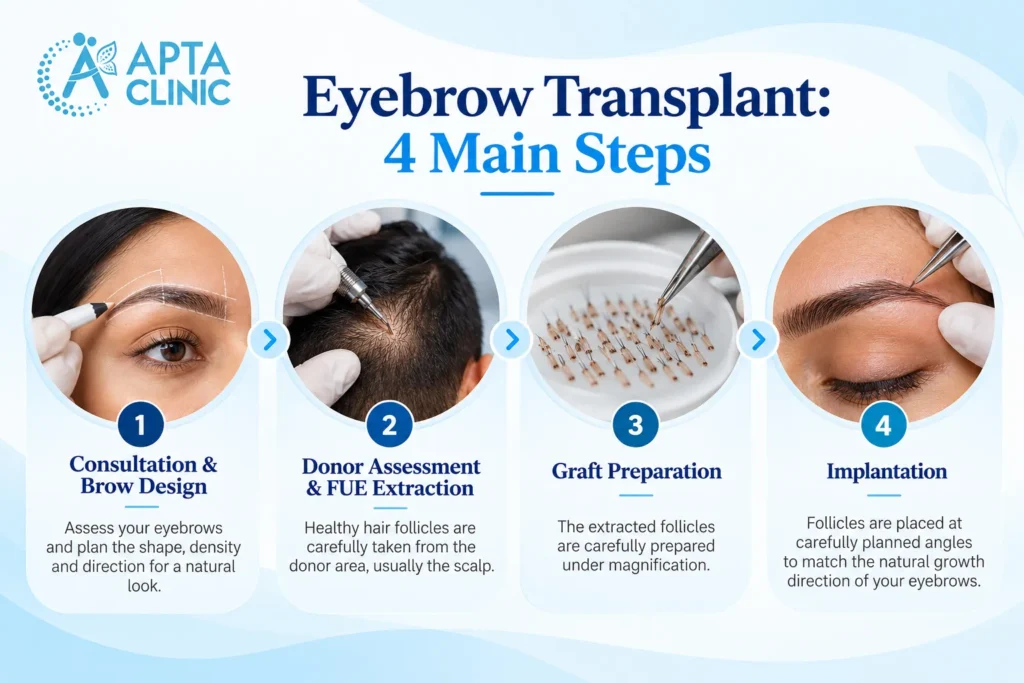
The procedure generally involves consultation and design, donor-area assessment, follicle extraction and implantation. The exact steps depend on the individual treatment plan and the technique selected by the treating clinician.
- Consultation and eyebrow design
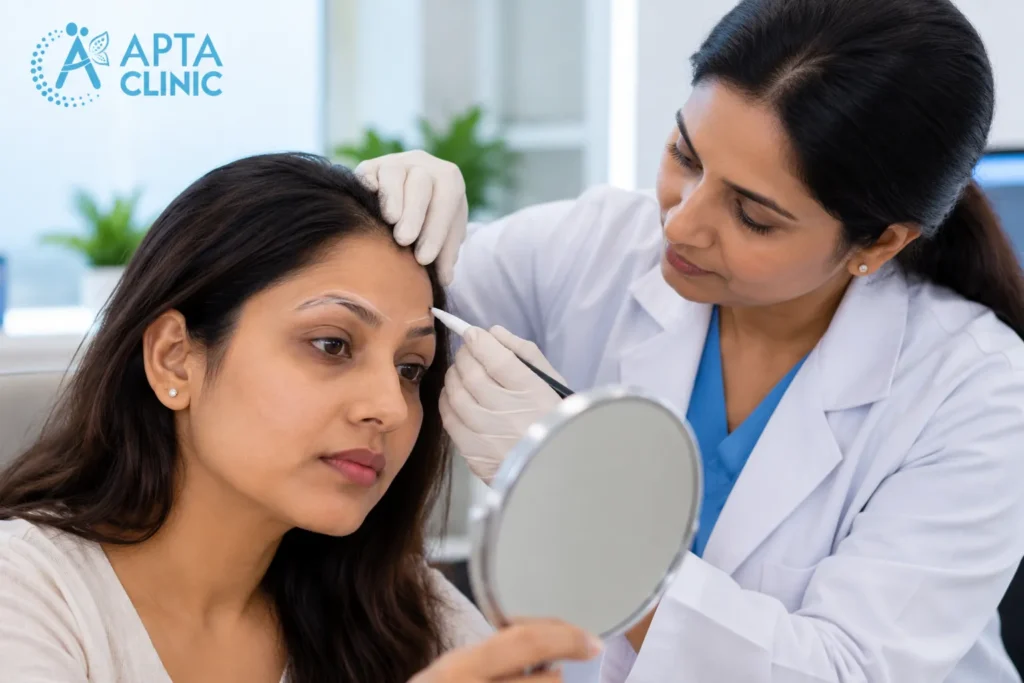
The clinician discusses your goals, examines your existing eyebrows and reviews the pattern of hair loss. The proposed shape, thickness, symmetry and areas requiring coverage are considered before treatment.
A natural eyebrow is not simply a straight row of hairs. The direction and angle of growth change across the inner brow, arch and tail. Your expectations should be discussed before the final design is agreed upon.
- Donor-area assessment
Hair is commonly taken from a suitable area of the scalp. The clinician assesses donor density, hair characteristics and the amount of hair that can reasonably be used.
Scalp hair may differ from natural eyebrow hair in thickness, curl and growth rate. These differences can affect the final appearance and maintenance requirements, so they should be discussed before surgery.
- Follicle extraction using FUE
APTA Clinic describes Follicular Unit Extraction, or FUE, on its eyebrow transplant service page.
With FUE, individual follicular units are extracted from the donor area using specialised instruments. The technique avoids removing a single long strip of scalp, but small extraction scars may still occur. Their visibility varies from person to person.
- Implantation into the eyebrow area
The selected follicles are implanted into carefully planned sites within the eyebrow. Their angle, direction and placement matter because eyebrow hairs need to lie naturally against the face.
Before providing consent, ask the treating clinician to explain the proposed technique, expected graft requirement, anaesthesia, possible risks and aftercare.
Eyebrow Transplant Healing Time: What to Expect
Healing differs between individuals. The initial recovery period is not the same as the time needed to see new hair growth, and the final cosmetic result takes considerably longer to assess.
The first few days
Mild swelling, redness, tenderness, bruising or small crusts may develop around the treated area. The donor site may also feel tender.
Follow the treating clinician’s instructions for cleaning, sleeping, medication and protecting the transplanted follicles. Avoid rubbing your eyebrows, picking crusts or applying makeup and skincare products to the treated area until you have been told it is safe.
Ask when you can wash your face, return to exercise and resume your normal grooming routine. Follow your own clinician’s advice rather than relying on a general recovery timeline.
The first few weeks
Small scabs generally settle as the skin heals. Some transplanted hairs may shed during the early weeks. This can be part of the normal hair-growth cycle and does not necessarily mean that the procedure has failed.
Avoid judging the result during this stage. Protect the area as instructed and attend any recommended follow-up appointments.
When does new eyebrow hair grow?
New growth develops gradually over several months. Some people may begin noticing new hairs within a few months, but the timing and density vary.
The final appearance may take around 8 to 12 months or longer to assess, depending on the individual and procedure. Transplanted hairs may continue to behave like scalp hair, so they can grow longer than natural eyebrow hairs.
Regular trimming may be needed to maintain the desired length and shape. Your clinician should explain the expected timeline, the possibility of uneven growth and whether any additional procedure might be considered after sufficient time has passed.
What Results Can You Expect From an Eyebrow Transplant?
The aim is to improve coverage in selected areas and create an eyebrow shape that suits your facial features. Results vary according to donor hair, skin characteristics, graft survival, implantation direction, healing and the cause of the original hair loss.
An eyebrow transplant cannot guarantee:
- Perfectly symmetrical eyebrows.
- A particular level of density.
- Texture identical to natural eyebrow hair.
- Growth from every transplanted follicle.
- Freedom from future grooming or maintenance.
Some transplanted hairs may grow in a different direction or have a different texture from surrounding eyebrow hair. Additional treatment may be discussed in selected cases, but it is not automatically necessary or suitable for everyone.
Where available, ask to see genuine before-and-after photographs shared with patient consent. Remember that another person’s result does not guarantee the same outcome for you.
What Are the Risks of an Eyebrow Transplant?
Eyebrow transplantation is a surgical procedure and has potential risks. These may include:
- Swelling, bruising, tenderness or discomfort.
- Infection or inflammation.
- Scarring in the donor or recipient area.
- Temporary or persistent changes in skin colour.
- Poor or uneven graft growth.
- Hairs growing in an unexpected direction or with a different texture.
- A result that does not match the agreed design or expectations.
- Continued eyebrow hair loss if the underlying condition remains active.
The risks depend on the individual, the procedure and the clinical circumstances. Discuss your medical history, current medicines, allergies, tendency to scar and existing skin conditions with the treating clinician.
Contact your treating clinician promptly if you develop worsening pain, spreading redness, increasing swelling, pus, fever or other unexpected symptoms after surgery. Seek urgent medical attention if you experience a severe or rapidly worsening reaction.
Eyebrow Transplant vs Microblading
Eyebrow transplantation and microblading are different procedures. A transplant moves hair follicles to the eyebrow area, while microblading uses pigment placed in the skin to create the appearance of individual hairs.
Consideration | Eyebrow transplant | Microblading |
What it involves | Surgical transfer of hair follicles | Cosmetic pigment application |
Hair growth | Can produce actual hair growth if grafts survive | Does not produce new hair follicles |
Recovery | Requires surgical healing | Requires healing after a cosmetic skin procedure |
Maintenance | Trimming may be needed because transplanted hair can grow longer | Pigment may fade and require touch-ups |
Suitability | Requires medical assessment and suitable donor hair | Depends on skin, desired appearance and suitability for cosmetic tattooing |
Neither option is right for everyone. The choice depends on whether you want actual hair growth, your skin and medical history, the cause of eyebrow thinning and your preferences about maintenance.
If the eyebrow loss is new or unexplained, seek medical assessment before choosing either a cosmetic or surgical approach.
How Much Does an Eyebrow Transplant Cost in Mysore?
The cost depends on the size of the area being treated, the number of grafts planned, donor hair availability, the complexity of the design, the procedure and the services included in the quotation.
A small gap may require a different treatment plan from extensive eyebrow restoration. There is no single price that applies to every patient.
APTA Clinic’s current eyebrow transplant price has not been verified for this article. Contact the clinic for its latest pricing and an individual estimate.
Before booking, ask whether the quotation includes the consultation, procedure, prescribed medicines or dressings where applicable, follow-up visits and management of postoperative concerns. Request a written breakdown and clarify any possible additional charges.
How to Prepare for an Eyebrow Transplant Consultation
To make the consultation useful, prepare information about your eyebrow hair loss and overall health.
Consider bringing:
- A list of current medicines and supplements.
- Details of allergies and existing medical conditions.
- Information about previous eyebrow procedures or cosmetic treatments.
- Details of skin symptoms or previous diagnoses affecting the brow area.
- Photographs showing how your eyebrows have changed over time, if available.
- Questions about the proposed design, donor area, risks, recovery and cost.
Tell the clinician if you have a history of abnormal scarring, poor wound healing or reactions to anaesthesia. Do not stop prescribed medicines unless your treating clinician advises you to do so.
Before consenting to surgery, make sure you understand the treatment plan, likely limitations, aftercare requirements and follow-up arrangements.
Eyebrow Transplant Consultation at APTA Clinic, Mysore
APTA Clinic lists eyebrow transplantation as a service in Mysore and describes FUE on its published service page. A consultation is needed to assess the cause of eyebrow thinning, determine whether transplantation is suitable and discuss realistic expectations.
To enquire about consultation availability and current pricing, contact APTA Clinic on +91 7411 707 555.
The clinic lists locations in Krishnamurthy Puram and Vijayanagar, Mysuru. Confirm the exact address and appointment arrangements directly with the clinic before visiting.
A consultation should give you the opportunity to ask questions about eyebrow design, donor hair, risks, recovery, maintenance and the expected timeline. You should have enough information to make a decision without feeling pressured to proceed.
Make an Informed Decision About Eyebrow Restoration
An eyebrow transplant may be an option for selected people with persistent sparse or missing eyebrow hair. Suitability depends on the cause of hair loss, donor hair availability, skin health and realistic expectations.
Before choosing an eyebrow transplant in Mysore, seek an individual medical assessment, understand the recovery process and ask for a clear explanation of costs, risks and long-term maintenance. These steps can help you decide whether surgical restoration is appropriate for your goals.
To enquire about an eyebrow transplant consultation at APTA Clinic, call +91 7411 707 555.
Medical disclaimer: This article provides general educational information and is not a substitute for an individual medical consultation. A qualified medical professional should assess your condition, suitability, risks and treatment options.
Frequently Asked Questions (FAQs)
An eyebrow transplant is a surgical procedure that transfers hair follicles from a donor area, usually the scalp, to areas of sparse or missing eyebrow hair. The transplanted follicles may produce new hair growth over time.
People with naturally thin eyebrows, persistent gaps from over-plucking or selected areas of hair loss due to injury or scarring may be candidates. Suitability depends on the cause of hair loss, donor hair availability, skin health and general medical history. An individual assessment is necessary.
Initial healing generally occurs over the first days and weeks, although individual recovery varies. Redness, swelling, tenderness and small crusts may occur. Follow the treating clinician’s instructions on washing, makeup, exercise and eyebrow grooming.
New hair growth usually develops gradually over several months. The final appearance may take around 8 to 12 months or longer to assess. The timeline depends on graft survival, healing and individual hair-growth patterns.
It may help restore hair in selected areas where repeated over-plucking has caused persistent loss. The follicles and surrounding skin need to be assessed before surgery is recommended.
They serve different purposes. An eyebrow transplant moves hair follicles to encourage actual hair growth, while microblading uses pigment to create the appearance of fuller eyebrows. The appropriate choice depends on your goals, medical history, skin condition and preference for maintenance.
Possible risks include swelling, bruising, infection, scarring, uneven growth, unexpected hair direction and results that do not match expectations. Discuss your personal risk factors and the plan for postoperative care with the treating clinician before consenting to surgery.
Call +91 7411 707 555 to ask about consultation availability and current pricing. APTA Clinic lists an eyebrow transplant service in Mysore. The clinician must confirm your suitability and proposed treatment plan.