
How to Know If You’re a Suitable Candidate for a Dental Bridge in Mysore
- Home
- Blog
- About Us
If you have one or more missing teeth, you may be wondering whether a dental bridge is the right way to restore your smile. Dental bridge eligibility depends on factors such as the number and location of missing teeth, the condition of the supporting teeth, gum health and your bite. A dentist needs to examine your mouth before confirming whether a bridge is suitable.
At APTA Clinic in Mysore, dental bridges are among the listed restorative dental services. An appointment can help you understand your tooth-replacement options and whether a bridge is appropriate for your individual needs.
What Is a Dental Bridge?
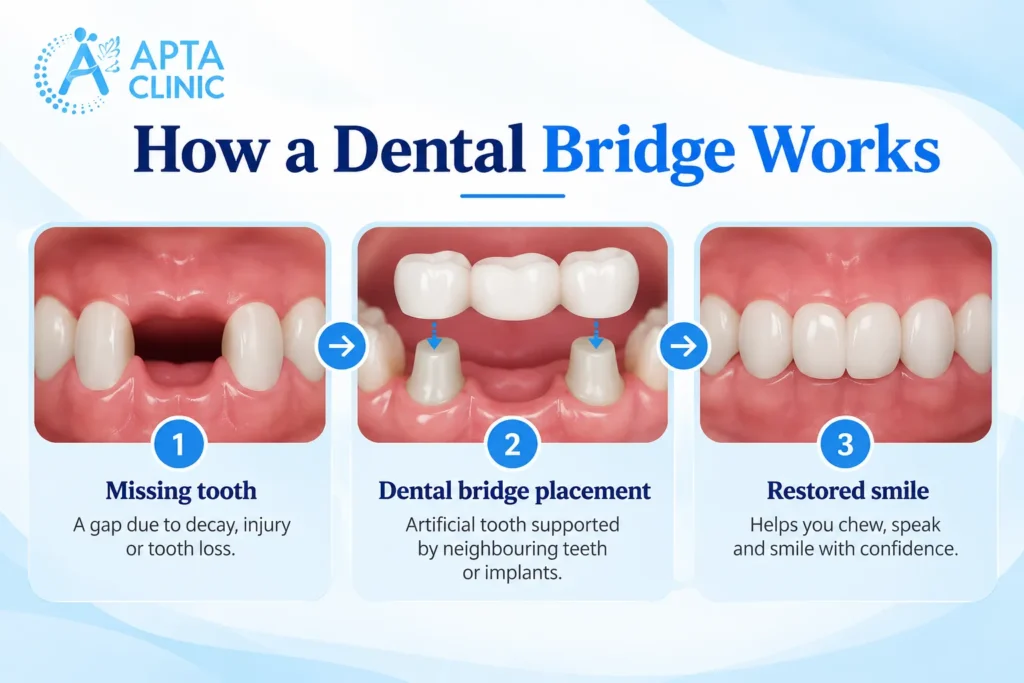
A dental bridge is a fixed dental restoration designed to replace one or more missing teeth. It fills the gap using artificial teeth, called pontics, supported by neighbouring natural teeth or, in some cases, dental implants.
A conventional bridge generally uses crowns placed over supporting teeth on either side of the gap. Other designs may be suitable in different clinical situations.
Dental bridges can help restore chewing function and the appearance of a smile. However, their suitability depends on the condition of the structures supporting the restoration. The American Dental Association explains that the supporting foundation is an important consideration when selecting a bridge.
Who May Be a Suitable Candidate for a Dental Bridge?
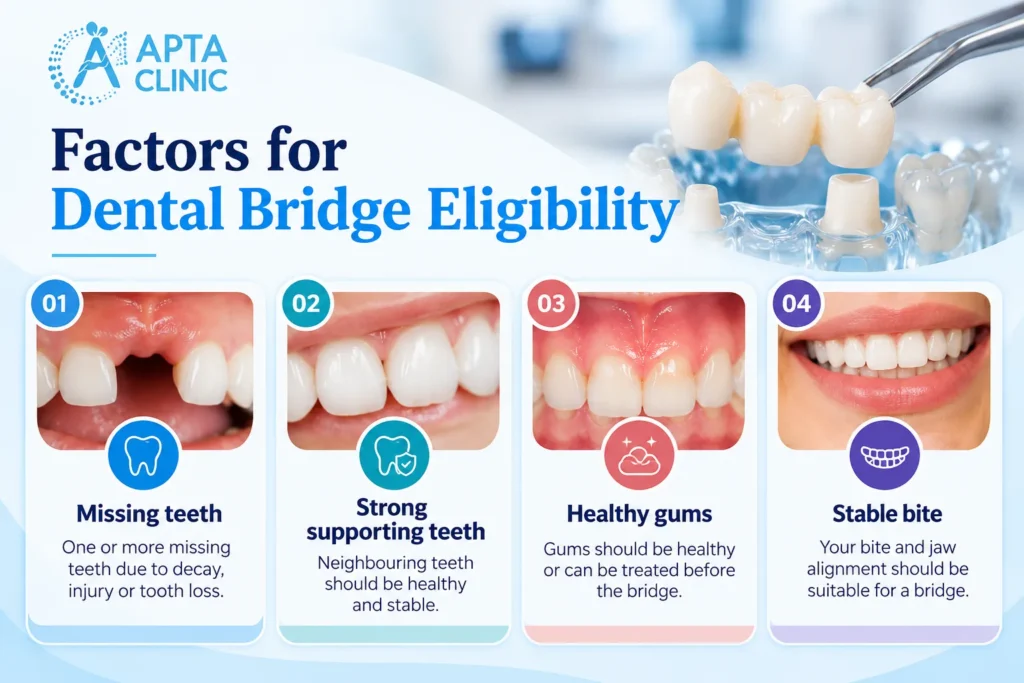
You may be considered for a dental bridge if you have one or more missing teeth and enough suitable support for the proposed restoration. These are common factors dentists assess, not a guarantee of eligibility.
- You Have One or More Missing Teeth
A dental bridge may be considered when a tooth has been lost because of decay, injury or another dental problem.
The number of missing teeth and their position matter. A short gap between suitable supporting teeth may be approached differently from several missing teeth in a row.
Your dentist will assess the gap and determine whether a conventional bridge, another bridge design or a different replacement option is more appropriate.
- The Supporting Teeth Are Strong Enough
For a conventional dental bridge, neighbouring teeth usually provide support. These teeth are sometimes called abutment teeth.
The dentist will check whether the supporting teeth are sufficiently healthy and stable to carry the planned restoration. Teeth affected by significant decay, fractures, extensive damage or poor support may not be suitable without further treatment.
If the neighbouring teeth are not suitable, your dentist may discuss other options, including an implant-supported restoration or a removable partial denture, depending on your clinical condition.
- Your Gums Are Healthy or Can Be Treated
Healthy gums are important for supporting the teeth involved in a bridge. Active gum disease can affect the stability of natural teeth and may compromise the long-term maintenance of a restoration.
If your gums are inflamed, bleed frequently or show signs of periodontal disease, your dentist may recommend addressing these problems before proceeding with a bridge.
This does not automatically rule out a dental bridge. It means the health of your gums and supporting tissues needs to be assessed and managed appropriately.
- Your Bite Can Support the Restoration
Your bite describes how your upper and lower teeth meet when you close your mouth. A dentist considers the way biting forces are distributed when planning a bridge.
Uneven bite forces, heavy grinding or clenching may affect the choice and design of a restoration. The location of the missing tooth also matters because front and back teeth experience different functional demands.
Your dentist can evaluate these factors and discuss whether a bridge is appropriate for your bite.
- The Gap Is Suitable for the Proposed Bridge Design
Not every missing-tooth gap can be restored with the same type of bridge.
The dentist considers:
- The number of missing teeth.
- The length and location of the gap.
- The health and position of nearby teeth.
- The available support for the bridge.
- Your bite and functional requirements.
- Your oral hygiene and ability to clean around the restoration.
These details help determine whether a conventional bridge, a resin-bonded bridge, an implant-supported bridge or another treatment option should be considered.
What Factors Can Affect Dental Bridge Eligibility?
Even if you have a missing tooth, a bridge may not be the most suitable option immediately. Several factors can influence the treatment recommendation.
Existing Tooth Decay or Infection
Untreated decay or infection in a tooth that would support a bridge may need attention first. Your dentist will assess the affected tooth and explain whether it can be treated and retained or whether another plan is needed.
Do not assume that a tooth is suitable simply because it is still present. Its condition and ability to provide stable support are important.
Gum Disease or Reduced Tooth Support
Gum disease can affect the tissues that support natural teeth. If supporting teeth are loose or have reduced periodontal support, a bridge may place additional demands on an already compromised foundation.
Your dentist may recommend treating gum disease and reassessing the teeth before deciding on a restoration.
Teeth Grinding or Clenching
Repeated grinding or clenching can place additional force on teeth and dental restorations. Tell your dentist if you grind your teeth, clench your jaw or have previously damaged dental restorations.
This information helps the dentist evaluate the risks and discuss ways to protect your teeth and any proposed bridge.
Oral Hygiene and Maintenance
A bridge needs regular cleaning, including around and underneath the replacement tooth. Plaque can accumulate around supporting teeth and gum tissues if the area is not cleaned properly.
Your dentist or dental team can show you suitable cleaning techniques, which may include a floss threader or an interdental brush depending on the bridge design.
If cleaning around a bridge would be difficult, discuss this before treatment. Maintenance is part of deciding whether the restoration is appropriate for you.
General Health and Treatment History
Your medical history, medications and previous dental treatment may also be relevant to treatment planning. Tell your dentist about medical conditions, regular medicines, allergies and any history of complications during dental treatment.
These details do not automatically determine eligibility, but they can help your dental professional plan care safely.
When Might a Dental Bridge Need to Be Delayed?
A dentist may recommend treating another problem before placing a bridge. This could include managing active decay, addressing gum inflammation or infection, or assessing a tooth that may not provide adequate support.
A delay does not necessarily mean that you can never receive a bridge. It may allow your dentist to improve the condition of your mouth before deciding on a longer-term restoration.
A bridge may also be unsuitable if the supporting teeth cannot reliably carry it or if another tooth-replacement option better meets your clinical needs.
Seek prompt dental assessment if you have worsening tooth pain, swelling, pus, fever or pain that is interfering with eating. Facial or neck swelling accompanied by difficulty breathing or swallowing requires emergency medical care.

What Happens During a Dental Bridge Assessment?
A dental bridge assessment helps the dentist understand your oral health and determine which options are reasonable for your situation.
Step 1: Discuss Your Dental Concerns
The dentist may ask when the tooth was lost, how it happened, whether you experience pain or sensitivity, and whether chewing or speaking has become difficult.
You can also explain what matters most to you, such as restoring function, improving appearance, understanding treatment time or comparing fixed and removable options.
Step 2: Examine Your Teeth and Gums
The dentist examines the missing-tooth area, nearby teeth, gum condition and bite. They may assess whether the supporting teeth are strong enough and whether there are signs of decay, infection or gum disease.
Step 3: Consider Imaging if Needed
Dental X-rays or other imaging may be recommended when clinically appropriate. Imaging can help the dentist assess structures that are not fully visible during a routine examination.
The type of imaging required depends on your individual condition and the treatment being considered.
Step 4: Discuss Suitable Options
After the assessment, the dentist can explain whether a bridge appears suitable and what factors affect the recommendation. If another treatment may be more appropriate, ask why and what the alternatives involve.
Step 5: Review Costs, Care and Follow-Up
Before agreeing to treatment, ask for a clear explanation of the proposed procedure, estimated cost, number of visits, maintenance requirements and any possible additional treatment.
The exact treatment plan and timeline depend on your clinical findings.
Dental Bridge vs Other Tooth Replacement Options
A dental bridge is one way to replace missing teeth. Other options may be appropriate depending on your oral health, the number of missing teeth and your preferences.
|
Option |
What to understand |
|
Conventional dental bridge |
Usually relies on supporting natural teeth beside the gap. The condition of these teeth is a key factor. |
|
Resin-bonded bridge |
Uses a bonding mechanism to attach the replacement tooth to neighbouring teeth. Suitability depends on the tooth location and bite. |
|
Implant-supported restoration |
Uses a dental implant to support a crown or bridge. It requires a separate assessment of bone, gum and general health factors. |
|
Removable partial denture |
Can replace one or more missing teeth and can be removed for cleaning. Fit, comfort and maintenance should be discussed. |
There is no single option that is best for everyone. A conventional bridge may be worth considering when the supporting teeth are suitable. An implant-supported restoration may be discussed when the goal is to avoid relying on neighbouring natural teeth, while a removable partial denture may suit some patients’ needs.
Ask your dentist to explain the benefits, limitations, maintenance and likely costs of the options that apply to your case.
Questions to Ask Before Choosing a Dental Bridge
Before proceeding with treatment, consider asking your dentist:
- Are the teeth next to my missing tooth strong enough to support a bridge?
- Do I need treatment for tooth decay or gum disease first?
- Which type of bridge, if any, is suitable for my situation?
- Would an implant or removable partial denture be a reasonable alternative?
- Will the supporting teeth need to be reshaped?
- How should I clean underneath the bridge?
- How many visits might be needed?
- What is included in the treatment estimate, and could additional costs arise?
- What follow-up care will I need?
These questions can help you understand the recommendation and make an informed decision.
Discuss Dental Bridge Eligibility at APTA Clinic in Mysore
If you have a missing tooth and are considering a dental bridge in Mysore, the next step is a dental assessment. A dentist can evaluate your supporting teeth, gums, bite and the location of the gap before discussing suitable treatment options.
APTA Clinic lists dental bridges, dental implants, crowns and dentures among its dental services. The most appropriate option depends on your examination findings rather than the appearance of the gap alone.
To ask about a dental consultation, contact APTA Clinic on +91 7411 707 555. You can also visit the clinic website at aptaclinic.com.
APTA Clinic, Mysuru
- Krishnamurthy Puram, Mysuru, Karnataka 570004
- Vijayanagar, Mysuru, Karnataka 570030
Confirm the preferred branch and appointment availability when contacting the clinic.
A consultation can help you understand your options and decide on the next step for replacing your missing tooth.
This article provides general educational information and does not replace a dental examination or an individual treatment recommendation.
Frequently Asked Questions (FAQs)
People missing one or more teeth may be candidates if there is suitable support for the restoration. A dentist evaluates the neighbouring teeth or implants, gum health, bite and the location of the gap before confirming suitability.
A dental examination is needed to determine your eligibility. Your dentist will assess the missing-tooth gap, supporting teeth, gums, bite and oral health, and may recommend imaging if required.
Possibly, depending on the severity and condition of the supporting teeth. Active gum disease may need to be managed before a bridge is considered. Your dentist can explain whether treatment is needed first.
For a conventional bridge, the supporting teeth need to be strong and stable enough to carry the restoration. If they are damaged or have inadequate support, your dentist may discuss treatment or alternative tooth-replacement options.
Neither option is best for every patient. A conventional bridge generally relies on neighbouring teeth, while an implant-supported restoration uses dental implants for support. Your oral health, treatment preferences, bone and gum condition, and budget can influence the recommendation.
It depends on the location and extent of the decay, particularly if a supporting tooth is affected. The dentist may recommend treating the decay first and then reassessing whether the tooth can support a bridge.
The experience varies by procedure and individual. A dentist can explain how discomfort is managed during treatment and what to expect afterwards. Contact your dentist if you develop persistent or worsening pain.
Call +91 7411 707 555 or visit APTA Clinic’s website to enquire about a consultation. Confirm the preferred branch and available appointment times directly with the clinic.