
Dental Implant vs Denture in Mysore: Key Differences
- Home
- Blog
- About Us
Missing teeth can affect chewing, speech and the appearance of your smile. If you are considering replacing one or more missing teeth, two options you may discuss with your dentist are dental implants and dentures.
Both are used to replace missing teeth, but they differ in how they are supported, how they are fitted and how they are maintained. Dental implants are placed in the jawbone and can support replacement teeth. Traditional dentures are removable appliances designed to replace some or all missing teeth.
There is no single option that suits everyone. Your dentist will consider your oral health, the number of missing teeth, the condition of your gums and jawbone, your preferences and your treatment goals before discussing suitable options.
What Is a Dental Implant?
-
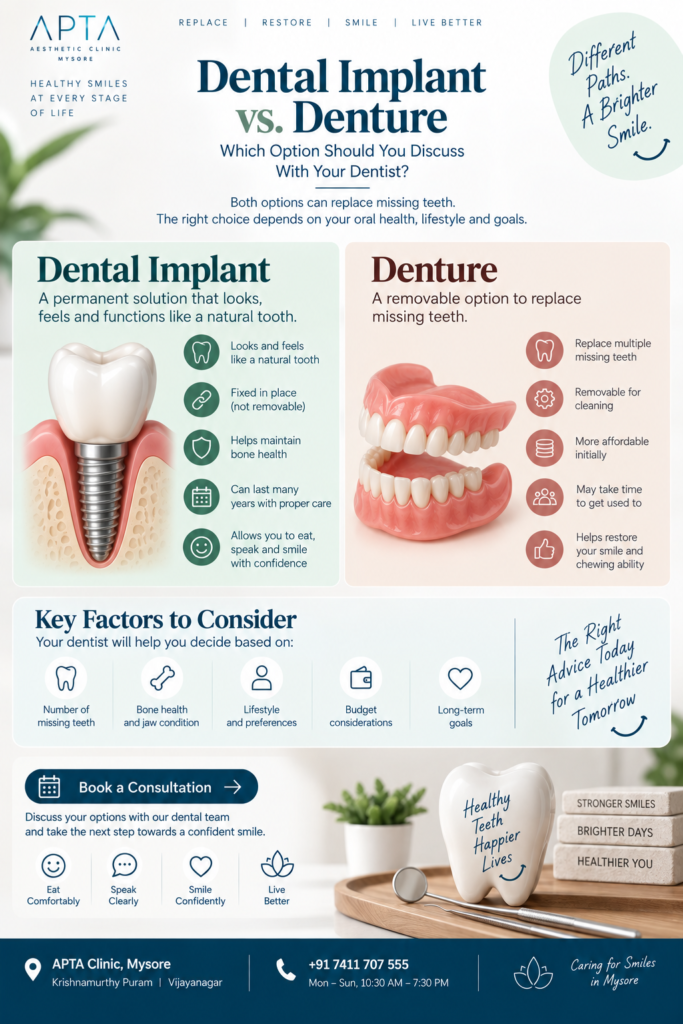
A dental implant is an artificial tooth root, commonly made from titanium, that is placed in the jawbone. Once the implant has healed and integrated with the bone, it can support a replacement tooth such as a crown. Implants may also be used to support bridges or certain types of dentures.
Implant treatment involves planning and assessment. Your dentist needs to evaluate whether the implant site and your overall oral health are suitable for the proposed treatment.
Key points about dental implants
- An implant is placed in the jawbone rather than resting only on the gums.
- It can support a crown, bridge or an implant-supported denture, depending on the treatment plan.
- Implant placement is a surgical procedure.
- Healing and integration with the bone are important stages.
- Implants require regular cleaning and professional follow-up.
- Additional treatment may be required in some cases.
An implant is not just the visible replacement tooth. It is part of a treatment process that includes assessment, placement, healing and restoration.
What Are Dentures?
Dentures are prosthetic appliances used to replace missing teeth. Traditional dentures are removable, meaning they can be taken out for cleaning and maintenance.
The type of denture depends on how many teeth are missing and the condition of the remaining teeth and oral tissues.
Common types of dentures
Complete dentures: These replace all teeth in an upper or lower arch.
Partial dentures: These replace some missing teeth when natural teeth remain.
Immediate dentures: These may be prepared before certain teeth are removed and fitted soon after extraction. Adjustments may be needed as the mouth heals and changes.
Implant-supported dentures: These use dental implants to provide support or retention. They combine aspects of implant treatment and denture restoration, and require assessment to determine suitability.
Dentures are designed to restore aspects of chewing, speech and smile appearance. Fit, comfort and function vary between individuals, and adjustments may be needed.
Dental Implant vs. Denture: Key Differences
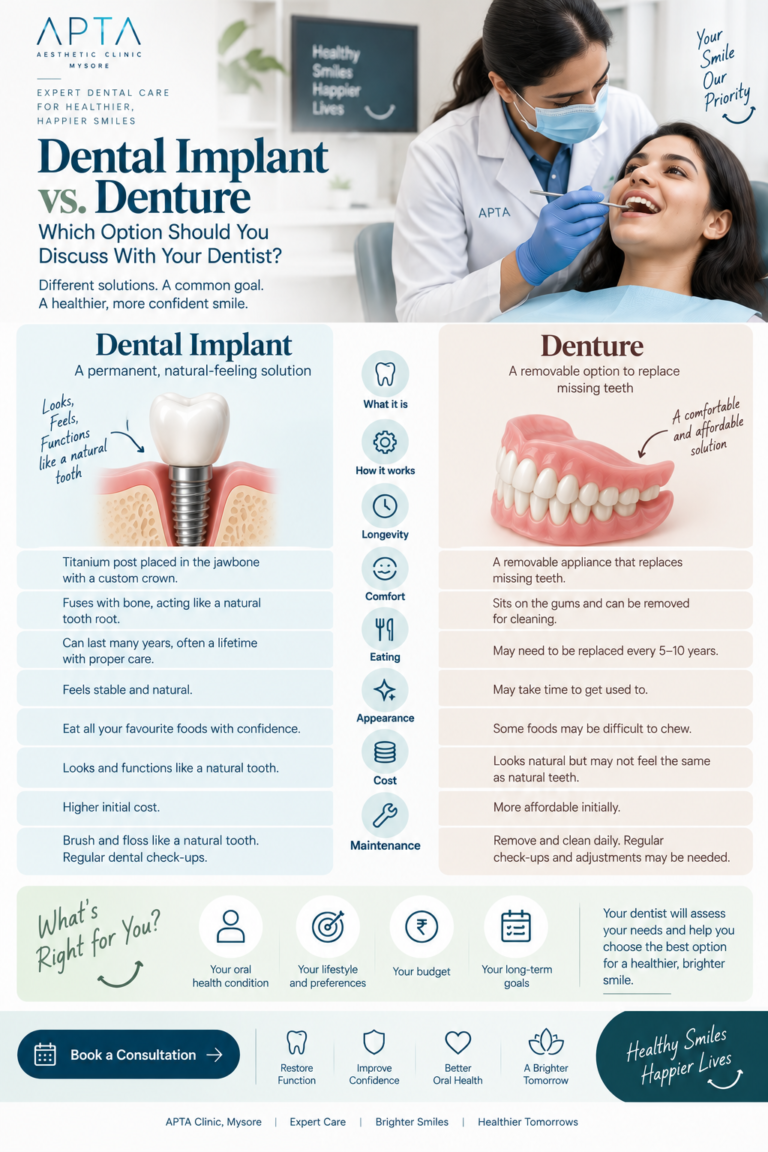
The main difference is how the replacement teeth are supported. An implant is placed in the jawbone, while a conventional removable denture rests on the oral tissues and may use remaining teeth or other features for support, depending on its design.
|
Comparison point |
Dental implant |
Traditional removable denture |
|
Support |
Supported by an implant placed in the jawbone |
Rests on the gums and oral tissues; some partial dentures may also use remaining teeth for support |
|
Removable or fixed |
The implant itself is fixed in the bone; the attached restoration may be designed differently |
Designed to be removed for cleaning |
|
Treatment process |
Involves assessment, surgical placement, healing and restoration |
Involves oral assessment, records or impressions, fabrication, fitting and possible adjustments |
|
Surgery |
Implant placement requires surgery |
Conventional denture fitting does not require implant placement |
|
Number of teeth replaced |
Can support a single crown or certain restorations replacing multiple teeth |
Can replace several teeth or a complete arch, depending on the denture |
|
Maintenance |
Requires daily oral hygiene around the restoration and professional monitoring |
Requires daily denture cleaning, oral hygiene and periodic assessment of fit |
|
Suitability |
Depends on oral health, bone and gum condition and other individual factors |
Depends on the pattern of tooth loss, oral tissues, remaining teeth and the type of denture |
|
Treatment timeline |
Includes a healing period that varies by case |
Timing depends on the denture type, fabrication and any necessary dental treatment |
This table describes general differences. Implant-supported dentures are a separate category and should not be confused with conventional removable dentures.
Who May Be Suitable for Dental Implants?
Dental implants may be considered for people who want to replace missing teeth with an implant-supported restoration. Suitability must be determined through a dental assessment.
Your dentist may consider:
- The condition and amount of available jawbone.
- The health of your gums and remaining teeth.
- The location and number of missing teeth.
- Your bite and the forces placed on the restoration.
- Your medical history and factors that may affect healing.
- Whether additional procedures or preparatory treatment may be needed.
- Your expectations, preferences and ability to maintain the restoration.
Having a missing tooth does not automatically mean that an implant is the right option. Your dentist can explain whether it is suitable, what the treatment would involve and whether another approach should be considered.
Who May Be Suitable for Dentures?
Dentures may be considered for people who need to replace several missing teeth or an entire arch. A partial denture may be an option when some natural teeth remain, while a complete denture is designed for an arch with no remaining natural teeth.
Your dentist may assess:
- How many teeth are missing and where the gaps are located.
- The condition of your gums and oral tissues.
- The health and position of any remaining teeth.
- The shape of your jaw and the available support.
- Your chewing and speech needs.
- Your ability to insert, remove and clean the appliance.
- Whether a conventional or implant-supported design should be discussed.
Dentures can require adjustments as the mouth changes. If you experience persistent soreness, looseness or difficulty chewing, contact your dental professional rather than attempting to alter the appliance yourself.
What Happens During Dental Implant Treatment?
Implant treatment commonly involves:
-
The exact implant process depends on the tooth being replaced, the condition of the implant site and the treatment plan.
- Consultation and assessment
The dentist discusses your concerns, examines your mouth and evaluates whether implant treatment may be appropriate. Imaging may be used when clinically indicated.
- Treatment planning
If an implant is considered suitable, the dentist explains the proposed placement, restoration, expected stages and any additional treatment that may be needed.
- Implant placement
The implant is surgically placed in the jawbone according to the treatment plan.
- Healing
The implant needs time to heal and integrate with the bone. The duration varies, and your dentist will advise when it is appropriate to proceed.
- Fitting the restoration
A crown, bridge or other planned restoration is attached when the dentist determines that the site is ready.
- Ongoing care
You receive instructions for cleaning and follow-up. Regular dental reviews help monitor the implant and surrounding tissues.
What Happens During Denture Treatment?
Denture treatment generally involves assessment, planning, fabrication and fitting. The steps depend on whether you need a complete, partial, immediate or implant-supported denture.
- Consultation and oral examination
Your dentist reviews the missing teeth, the condition of your gums and remaining teeth, and your expectations.
- Planning the denture
The dentist discusses the type of denture that may be appropriate and explains its expected function, fit and maintenance.
- Impressions and measurements
Records of your mouth are taken as needed to help design the denture.
- Fabrication
The denture is made according to the treatment plan and the records collected.
- Fitting and adjustments
The dentist checks how the denture fits and functions. Adjustments may be required, especially as you adapt to a new appliance.
- Care instructions and follow-up
You receive guidance on cleaning, storage, wearing and when to return for review.
Cleaning and Maintenance
Both implants and dentures need consistent care. The daily routine differs according to the type of restoration.
Caring for dental implants
- Brush carefully around the implant-supported restoration.
- Clean between teeth and around the restoration using suitable tools recommended by your dental team.
- Attend regular dental reviews.
- Follow any post-surgical instructions provided.
- Contact your dentist if you notice persistent pain, swelling, bleeding or movement of the restoration.
Implants can develop complications and should not be considered maintenance-free.
Caring for dentures
- Remove and clean removable dentures according to your dentist’s instructions.
- Clean your gums, tongue and palate gently.
- Handle the denture carefully to reduce the risk of damage.
- Store it as advised when it is not being worn.
- Attend dental reviews to check the fit and the health of your mouth.
- Seek advice if the denture becomes loose, damaged or persistently uncomfortable.
Changes in the gums and jawbone can affect denture fit over time. Your dentist can advise whether adjustment, relining or replacement should be considered.
What Can Affect the Cost?
The cost of replacing missing teeth depends on the treatment plan. A simple comparison of the initial appliance or procedure may not reflect all the stages involved.
Factors that can affect the overall cost include:
- The number of teeth being replaced.
- Whether the treatment involves a conventional denture, an implant or an implant-supported denture.
- The type and design of the restoration.
- The condition of the gums, remaining teeth and jawbone.
- Whether extractions or other preparatory procedures are required.
- The materials and laboratory work involved.
- The number of appointments and follow-up requirements.
- Whether adjustments or replacement may be needed later.
Ask your dentist for a written estimate and clarify which stages are included. For implant treatment, ask about assessment, placement, restoration and follow-up. For dentures, ask about impressions, fabrication, fitting, adjustments and future maintenance.
APTA Clinic’s current fees and any applicable payment arrangements should be confirmed directly with the clinic.
Questions to Ask Your Dentist
Before choosing between an implant and a denture, consider asking:
- What are the available options for replacing my missing tooth or teeth?
- Am I suitable for dental implants? If not, what factors affect that decision?
- Would a complete or partial denture be appropriate for my situation?
- Could an implant-supported denture be considered?
- Will I need any treatment before the replacement tooth or appliance is fitted?
- What are the expected stages and timeline for each option?
- How should I clean and maintain the proposed restoration?
- What limitations, risks or complications should I understand?
- What is included in the cost estimate?
- What follow-up appointments will I need?
These questions can help you understand the available choices and the reasoning behind your dentist’s recommendation.
Dental Implant vs. Dentures: Key Differences
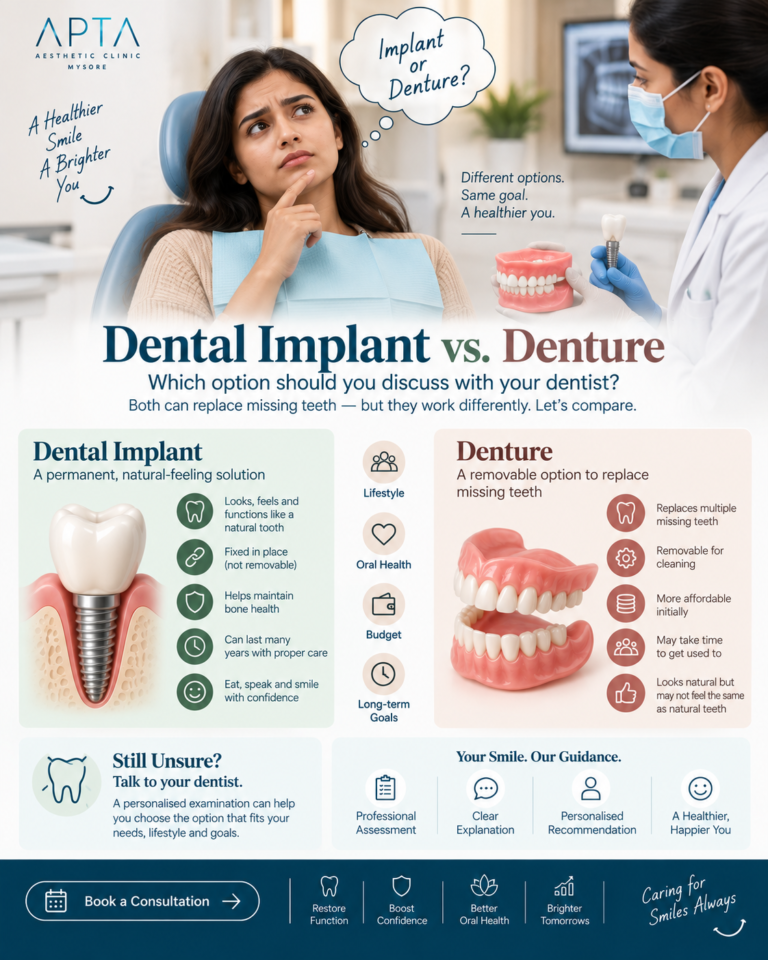
Dental implants and dentures are two options for replacing missing teeth, but they differ in how they are supported, fitted and maintained. A dental implant is placed in the jawbone to support a replacement tooth, while a conventional denture is a removable appliance that rests on the gums and may replace some or all missing teeth.
Implants are fixed in place and may be considered when a patient wants a non-removable replacement. Treatment involves a surgical procedure and healing time, and suitability depends on factors such as bone support, gum health and overall health. A dentist must assess whether implant treatment is appropriate.
Dentures can be removed for cleaning and may be used to replace several teeth or a complete arch. They generally do not require implant surgery, although adjustments or relining may be needed as the mouth changes. Some people take time to get used to speaking and eating with a new denture, and its fit should be reviewed if it becomes loose or uncomfortable.
Consult APTA Clinic in Mysore for Your Dental Concerns
Book a dental consultation with APTA Clinic in Mysore to discuss your tooth and understand which restorative treatment may be appropriate for your needs.
APTA Clinic contact details
- Krishnamurthy Puram, Mysore – 570004
- Vijayanagar, Mysore – 570030
- Phone: +91 7411 707 555
- Listed hours: Monday to Sunday, 10:30 AM–7:30 PM
Frequently Asked Questions (FAQs)
A dental implant is placed in the jawbone and can support a replacement tooth or other restoration. A conventional denture is a removable appliance that replaces some or all missing teeth. Implant-supported dentures use implants for additional support or retention.
No. Suitability depends on factors such as jawbone and gum health, oral condition, medical history and the proposed restoration. A dentist needs to assess your situation before recommending implant treatment.
Complete dentures are designed to replace all teeth in an upper or lower arch. Whether they are suitable for you depends on your oral tissues, treatment needs and assessment by a dentist.
Conventional dentures are removable and should be cleaned according to your dentist’s instructions. Implant-supported denture designs vary, so ask your dentist whether the proposed appliance is removable or fixed.
The timeline varies according to the implant site, healing, restoration and whether additional procedures are needed. Your dentist can explain the expected stages after examining your mouth.
The timeline depends on the type of denture, the records and fabrication process, and any dental treatment required beforehand. Your dentist can provide an estimate for your case.
There is no reliable way to compare costs without knowing the complete treatment plan. The number of teeth, type of restoration, additional procedures and follow-up needs can all affect the total.
APTA Clinic provides an appointment form and lists +91 7411 707 555 as its contact number. Its website lists dental services and locations in Mysore.
APTA Clinic lists locations in Krishnamurthy Puram and Vijayanagar, Mysore.