
Dental Bridge vs Implant in Mysore: Key Differences
- Home
- Blog
- About Us
Missing a tooth can affect how you chew, speak and feel about your smile. If you are exploring tooth-replacement options, two treatments you may hear about are dental bridges and dental implants.
Both can be used to replace missing teeth, but they work differently. A traditional bridge is supported by neighbouring teeth, while an implant is placed in the jawbone and can support a replacement crown. The right option depends on your oral health, the condition of nearby teeth, the available bone, your preferences and your dentist’s assessment.
This guide explains the differences between a dental bridge and a dental implant to help you prepare for a consultation in Mysore.
What Is a Dental Bridge?
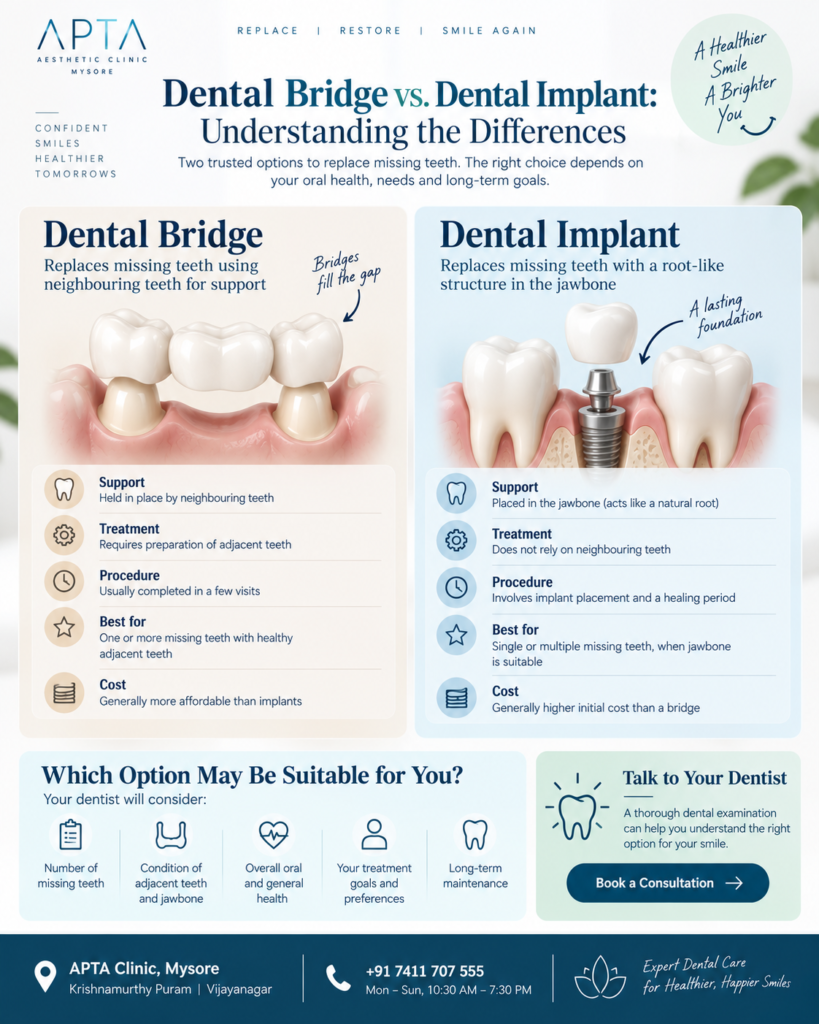
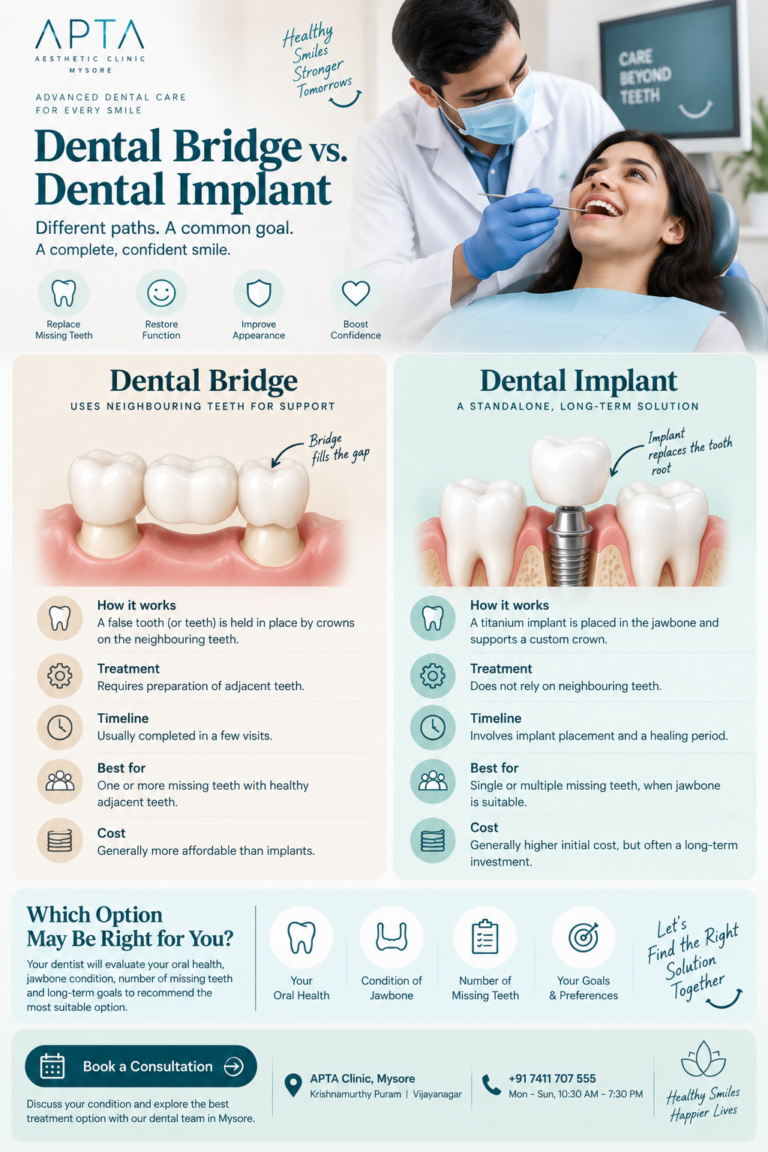
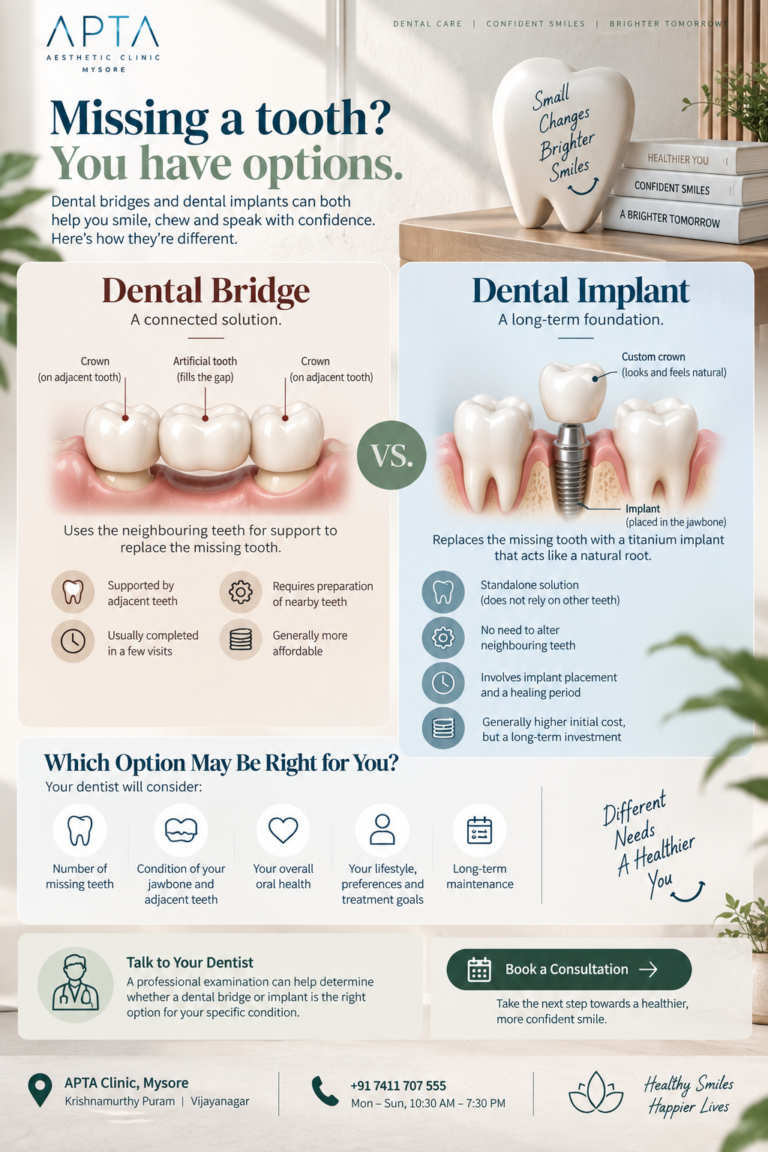
A dental bridge is a fixed restoration used to fill the space left by one or more missing teeth. A traditional bridge is supported by teeth next to the gap. These supporting teeth are prepared to hold the bridge, which includes one or more replacement teeth.
A dentist may discuss a bridge when the neighbouring teeth can provide suitable support and the overall condition of the mouth makes this approach appropriate.
Points to understand about a dental bridge
- It replaces the visible missing tooth or teeth without placing an implant in the jawbone.
- A traditional bridge relies on supporting teeth beside the gap.
- Preparing those teeth may involve removing some tooth structure.
- The bridge needs regular cleaning and professional review.
- The design and number of replacement teeth depend on the individual case.
A bridge is not the same as a removable denture. A fixed bridge is attached in the mouth, whereas a removable denture can be taken out for cleaning.
What Is a Dental Implant?
A dental implant is an artificial tooth root, commonly made from titanium, that is placed in the jawbone. It can support a crown to replace a single missing tooth or be used as part of a restoration for multiple missing teeth.
Implant treatment involves assessment and planning. The dentist considers the condition of the gums and jawbone, general oral health and other factors that may affect treatment. The implant must integrate with the bone before the final restoration is completed, according to the treatment plan.
Points to understand about a dental implant
- It is placed in the jawbone rather than relying on neighbouring teeth for support.
- A crown can be attached to an implant to replace a missing tooth.
- Treatment involves a surgical stage and a period of healing.
- The suitability of an implant depends on individual clinical factors.
- Implants require ongoing oral hygiene and dental follow-up.
An implant is not simply a replacement crown. It is a treatment process that includes assessment, placement, healing and restoration.
Dental Bridge vs. Dental Implant: Key Differences
The main difference is how each restoration is supported. A traditional bridge uses neighbouring teeth, while an implant is supported by the jawbone.
|
Comparison point |
Dental bridge |
Dental implant |
|
Support |
Usually supported by prepared neighbouring teeth |
Supported by an implant placed in the jawbone |
|
Treatment approach |
Involves preparing supporting teeth and fitting the bridge |
Involves implant assessment, placement, healing and fitting the restoration |
|
Effect on neighbouring teeth |
A traditional bridge usually requires preparation of supporting teeth |
An implant does not rely on neighbouring teeth for support |
|
Surgical placement |
A traditional bridge does not require implant placement in the jawbone |
Implant placement is a surgical procedure |
|
Healing considerations |
The dentist considers the condition of the supporting teeth and gums |
Healing and integration with the jawbone are important parts of treatment |
|
Cleaning and maintenance |
Requires careful cleaning around and beneath the bridge, as advised |
Requires careful cleaning around the implant restoration and regular professional care |
|
Suitability |
Depends on the gap, supporting teeth, gums and bite |
Depends on bone and gum health, overall oral health and other individual factors |
These are general differences. The details can vary depending on the type of bridge or implant restoration being considered.
Who May Be Suitable for Each Option?
There is no single tooth-replacement option that is right for everyone. A dentist will examine your mouth and discuss the benefits, limitations and practical considerations of the available treatments.
When a dental bridge may be considered
A bridge may be considered when:
- The teeth next to the gap can provide suitable support.
- The condition of the supporting teeth and gums allows for a bridge.
- The proposed bridge design is appropriate for the number and position of missing teeth.
- The patient understands the preparation and maintenance involved.
A traditional bridge may require reshaping the supporting teeth. Your dentist can explain what that means for your particular teeth and whether another design or treatment option should be considered.
When a dental implant may be considered
An implant may be considered when:
- The missing tooth or teeth can be replaced with an implant-supported restoration.
- The jawbone and gums are suitable, or any additional treatment needed can be discussed.
- The patient’s oral and general health are compatible with the proposed procedure.
- The patient understands the surgical stage, healing period, restoration and ongoing maintenance.
An implant is not automatically suitable simply because a tooth is missing. A clinical assessment is needed to determine whether it is appropriate and what planning may be required.
What Happens During Treatment?
The treatment process differs between bridges and implants. Your dentist should explain the expected stages and timeline for your case before treatment begins.
Dental bridge treatment
A traditional bridge commonly involves:
- Examination and planning: The dentist evaluates the gap, supporting teeth, gums and bite.
- Preparation: If a traditional tooth-supported bridge is selected, the supporting teeth are prepared as required for the restoration.
- Records and fabrication: Impressions or other records are taken so the bridge can be made to fit.
- Fitting: The bridge is checked and secured according to the treatment plan.
- Review and care: The dentist explains how to clean the bridge and when to return for follow-up.
The exact sequence depends on the bridge design and your clinical needs.
Dental implant treatment
Implant treatment commonly involves:
- Assessment and planning: The dentist reviews your oral health and evaluates the jawbone and proposed implant site. Imaging may be used when appropriate.
- Implant placement: If treatment is suitable, the implant is placed in the jawbone.
- Healing: The implant is allowed to heal and integrate with the bone according to the treatment plan.
- Restoration: A crown or other suitable restoration is attached when the dentist determines that it is appropriate.
- Maintenance: You receive instructions for cleaning and follow-up care.
Some patients may need additional procedures or a modified plan. The number of visits and overall treatment time cannot be determined without an individual assessment.
Maintenance and Long-Term Care
Both bridges and implants need daily care and regular dental reviews. Neither should be treated as a replacement for oral hygiene.
Caring for a dental bridge
Your dentist may recommend that you:
- Brush twice daily with fluoride toothpaste.
- Clean carefully around the bridge and supporting teeth.
- Use suitable flossing aids or interdental cleaning tools as demonstrated by your dental team.
- Attend recommended dental check-ups.
- Contact the clinic if the bridge feels loose, causes persistent discomfort or becomes damaged.
Cleaning beneath a bridge can require a specific technique. Ask your dentist or hygienist to demonstrate the method appropriate for your restoration.
Caring for a dental implant
Your dentist may recommend that you:
- Brush carefully around the implant-supported restoration.
- Clean between teeth and around the implant using suitable tools.
- Attend regular professional reviews.
- Follow any instructions provided after surgery and during healing.
- Seek advice if you notice persistent discomfort, swelling, bleeding or movement of the restoration.
An implant can still develop problems and needs ongoing care. Your dental team can advise you about the maintenance schedule for your restoration.
What Can Affect the Cost?
The cost of a dental bridge or implant depends on the treatment plan. It is not possible to give a reliable comparison without knowing the number of missing teeth, the type of restoration and the clinical work required.
Factors that may affect the overall cost include:
- The number and position of missing teeth.
- The type and design of bridge or implant restoration.
- The condition of the neighbouring teeth and gums.
- The amount and condition of available jawbone.
- Whether additional treatment or procedures are required.
- The materials selected and the stages included in the treatment plan.
- The number of appointments and follow-up requirements.
When discussing an estimate, ask what is included and whether any additional treatment may be needed. For an implant, clarify which assessment, placement, restoration and follow-up stages are covered. For a bridge, ask about the preparation, fabrication, fitting and review stages.
APTA Clinic’s current fees should be confirmed directly with the clinic; this article does not quote treatment prices.
Questions to Ask Your Dentist
Before deciding between a dental bridge and an implant, consider asking:
- What are the options for replacing my missing tooth or teeth?
- Are my neighbouring teeth suitable to support a bridge?
- Am I a candidate for an implant, and what factors affect that decision?
- Would either option require additional treatment?
- What are the stages and expected timeline for each option in my case?
- How should I clean and maintain the proposed restoration?
- What complications or limitations should I understand?
- What is included in the cost estimate?
- What follow-up appointments will I need?
- If I do not proceed immediately, what should I do to look after my oral health?
These questions can help you understand the reasoning behind the treatment recommendation and make an informed decision with your dentist.
How Does Your Oral Health Affect the Choice Between a Bridge and an Implant?
Your oral health plays an important role in deciding how a missing tooth should be replaced. Before recommending a dental bridge or implant, your dentist will assess the gap, the neighbouring teeth, your gums, your bite and the condition of the supporting bone. A conventional bridge relies on suitable supporting teeth, while an implant needs adequate bone and healthy tissues around the treatment site. Active dental problems may need to be addressed before replacement treatment begins. Your dentist can explain whether either option is appropriate or whether another approach should be considered.
A conventional dental bridge usually fills the gap by attaching an artificial tooth to supporting teeth beside the space. These supporting teeth may need to be reshaped to accommodate the bridge. An implant-supported crown, by contrast, replaces an individual missing tooth by attaching a crown to an implant placed in the jawbone. This can avoid preparing neighbouring teeth when they are otherwise healthy and suitable to remain untouched. However, implant treatment involves surgery and requires careful assessment and planning. The choice depends on your clinical situation, the condition of adjacent teeth and your treatment preferences.
Why Is Cleaning Around a Bridge or Implant Important?
Both bridges and implants need consistent daily care and regular dental reviews. A bridge can create areas beneath or around the replacement tooth where food and plaque may collect, so your dentist or hygienist can show you how to clean those spaces effectively. Around implants, careful cleaning is important because inflammation and disease can affect the tissues supporting the implant. Your cleaning routine may need to include tools suited to your restoration, such as interdental brushes or specialised flossing aids. Follow the instructions provided by your dental team and attend recommended maintenance appointments.
Are There Alternatives to Bridges and Dental Implants?
Yes. A removable partial denture may be an option for replacing one or more missing teeth. Depending on your oral health, the position of the gap and how your teeth function together, your dentist may also discuss whether leaving the space is reasonable. Each option has different considerations relating to comfort, appearance, cleaning, stability, treatment time and cost. A removable denture can be taken out for cleaning, while bridges and implant-supported restorations are fixed in place. Discuss the advantages and limitations of each suitable option before making a decision.
Questions to Ask Before Starting Tooth-Replacement Treatment
Before proceeding with a bridge or implant, consider asking your dentist:
- Which options are suitable for replacing my missing tooth, and why?
- Are the teeth beside the gap healthy enough to support a bridge?
- Do I have sufficient bone and healthy gum tissue for an implant?
- Will I need any additional treatment before the replacement is fitted?
- How long might the complete treatment process take?
- What cleaning routine and follow-up visits will I need?
- What are the expected costs, including any preparatory or maintenance treatment?
- If the first option is not suitable, what alternatives could I consider?
These questions can help you understand the treatment plan and the responsibilities involved in maintaining your replacement tooth.
Consult APTA Clinic in Mysore for Your Dental Concerns
Book a dental consultation with APTA Clinic in Mysore to discuss your tooth and understand which restorative treatment may be appropriate for your needs.
APTA Clinic contact details
- Krishnamurthy Puram, Mysore – 570004
- Vijayanagar, Mysore – 570030
- Phone: +91 7411 707 555
- Listed hours: Monday to Sunday, 10:30 AM–7:30 PM
Frequently Asked Questions (FAQs)
A traditional dental bridge is supported by neighbouring teeth, while a dental implant is placed in the jawbone and can support a replacement crown. The assessment, procedure and maintenance requirements differ between the two.
A traditional tooth-supported bridge usually requires preparation of the supporting teeth. The amount and type of preparation depend on the design and the individual case. Ask your dentist what would be involved for your teeth.
No. Implant suitability depends on factors such as the condition of the jawbone and gums, oral health and relevant medical considerations. A dentist needs to assess the individual before recommending treatment.
The timeline varies. A bridge involves planning, preparation and fitting, while implant treatment also includes surgical placement and healing before the final restoration. Your dentist can explain the expected schedule for your case.
There is no reliable answer without comparing complete treatment plans. Costs can vary according to the restoration design, number of teeth involved, additional procedures and what is included in the estimate.
Both require consistent oral hygiene and professional follow-up. The cleaning methods differ, so your dental team should demonstrate how to care for the specific restoration you receive.
Implants can support different types of restorations, including some designs used to replace multiple teeth. The number and placement of implants depend on the treatment plan and clinical assessment.
APTA Clinic provides an appointment form and lists +91 7411 707 555 as its contact number. Its website lists dental services and locations in Mysore.
APTA Clinic lists locations in Krishnamurthy Puram and Vijayanagar, Mysore.