
Acne Marks vs Acne Scars: How Are They Different and What Are the Options?
- Home
- Blog
- About Us
A dark spot left after a pimple and a deep indentation in the skin are often both called an “acne scar.” Medically, they can be quite different.
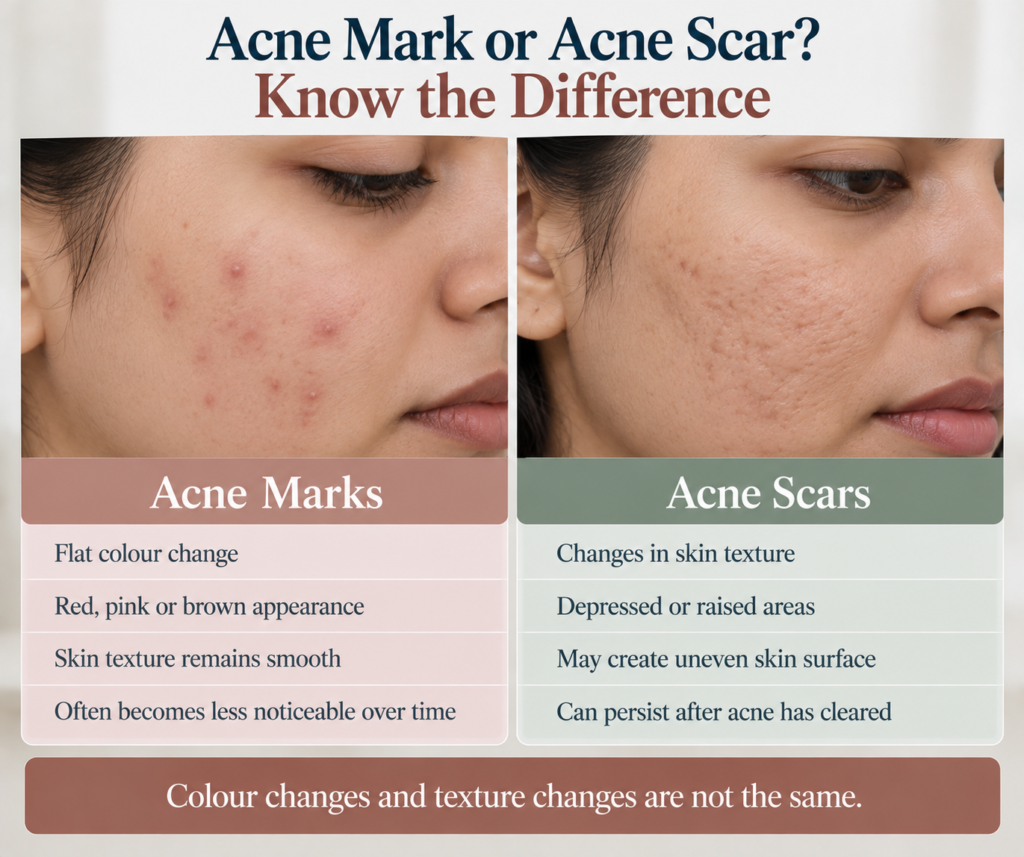
Some changes left after acne mainly affect skin colour. They may appear as red, pink, brown or darker flat areas and can gradually become less noticeable. Acne scars involve a change in the skin’s structure or texture. They may appear as depressions, uneven areas or raised scar tissue.
This difference matters because treatment for pigmentation is not necessarily the same as treatment for a depressed or raised scar.
If you are considering acne scar treatment in Mysore, identifying what kind of post-acne change you have is an important first step.
What Is the Difference Between Acne Marks and Acne Scars?
A useful way to understand the difference is to look at whether the main change is colour or skin structure.
Acne marks
After an acne lesion heals, the skin may be left with a flat area of altered colour. Depending on the individual and skin tone, it can look red, pink, brown, darker than the surrounding skin or, in some cases, lighter.
Post-inflammatory hyperpigmentation (PIH) is one common example.
These flat colour changes are generally different from true structural acne scars. They can gradually become less noticeable, although the time required varies.
Acne scars
Acne scars involve a change in the structure or texture of the skin.
They can include:
- Ice-pick scars
- Boxcar scars
- Rolling scars
- Raised scars
- Hypertrophic scars or keloids in some cases
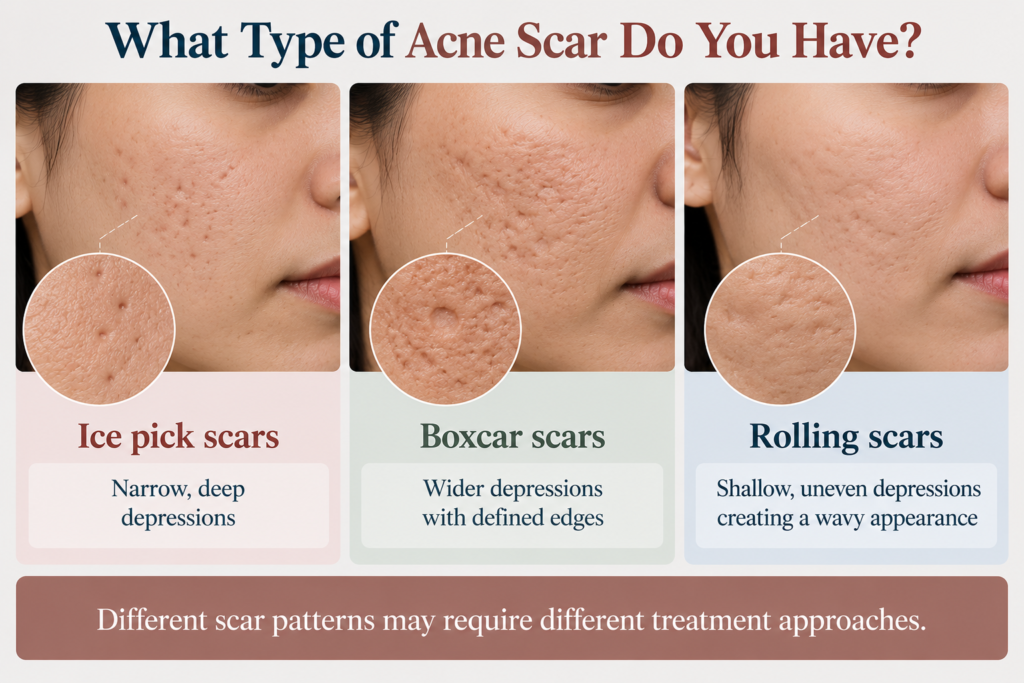
The three commonly described types of atrophic acne scars are ice-pick, boxcar and rolling scars.
A person can also have both pigmentation and structural scarring after acne.
What Do Acne Marks Look Like?
Acne marks are generally flat rather than indented.
Red or pink areas
Some people notice red or pink areas after an inflamed pimple heals. These colour changes can be more noticeable in lighter skin tones.
Brown or darker pigmentation
Brown or darker areas can occur after inflammation, particularly in people with medium to darker skin tones. DermNet notes that post-inflammatory hyperpigmentation is more common in darker skin types.
The presence of a dark spot does not automatically mean that the skin has developed a permanent scar.
Colour changes after inflammation
Acne inflammation can affect skin colour even after the original breakout has disappeared.
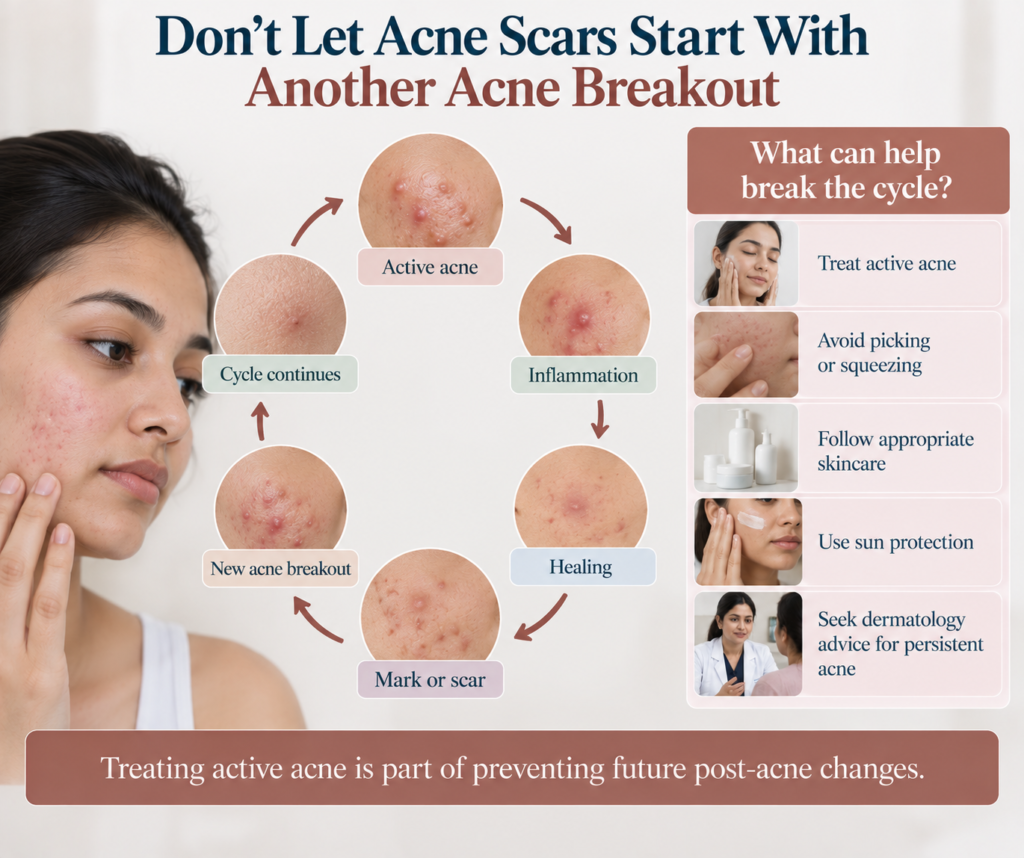
That is one reason controlling active acne matters. New inflammatory breakouts can result in additional post-acne colour changes and can contribute to further scarring.
How long do acne marks take to fade?
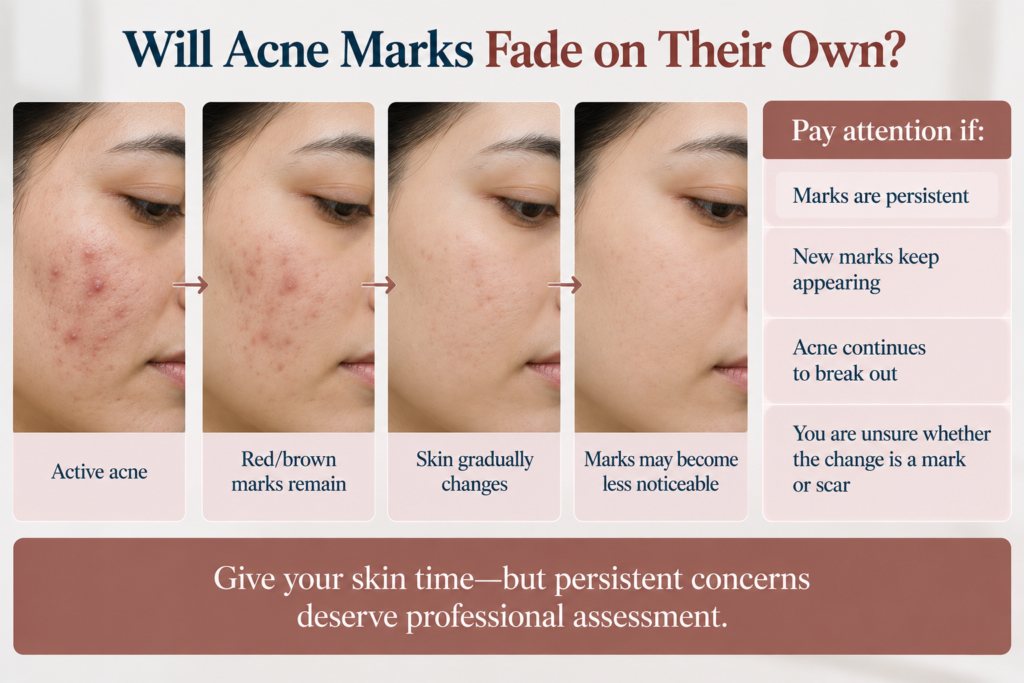
Many post-acne colour changes gradually become less noticeable. However, fading is not always quick.
Skin tone, inflammation, repeated breakouts, sun exposure and individual skin response can all affect how long pigmentation remains. Colour changes associated with acne may take months or longer to improve.
If pigmentation persists or becomes a concern, a dermatologist can assess whether it represents post-inflammatory pigmentation or another skin condition.
What Do Acne Scars Look Like?
Unlike a flat mark, a structural acne scar changes the surface or contour of the skin.
Depressed or indented acne scars
These appear as areas where the skin surface dips below the surrounding skin.
Common types include:
Ice-pick scars
Narrow, deeper depressions.
Boxcar scars
Wider depressions with more clearly defined edges.
Rolling scars
Broader depressions with sloping edges that can create an uneven or wavy appearance.
Raised acne scars
Some acne scars become raised instead of depressed.
Hypertrophic scars remain within the area of the original injury, while keloids can extend beyond it. Raised scars need a different treatment approach from depressed acne scars.
Uneven skin texture
Sometimes the main concern is texture rather than colour.
You may notice uneven areas when looking at the skin under certain lighting, even when dark pigmentation is not very obvious.
A treatment intended mainly for pigmentation may therefore not address a deeper structural depression.
What Do Acne Marks Look Like?
Acne marks are generally flat rather than indented.
Red or pink areas
Some people notice red or pink areas after an inflamed pimple heals. These colour changes can be more noticeable in lighter skin tones.
Brown or darker pigmentation
Brown or darker areas can occur after inflammation, particularly in people with medium to darker skin tones. DermNet notes that post-inflammatory hyperpigmentation is more common in darker skin types.
The presence of a dark spot does not automatically mean that the skin has developed a permanent scar.
Colour changes after inflammation
Acne inflammation can affect skin colour even after the original breakout has disappeared.
That is one reason controlling active acne matters. New inflammatory breakouts can result in additional post-acne colour changes and can contribute to further scarring.
Can Acne Marks Fade on Their Own?
Yes. Some post-acne colour changes gradually fade without procedural treatment.
Post-inflammatory hyperpigmentation can improve with time, although more pronounced pigmentation may take months or longer. Continuing acne inflammation can also lead to new areas of pigmentation.
Factors that can affect how noticeable the marks remain include:
- Skin tone
- Degree of inflammation
- Repeated acne breakouts
- Sun exposure
- Previous treatment
- Individual skin response
If new acne continues to appear, new post-acne marks can continue to develop.
A dermatologist can assess whether your pigmentation is likely to improve with time and whether treatment may be appropriate.
Can Acne Scars Be Treated?
Yes. Acne scars can often be treated to reduce their appearance and improve uneven skin texture.
However, treatment does not guarantee complete removal.
The appropriate approach depends on several factors, including:
- Scar type
- Scar depth
- Number of scars
- Skin type
- Skin tone and pigmentation tendency
- Active acne
- Previous treatments
- Location of the scars
- Individual treatment goals
The American Academy of Dermatology notes that acne-scar treatment plans are individualized according to factors such as scar type, skin tone and other patient-specific considerations.
This is why a procedure that helped another person may not be the right choice for your skin.
What Are the Treatment Options for Acne Scars?
There is no single acne scar treatment that suits every person.
A dermatologist may recommend one procedure or combine different approaches depending on the scar pattern and the condition of the skin. The AAD describes several treatment options for acne scarring, including chemical peels, laser treatment, microneedling, radiofrequency, scar surgery and other approaches.
Topical treatments
Some topical treatments may help selected mild acne scarring or associated pigmentation.
They are generally less useful for deeper structural scars. A dermatologist can determine whether topical treatment is appropriate for your particular concern.
Chemical peels
Chemical peels use a chemical solution to produce controlled exfoliation of the skin.
Depending on the formulation, they may be considered for acne, post-acne pigmentation or selected superficial scarring.
The type and strength of a peel need to be selected according to the person’s skin and treatment goal. This is particularly relevant for people who are prone to pigmentation changes.
Microneedling
Microneedling uses fine needles to create controlled micro-injuries in the skin. This stimulates a wound-healing response and new collagen production.
It may be considered for selected depressed acne scars. The AAD includes microneedling among procedures used to treat acne scarring.
Laser and energy-based treatments
Certain laser and energy-based treatments can be used for acne scars and uneven skin texture.
The appropriate device and settings depend on the person’s skin characteristics and the type of scar being treated.
People who are prone to post-inflammatory pigmentation may require particularly careful treatment selection.
Subcision
Subcision can be considered for selected depressed scars where fibrous bands beneath the scar contribute to the indentation.
It is not suitable for every scar pattern. A dermatologist needs to assess the scar before deciding whether this procedure is appropriate.
Combination treatment
Different scar types can respond differently to treatment.
For that reason, a dermatologist may use more than one approach or treat different areas in stages. The AAD notes that combination treatment may be used when a single procedure is unlikely to address all aspects of the scarring.
Why Treating Active Acne Matters
If new acne continues to develop, new post-acne marks and scars can also appear.
The AAD notes that acne-scar treatment plans will often begin with controlling active acne because reducing new breakouts can help prevent additional scarring.
That does not necessarily mean you must wait until your skin is completely clear before discussing existing scars.
Instead, your dermatologist can decide how active acne and established scarring should be managed together.
When Should You See a Dermatologist for Acne Marks or Scars?
Consider a dermatology consultation if:
- Acne marks or scars have persisted despite your usual skincare
- You have deep or noticeable changes in skin texture
- Acne keeps returning
- New dark marks continue appearing after breakouts
- Existing pigmentation appears to be worsening
- Previous treatments have not helped
- You are unsure whether you have pigmentation or true scarring
- You are considering chemical peels, microneedling, laser treatment or subcision
You do not have to wait until acne scars become severe before discussing them with a dermatologist.
The first step can simply be identifying whether the concern is pigmentation, structural scarring, active acne or a combination.
How Is Acne Scar Treatment Chosen?
Acne scar treatment should be based on the actual type of scarring rather than a list of popular procedures.
During an assessment, a dermatologist may consider the following.
Scar type
An ice-pick scar is structurally different from a rolling scar or a raised scar, so the treatment approach may differ.
Scar depth
A superficial texture irregularity and a deeper depression do not necessarily respond to the same treatment.
Skin type and pigmentation
Skin tone and a person’s tendency to develop post-inflammatory pigmentation can influence treatment selection.
Active acne
If breakouts are still occurring, acne management may form part of the treatment plan.
Previous treatments
Tell your dermatologist about acne medications, skincare products, peels, procedures and previous scar treatments.
This information can affect which treatments are appropriate and which may need to be avoided.
Your treatment goals
One person may mainly want to address pigmentation. Another may be more concerned about deep scars or uneven texture.
A treatment plan should reflect the specific concern being assessed.
What Should You Ask During an Acne Scar Consultation?
If you are considering acne scar treatment in Mysore, you can ask:
- Do I have acne marks, acne scars or both?
- What type of acne scars do I have?
- Are my scars depressed or raised?
- Is my active acne under control?
- Which treatment options are appropriate for my skin type?
- How many sessions might I need?
- What downtime should I expect?
- What side effects are possible?
- Could treatment cause pigmentation changes?
- Would combination treatment be appropriate?
- What should I do before and after treatment?
- What improvement is realistic for my scars?
These questions can help you understand why a particular treatment is being considered instead of choosing a procedure based only on photographs or online testimonials.
Acne Scar Treatment in Mysore: What to Expect at APTA Clinic
APTA Clinic’s published acne-treatment information describes an individualized approach based on factors such as skin type, acne severity, previous treatments and the presence and type of scarring.
Its published treatment information includes chemical peels, laser therapy, microneedling, medical-grade facials and prescription medications among approaches used according to the condition being treated.
For someone concerned about post-acne marks or scars, the initial assessment can help establish whether the main issue is:
- Pigmentation
- Structural scarring
- Active acne
- A combination of these concerns
That distinction helps determine whether the focus should be acne control, pigmentation management, scar treatment or a combination.
APTA Clinic’s published acne-treatment information lists locations in Krishnamurthy Puram and Vijayanagar, Mysore, with the phone number +91 7411 707 555.
Clinic information should be confirmed with APTA Clinic before publishing or updating the page if details have changed.
Acne Marks vs Acne Scars: The Key Differences
| Feature | Acne Marks | Acne Scars |
|---|---|---|
|
Appearance |
Usually flat areas of altered colour |
Depressed, uneven or raised areas |
|
Common examples |
Red, pink or brown post-acne spots |
Ice-pick, boxcar, rolling or raised scars |
|
Main change |
Skin colour |
Skin structure or texture |
|
Natural improvement |
Many colour changes gradually fade |
Structural scars usually persist to some degree |
|
Treatment |
May involve skincare, pigmentation treatment or selected procedures |
May require scar-specific procedures |
The distinction is useful, but appearance alone does not always establish exactly what is happening in the skin.
Frequently Asked Questions (FAQs)
No. Acne marks generally refer to flat colour changes left after acne, such as red, pink or brown areas. Acne scars involve structural changes in the skin, including depressions or raised scar tissue.
Many post-acne colour changes gradually fade. The time required varies, and some pigmentation can remain for months or longer.
Acne scar treatment generally aims to reduce the appearance of scars and improve skin texture. Complete removal cannot be guaranteed, and the amount of improvement varies according to scar type, depth, skin characteristics and treatment.
Treatment depends on the type of scar and the condition of the skin. Depending on the assessment, options may include chemical peels, microneedling, laser or other energy-based treatments, subcision and combination approaches. A dermatologist should assess the scars before a procedure is selected.
Some acne scar treatments are intended to improve uneven texture and reduce the appearance of depressed scars. The degree of improvement depends on the scar type and individual skin characteristics.
The timeframe depends on the treatment, scar type and how the skin responds. Some treatments require multiple sessions, while combination approaches may be carried out in stages.
Certain laser treatments can be used for acne scarring, but the appropriate treatment and settings depend on the person’s skin and scar characteristics. A dermatologist should determine whether laser treatment is appropriate.
Consider a consultation if marks persist, new pigmentation continues to appear, acne keeps returning, previous skincare has not helped, or you are unsure whether you have pigmentation or structural scarring.
The cost depends on factors such as the treatment selected, areas treated, number of sessions and whether combination procedures are needed. The supplied APTA Clinic information does not provide a verified acne-scar price, so a specific cost should not be published without confirmation from the clinic.
APTA Clinic’s published acne-treatment information discusses active acne, post-acne marks and acne scars and lists approaches such as chemical peels, laser therapy and microneedling, depending on the individual’s condition.