
Psoriasis vs Eczema: How Are These Common Skin Conditions Different?
- Home
- Blog
- About Us
Psoriasis and eczema can both cause itchy, dry, inflamed or scaly skin. Because some of the symptoms overlap, it can be difficult to tell them apart by looking at a rash alone.
Psoriasis is a chronic inflammatory skin condition in which skin cells build up more quickly than usual, leading to thickened, raised areas and scale. Eczema refers to a group of inflammatory skin conditions. Atopic dermatitis, one of the most common forms, is particularly associated with dry skin and significant itching.
The appearance of both conditions can also vary with skin tone. A rash that looks obviously red in one person may appear violet, brown, grey or less visibly red in another.
If you have recurring itching, scaling or inflammation that is not settling with your usual skin care, a dermatologist can examine the affected skin and determine whether the pattern is consistent with psoriasis, eczema or another condition.
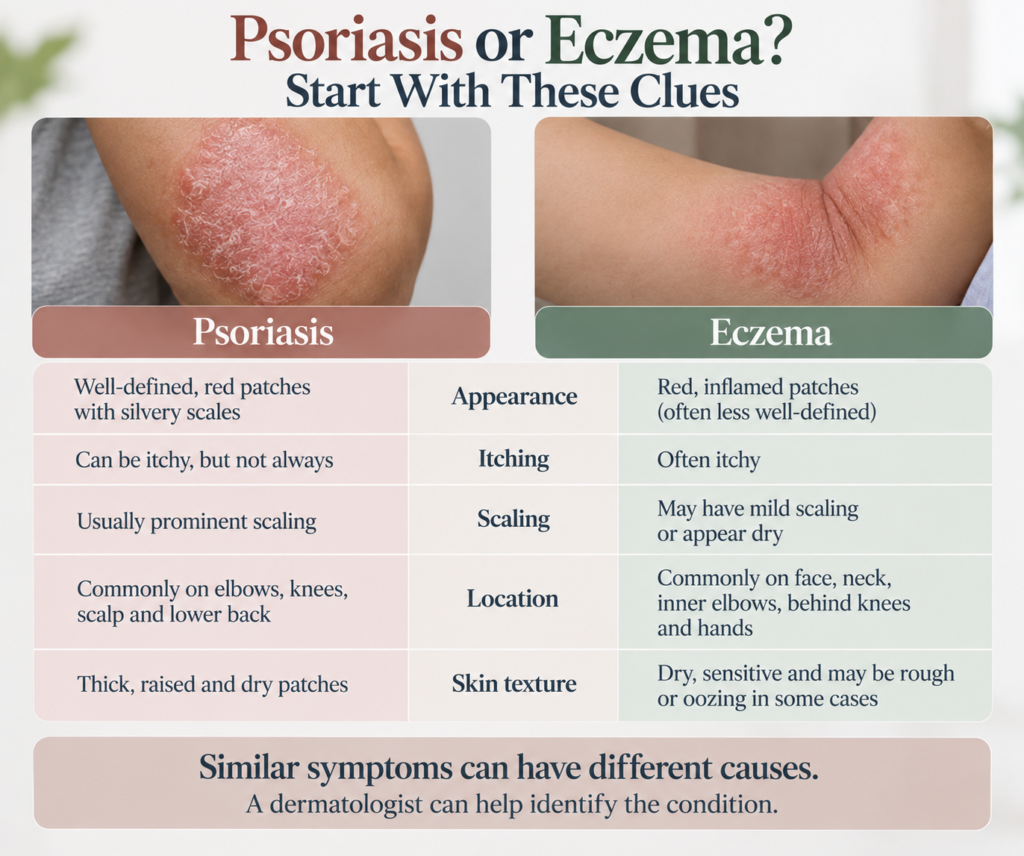
What Is Psoriasis?
Psoriasis is a chronic inflammatory condition that causes skin cells to build up rapidly. This can produce thick, raised patches known as plaques, often with a dry layer of scale over the surface.
Plaque psoriasis is the most common form, but psoriasis can affect other areas and may involve the scalp or nails. Some people also develop joint symptoms associated with psoriasis.
Common features can include:
- Thick or raised patches
- Dry scaling
- Itching
- Clearly defined affected areas
- Scalp involvement
- Nail changes
Psoriasis is not contagious. It cannot be caught through physical contact or by sharing a swimming pool with someone who has psoriasis.
What Is Eczema?
Eczema is a general term for a group of conditions that cause itchy, dry and inflamed skin. Atopic dermatitis is one of the most common types.
A prominent feature of atopic dermatitis is itching. Scratching can further damage the skin and contribute to thickening or other changes over time.
Depending on the type and stage of eczema, symptoms may include:
- Significant itching
- Dry or scaly skin
- Inflamed areas
- Rough or thickened skin
- Small bumps
- Crusting or oozing in some cases
- Changes in skin colour following inflammation
Eczema is not contagious.
What Do Vitiligo Patches Look Like?
Vitiligo can look different from one person to another.
The patches may:
- appear lighter than the surrounding skin
- become completely white
- have noticeable borders
- occur in more than one area
- increase in size over time
- occur on both sides of the body in some forms
- cause hair in the affected area to become white or grey
Some people experience itching when vitiligo first appears or becomes active, although significant discomfort is not typical.
These features can suggest vitiligo, but they do not confirm it. A dermatologist may use examination and additional tools when necessary.
What Is Tinea Versicolor?
Tinea versicolor is a common skin condition caused by an overgrowth of yeast that normally lives on the skin.
It can produce patches that are lighter or darker than the surrounding skin. The affected areas may be dry or scaly and can sometimes itch. The patches commonly occur on the chest, back, shoulders and other areas of the trunk.
Because tinea versicolor can produce lighter patches, it is sometimes confused with vitiligo.
The two conditions have different causes and require different management.
Psoriasis vs Eczema: What Is the Difference?
The two conditions can look similar, but a dermatologist may consider several differences when examining them.
| FEATURE | Psoriasis | Eczema |
|---|---|---|
|
Typical appearance |
Thick, raised patches with scale |
Dry, inflamed and often very itchy skin |
|
Scaling |
Often prominent and clearly defined |
Can occur with dryness and inflammation |
|
Itching |
Can occur, with severity varying between people |
Often a prominent symptom, especially with atopic dermatitis |
|
Common locations |
Elbows, knees, scalp and other areas depending on type |
Skin folds, hands, face and other areas depending on type |
|
Skin changes |
Rapid skin-cell turnover contributes to plaques |
Skin-barrier dysfunction is important in atopic dermatitis |
These are general patterns, not diagnostic rules. There can be overlap, and a person can have both psoriasis and eczema.
The AAD notes that dermatologists may distinguish the conditions by considering the appearance of the skin, the amount of itching and where the rash occurs.
How Can Psoriasis and Eczema Look on Different Skin Tones?
Skin conditions should not be judged only by whether the affected area looks “red.”
On lighter skin, psoriasis may appear red or pink with silvery-white scale. On darker skin, it can appear violet, dark brown or less obviously red.
Eczema can also appear differently depending on skin tone. Areas of inflammation may look darker brown, purple or grey rather than bright red.
Inflammation can leave temporary or longer-lasting changes in skin colour even after the active condition improves.
This variation is one reason online photographs should not be treated as a substitute for a dermatological examination
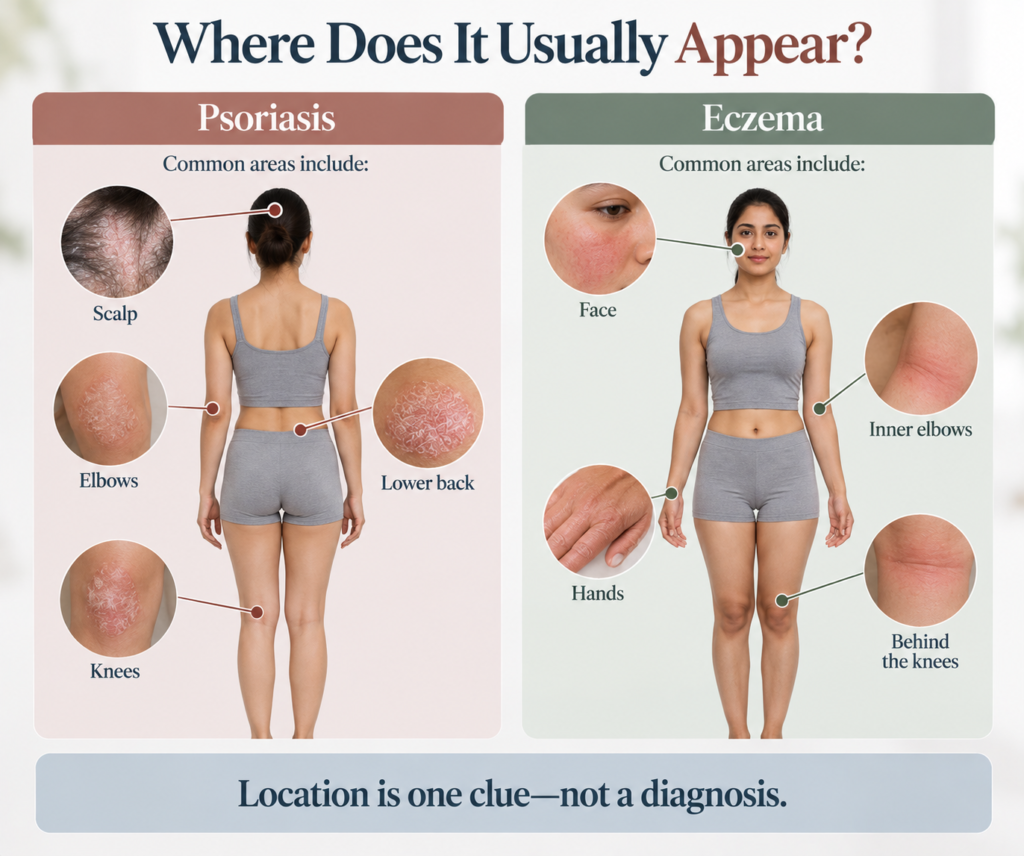
Where Does Psoriasis Usually Appear?
Psoriasis can affect different parts of the body depending on its type.
Common areas include:
- Elbows
- Knees
- Scalp
- Trunk
- Nails
- Other areas of the skin
The affected patches are often thicker and more clearly defined than the surrounding skin.
However, location alone cannot establish the diagnosis.
Where Does Eczema Usually Appear?
Eczema can occur in different locations depending on the type of eczema and the person’s age.
Atopic dermatitis commonly affects areas such as:
- Skin folds
- Hands
- Face
- Neck
- Arms
- Legs
The distribution can change over time.
With atopic dermatitis, itching can be particularly important. In some people, significant itching may occur before the visible rash becomes obvious.
Is Psoriasis More Scaly Than Eczema?
Psoriasis commonly produces thickened plaques with visible scale. On lighter skin, the scale may have a silvery-white appearance.
Eczema can also become dry and scaly, but prominent itching and inflammation are often part of the picture.
Scaling alone cannot tell you that a rash is psoriasis. Fungal infections, contact dermatitis and other skin conditions can also produce scaling.
A dermatologist considers the complete pattern rather than relying on one symptom.
Why Are Psoriasis and Eczema Sometimes Confused?
Both conditions can cause:
- Itching
- Dryness
- Inflammation
- Scaling
- Thickened skin
- Recurring flare-ups
- Changes in skin colour after inflammation
The overlap can make self-diagnosis difficult.
The distinction can be particularly challenging when the rash does not have a typical appearance or when several skin conditions are present at the same time.
Can You Have Both Psoriasis and Eczema?
Yes.
A person can have both psoriasis and eczema. Having one condition does not automatically rule out the other.
If a recurring rash does not behave as expected or continues despite treatment, a dermatologist can review the symptoms and examine the affected areas rather than assuming that every flare has the same cause.
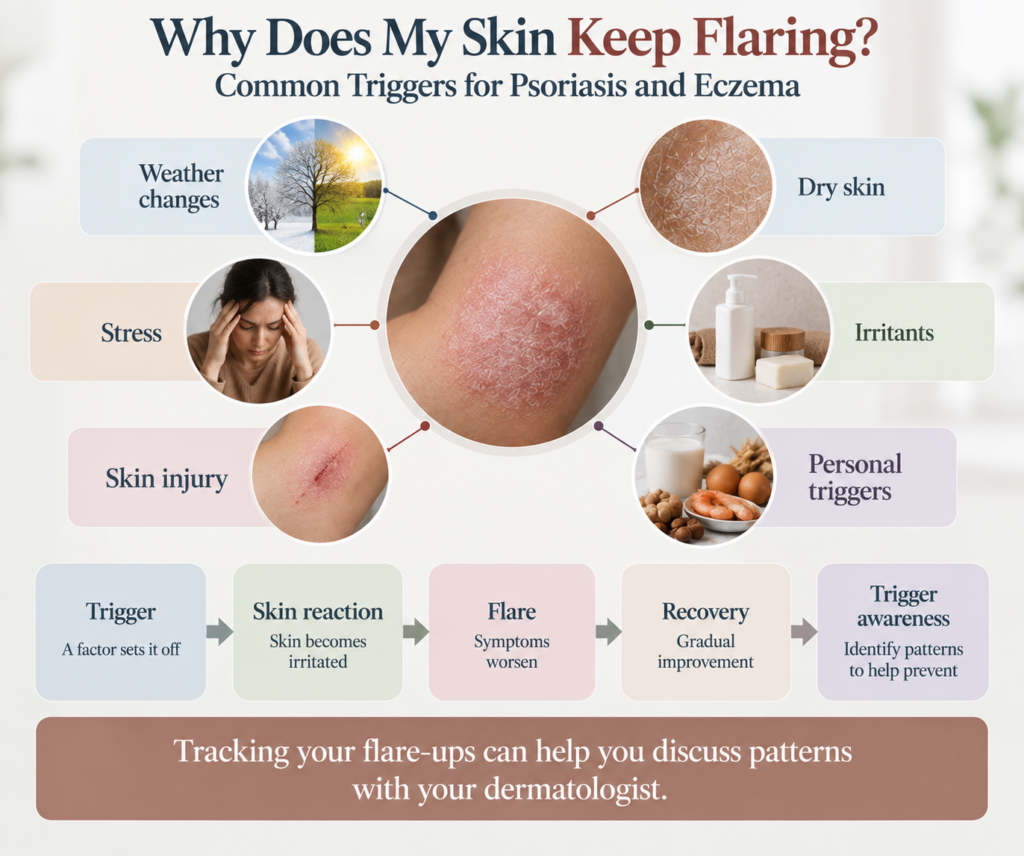
What Can Trigger or Worsen Symptoms?
Triggers vary between individuals and depend on the condition.
For eczema, possible aggravating factors include:
- Irritating skincare products
- Certain soaps or detergents
- Dry environments
- Heat or sweating
- Scratching
- Individual allergens or irritants
For psoriasis, flare-ups may be associated with factors such as illness, stress and other individual triggers. During a psoriasis assessment, a dermatologist may ask about recent illness, stress and family history.
Keeping track of when your symptoms appear or become worse can be useful during a consultation.
Are Psoriasis and Eczema Contagious?
No.
Psoriasis is not contagious, and eczema is not something you catch from another person.
You cannot develop either condition simply by touching someone who has it.
If a rash has not yet been diagnosed, however, it is important not to assume that every itchy or scaly rash is eczema or psoriasis. Some infections can resemble these conditions and require different treatment.
When Should You See a Dermatologist?
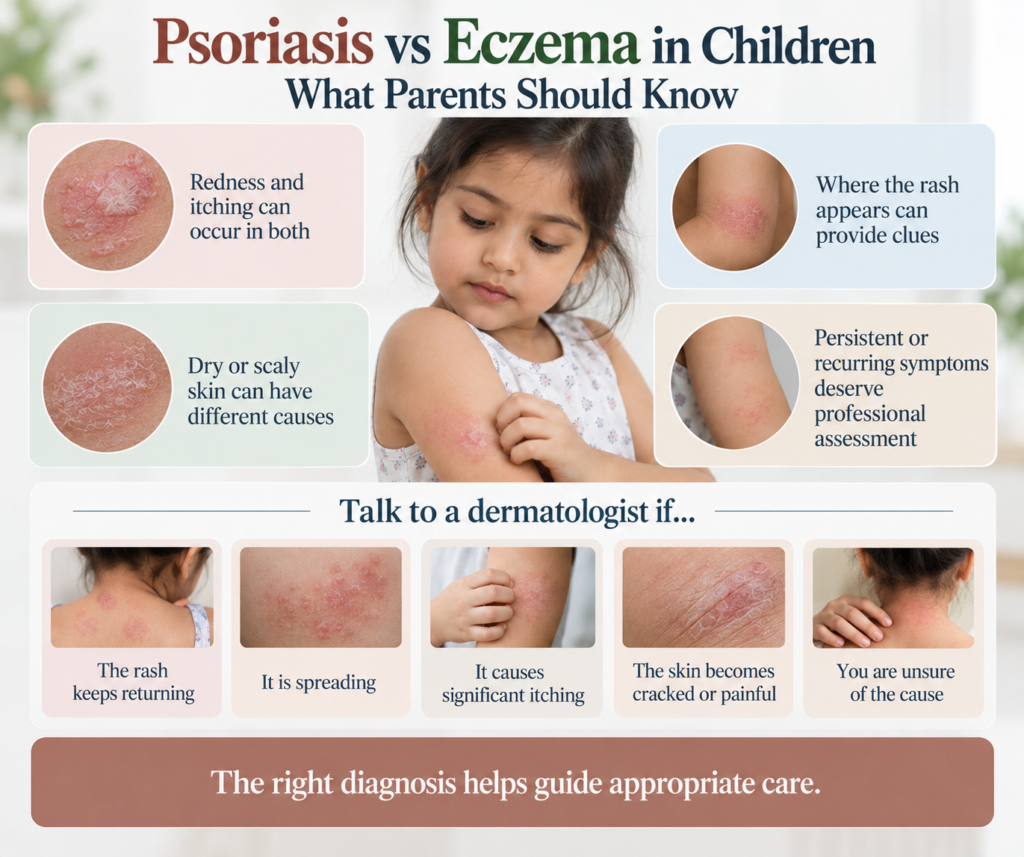
Consider arranging a dermatology consultation if you have:
- A rash that keeps returning
- Persistent itching
- Thick or increasingly scaly patches
- Inflammation that does not settle
- Cracking, oozing or significant irritation
- Symptoms affecting sleep or daily activities
- Scalp or nail changes along with skin symptoms
- A rash that repeatedly worsens despite home care
- Uncertainty about whether the problem is eczema, psoriasis, an infection or another skin condition
Medical attention is also appropriate when a skin condition is rapidly worsening, becomes very painful, develops extensive blistering or occurs with symptoms suggesting a serious allergic or systemic reaction.
How Does a Dermatologist Diagnose Psoriasis or Eczema?
Diagnosis usually begins with your medical history and an examination of the skin.
A dermatologist may consider:
- Where the rash occurs
- How long it has been present
- Whether it comes and goes
- How much it itches
- What the affected skin looks and feels like
- Previous skin problems
- Family history
- Current medicines
- Possible triggers
- Nail or joint symptoms
For psoriasis, the dermatologist may examine the skin, scalp and nails. A small skin biopsy may sometimes be used when the diagnosis is uncertain.
Eczema is also diagnosed largely through the clinical pattern and medical history.
There is no reliable home test based on one symptom that can distinguish psoriasis from eczema in every case.
Why Does the Diagnosis Matter Before Treatment?
Psoriasis and eczema are different conditions, so treatment needs to match the diagnosis.
Psoriasis treatment can include topical medicines, phototherapy or medicines that work throughout the body, depending on the type and severity.
Eczema management may involve regular moisturising, avoiding identified irritants and prescription treatment when necessary.
Using a product simply because it helped someone else may not be appropriate for your skin. A different condition can produce a similar-looking rash and require a different approach.
General Treatment Approaches for Psoriasis
There is no single treatment that is suitable for everyone with psoriasis.
Depending on the type and severity, a dermatologist may consider:
- Topical medicines
- Skin-care and moisturising measures
- Phototherapy
- Systemic medicines
- Biologic medicines for selected patients
- Management of associated symptoms or conditions
The choice can depend on the type of psoriasis, areas affected, severity, other medical conditions and medicines being taken.
General Treatment Approaches for Eczema
Eczema management also varies from person to person.
Depending on the type and severity, treatment may include:
- Regular moisturising
- Avoidance of identified irritants or triggers
- Prescription topical medicines
- Other medicines when clinically appropriate
- Measures to manage itching
- Ongoing skin-barrier care
The treatment plan depends on the type of eczema and the individual’s symptoms.
Can Home Remedies Treat Psoriasis or Eczema?
Basic skin care can be useful for many people, but home remedies should not replace a diagnosis when symptoms are persistent or recurrent.
Applying multiple oils, creams, exfoliants or anti-rash products without knowing the cause can make it harder to identify what is actually affecting the skin.
If a rash keeps returning, becomes more extensive or does not respond to your usual skin care, professional assessment is worth considering.
Why Can Self-Diagnosis Be Misleading?
A photograph may show the colour, scaling or location of a rash, but it does not provide the complete clinical history.
Psoriasis can resemble eczema. Fungal infections, contact dermatitis and other inflammatory skin conditions can also produce itching and scaling.
A dermatologist can assess the pattern and decide whether additional examination or testing is needed.
This is especially relevant when symptoms have continued despite treatment or repeatedly return.
What Should You Ask During a Dermatology Consultation?
If you are unsure whether your symptoms are related to psoriasis, eczema or another skin condition, consider asking:
- What does the examination suggest?
- Could another skin condition look similar?
- Do I need any additional testing?
- What might be triggering or worsening the symptoms?
- What treatment options are appropriate for this diagnosis?
- How should I care for my skin between flare-ups?
- How long should I use the recommended treatment?
- What side effects should I watch for?
- When should I return for follow-up?
- Which symptoms would require earlier medical attention?
These questions can help you understand why a particular treatment has been recommended.
Dermatology Consultation in Mysore
If recurring itching, scaling or inflamed skin is affecting your daily comfort, a dermatologist can assess whether the pattern is consistent with psoriasis, eczema or another skin condition.
The supplied clinic information states that APTA Clinic provides dermatology services in Mysuru and lists locations in Krishnamurthy Puram and Vijayanagar, Mysore.
The source also lists the clinic’s published phone number as +91 7411 707 555.
For current doctors, services, timings and appointment availability, verify the information directly with the clinic before publishing.
Book a Dermatology Consultation
Psoriasis and eczema can look similar, but they are different conditions.
The location of the rash, degree of itching, appearance of scaling and pattern of recurrence can all provide useful clues. They do not always establish the diagnosis by themselves.
If you have recurring dry, itchy, inflamed or scaly skin, discussing it with a dermatologist can help clarify what is causing the symptoms and whether further evaluation is necessary.
Frequently Asked Questions (FAQs)
Psoriasis commonly causes well-defined, thickened or raised patches with scale. Eczema, particularly atopic dermatitis, is often associated with dry, inflamed skin and significant itching. However, the two conditions can overlap, so symptoms alone cannot always establish the diagnosis.
Both conditions can itch. Eczema, especially atopic dermatitis, is often associated with intense itching, while the severity of itching in psoriasis varies between individuals.
Yes. Both conditions can appear differently depending on skin tone. Psoriasis may appear violet, dark brown or less obviously red on darker skin, while eczema can also produce brown, purple or grey areas.
Eczema can occur in different locations. Atopic dermatitis commonly affects areas such as the skin folds, hands, face, neck, arms and legs, depending on the individual’s age and disease pattern.
Not always. Psoriasis can often be diagnosed through a clinical examination. If the diagnosis is uncertain, a dermatologist may sometimes recommend a skin biopsy.
Psoriasis is a chronic condition, and its course varies between individuals. Treatment focuses on controlling symptoms and disease activity. A universal permanent cure should not be promised.
Potential aggravating factors vary. Illness, stress and individual triggers may contribute to flare-ups. A dermatologist may ask about these factors during assessment.
For persistent or recurring symptoms, it is better to establish the likely cause rather than repeatedly trying different products. Some rashes have causes other than psoriasis or eczema and may require different management.
Dermatology services for skin conditions are available in Mysuru. The supplied clinic information states that APTA Clinic provides dermatology services and lists locations in Krishnamurthy Puram and Vijayanagar.
Be ready to explain when the symptoms started, where they first appeared, whether they come and go, what makes them better or worse, which products or medicines you have already tried, and whether you have experienced similar episodes previously.