
How to Choose the Right Dermatologist for Your Skin Concern
- Home
- Blog
- About Us
Searching for the best dermatologist in Mysore can give you a long list of clinics, doctors, reviews and treatment advertisements. That can make the choice harder, especially when several practitioners appear to offer similar services.
A more useful approach is to look at whether the dermatologist is qualified to evaluate your particular concern, how they approach diagnosis, what treatment options they provide and whether they explain the expected benefits and risks clearly.
A dermatologist is a medical doctor who specialises in conditions affecting the skin, hair and nails. Dermatology training covers the diagnosis and management of a wide range of medical skin conditions as well as relevant procedures.
If you are choosing a dermatologist in Mysore, these are the factors worth checking before you book an appointment.

Check the Dermatologist's Medical Qualifications
Start with the doctor’s medical education and dermatology qualification.
In India, postgraduate training in Dermatology, Venereology and Leprosy is a recognised specialist pathway. The National Medical Commission’s postgraduate curriculum covers clinical assessment, diagnosis, investigations, treatment and procedural skills in dermatology.
When checking a dermatologist’s profile, look for information such as:
- Medical degree
- Postgraduate qualification in dermatology
- Additional fellowship or specialist training, where relevant
- Professional registration
- Current clinical role
A title such as “skin expert” or “skin specialist” does not tell you what medical training a practitioner has. Look for the actual qualification.
Check Whether They Treat Your Particular Concern
Dermatology covers many different conditions.
The dermatologist you choose should be comfortable evaluating the problem you actually have. For example, the considerations may differ for:
- Acne and acne scars
- Pigmentation problems
- Psoriasis or eczema
- Persistent rashes
- Skin infections
- Hair loss
- Scalp conditions
- Nail disorders
- Changing moles or skin growths
- Cosmetic skin concerns
You do not necessarily need to find someone who focuses exclusively on your condition. What matters is whether your concern falls within their clinical practice and whether they can assess it appropriately.
Look at Relevant Clinical Experience
Years of experience can be useful information, but the number alone does not tell you whether a dermatologist is suitable for your concern.
Suppose you are dealing with persistent acne. You may want to know whether the dermatologist regularly manages acne and scarring.
If your concern is unexplained pigmentation, ask whether they evaluate pigmentary disorders.
For recurring itching or rashes, find out whether the dermatologist assesses inflammatory and allergic skin conditions.
The more relevant question is:
Does this dermatologist regularly evaluate problems like mine?
Make Sure the Consultation Includes Medical Assessment
Some skin problems are straightforward. Others need closer evaluation.
A rash, sudden hair loss, unusual pigmentation, persistent itching or a changing skin lesion can have several possible causes. A dermatologist’s role includes working out what may be causing the problem before deciding which treatment is appropriate.
This is particularly important when comparing a medical dermatology consultation with a general beauty or skincare service.
If you have an unexplained or persistent problem, diagnosis should be part of the consultation.
Find Out How the Diagnosis Will Be Established
Different skin conditions can produce similar symptoms.
Redness, scaling, itching, pigmentation changes and hair loss can occur for different reasons. Sometimes a clinical examination is enough. In other situations, a dermatologist may recommend additional investigations.
Depending on the condition, these may include:
- Laboratory investigations
- Skin sampling or biopsy
- Microscopic examination
- Other diagnostic procedures
The NMC’s dermatology curriculum includes clinical diagnosis and the use and interpretation of relevant investigations as part of specialist training.
A useful question during your appointment is:
“What do you think is causing my skin problem, and how will we confirm it?”
Pay Attention to the Consultation Itself
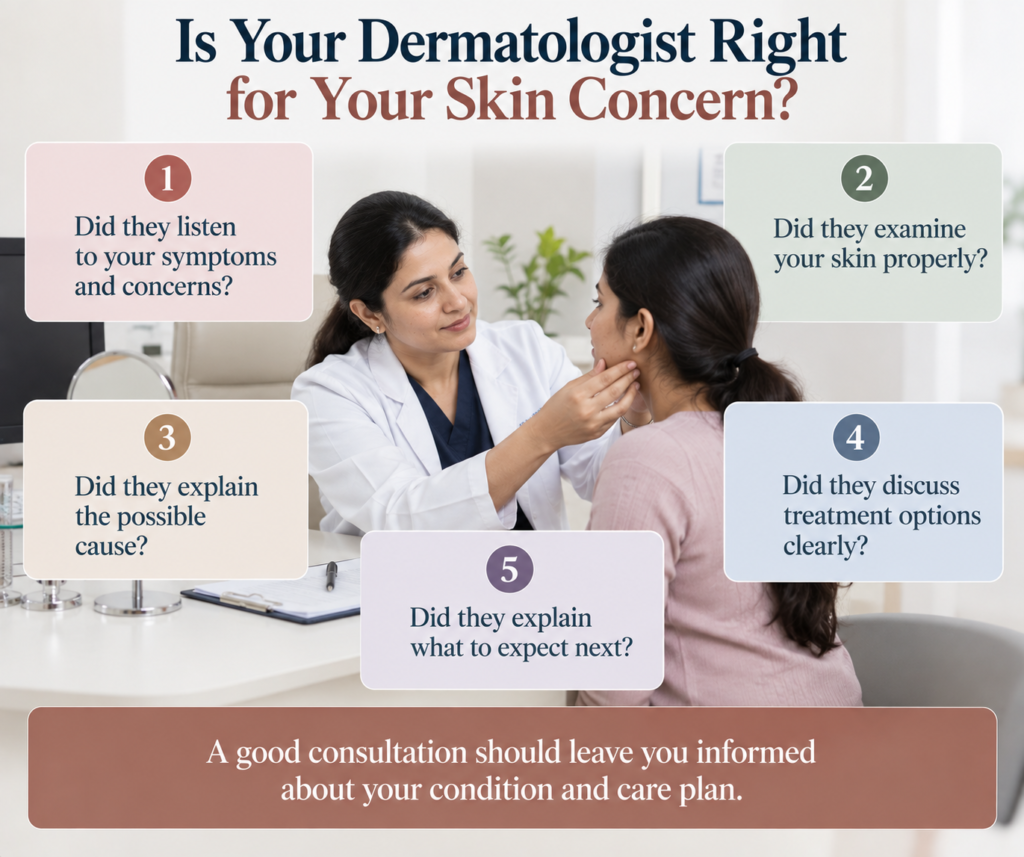
Your first consultation can tell you a lot about how the dermatologist approaches patient care.
The doctor may ask when your problem started, how it has changed and what treatments you have already tried. They may also ask about:
- Current medicines
- Allergies
- Previous diagnoses
- Other medical conditions
- Family history
- Skincare products
- Previous investigations
The dermatologist should then examine the affected skin, hair or nails and explain the next step.
The American Academy of Dermatology recommends preparing your medical history, medication list, relevant test results and questions before a dermatology appointment.
Ask About Treatment Options and Alternatives
Once the likely diagnosis has been established, ask what treatment options are available.
Depending on your condition, dermatological treatment may involve:
- Prescription medicines
- Topical treatments
- Skin-care measures
- Phototherapy or other light-based treatments
- Procedures
- Hair or scalp treatments
- Cosmetic dermatology procedures
The appropriate treatment depends on the diagnosis and your individual circumstances.
You can ask:
- Why are you recommending this treatment?
- Are there alternatives?
- What benefits can I reasonably expect?
- What are the possible side effects?
- How long might treatment take?
- What happens if the treatment does not work as expected?
A good explanation is more useful than a promise of a particular result.
Is Psoriasis More Scaly Than Eczema?
Psoriasis commonly produces thickened plaques with visible scale. On lighter skin, the scale may have a silvery-white appearance.
Eczema can also become dry and scaly, but prominent itching and inflammation are often part of the picture.
Scaling alone cannot tell you that a rash is psoriasis. Fungal infections, contact dermatitis and other skin conditions can also produce scaling.
A dermatologist considers the complete pattern rather than relying on one symptom.

Ask About Follow-Up
Some skin conditions can be managed with a short course of treatment. Others require ongoing monitoring.
Before starting treatment, ask:
“When should my condition be reviewed?”
You can also ask:
- Will I need another appointment?
- How will improvement be assessed?
- When would the treatment be changed?
- What should I do if my symptoms become worse?
- Will I need maintenance treatment?
The answer will depend on the diagnosis and treatment plan. Be cautious about fixed timelines presented as though they apply to every patient.
Check Whether the Clinic Provides the Care You Need
The clinic itself matters.
Before booking, check whether it:
- Provides medical dermatology services
- Has appropriately qualified dermatology professionals
- Clearly explains its services
- Provides a consultation before treatment
- Has suitable facilities for the treatments it offers
- Explains risks and aftercare
- Provides a way to contact the clinic
- Offers follow-up where appropriate
A clinic offering many procedures is not automatically the right choice for every skin problem.
The relevant question is whether the clinic can provide appropriate care for your particular concern.
Be Careful With Guaranteed Results
Dermatological and cosmetic treatments do not produce identical results for everyone.
The outcome can depend on the diagnosis, skin type, medical history, treatment selected and individual response.
Be cautious about promises such as:
- Guaranteed results
- Zero-risk treatment
- Permanent results for every patient
- Complete removal of a condition
- The same number of sessions for everyone
- A fixed result regardless of diagnosis
A responsible consultation should explain what treatment may achieve as well as its limitations and potential risks.
Know the Difference Between a Dermatologist and a Skin or Beauty Practitioner
The term “skin specialist” is used broadly in advertising.
A dermatologist is a medical doctor specialising in diagnosing and treating conditions affecting the skin, hair and nails. Other skincare or beauty professionals may provide cosmetic services, but their education and scope of practice can be different.
This distinction becomes especially important when you have an unexplained medical problem.
For persistent rashes, unusual pigmentation, significant acne, recurring infections, unexplained hair loss or changing skin lesions, look for a medically qualified professional who can evaluate the underlying problem.
Prepare Before Your Dermatology Appointment
A little preparation can make the consultation more useful.
Take:
- A list of your current medicines
- Vitamins and supplements
- Details of known allergies
- Previous prescriptions
- Relevant laboratory reports
- Biopsy or scan reports, where applicable
- Information about previous skin treatments
- A list of questions
If your symptoms come and go, photographs from an earlier flare can also help show how the condition has changed.
The American Academy of Dermatology recommends bringing medication information, medical history, relevant test results and questions to a dermatology appointment.
How Should You Compare Dermatologists in Mysore?
When comparing dermatologists, you can use a simple checklist rather than relying on one rating or review.
| What to check | Why it matters |
|---|---|
|
Medical qualification |
Confirms relevant medical training |
|
Dermatology training |
Shows specialist education in the field |
|
Experience with your concern |
Helps establish whether your problem is within the doctor’s clinical practice |
|
Diagnostic approach |
Shows how the cause of your problem will be assessed |
|
Treatment options |
Helps you understand what approaches may be available |
Online reviews can provide information about other patients’ experiences, but they are only one source of information. Medical qualifications, clinical suitability and the consultation itself also deserve attention.
Ask Who Will Actually Perform Your Treatment
This is particularly important if your consultation leads to a procedure.
Before agreeing to treatment, ask:
- Who will perform the procedure?
- What are their qualifications?
- Is the procedure performed by the dermatologist or another practitioner?
- Where will it be performed?
- What aftercare is provided?
- What should you do if you experience a complication?
Knowing who is responsible for your care helps avoid confusion later.

Understand the Cost Before Starting Treatment
Cost can be an important practical consideration, particularly when treatment involves multiple sessions or ongoing medication.
Ask what the quoted amount includes.
Depending on the treatment, costs may involve:
- Consultation
- Diagnostic tests
- Medicines
- Procedures
- Follow-up visits
- Additional sessions
- Aftercare
Do not choose a dermatologist solely because the initial price is lower. At the same time, a higher price by itself does not establish better medical care.
Ask for a clear explanation of the expected costs before starting treatment.
Questions to Ask Before Choosing a Dermatologist
You can save these questions on your phone before your appointment:
- What are your qualifications in dermatology?
- Do you regularly treat my particular skin concern?
- How will you determine the diagnosis?
- Could another condition be causing these symptoms?
- Do I need any tests?
- What treatment options are available?
- Are there alternatives?
- What are the possible risks and side effects?
- How long might treatment take?
- Will I need follow-up appointments?
- What should I do if my symptoms become worse?
- Who will perform any procedure?
- What is included in the treatment cost?
- Is the treatment medical, cosmetic or both?
These questions move the conversation away from advertising claims and towards the actual care being offered.
What Does "Best Dermatologist in Mysore" Actually Mean?
The phrase “best dermatologist in Mysore” is commonly used when people search online, but there is no single dermatologist who is necessarily the right choice for every patient.
Someone with severe acne may look for experience managing acne and scarring.
Someone with persistent pigmentation may want a dermatologist who regularly evaluates pigmentary disorders.
Someone experiencing unexplained hair loss may need assessment of both the scalp and possible underlying causes.
So instead of asking only:
“Who is the best dermatologist in Mysore?”
a more useful question is:
“Which qualified dermatologist is appropriate for my particular concern?”
That gives you a practical basis for comparing your options.
Dermatology Care at APTA Clinic, Mysore
The supplied clinic information states that APTA Clinic is a multi-specialty clinic in Mysuru with dermatology among its listed services. It identifies Dr. Swathi Anand as a Dermatologist & Aesthetician and lists qualifications including MBBS, DDVL and Fellowship (RGUHS).
The same source lists APTA Clinic locations in Krishnamurthy Puram and Vijayanagar, Mysore, along with the published contact number +91 7411 707 555.
If you are considering APTA Clinic, the same questions discussed in this guide still apply. Check the dermatologist’s qualifications, explain your concern, ask how it will be assessed, discuss treatment options and understand the follow-up plan before proceeding.
Verify current doctor availability, clinic locations, timings and appointment details directly with APTA Clinic before publishing or visiting.
Final Takeaway
Choosing a dermatologist is a medical decision, so qualifications and suitability should come before promotional claims.
Start by checking the doctor’s dermatology training. Then consider whether they regularly manage your particular concern, how they approach diagnosis, what treatment options they can offer and how clearly they discuss risks and follow-up.
If you are looking for a dermatologist in Mysore, use the first consultation to understand your condition and the reasoning behind the recommended treatment.
Frequently Asked Questions (FAQs)
Rather than relying on a single ranking, compare dermatologists based on their medical qualifications, experience with your particular concern, diagnostic approach, treatment options, communication and follow-up.
Look for a medical degree followed by appropriate postgraduate dermatology training. You can also check additional fellowships or specialist training relevant to your concern. In India, postgraduate training in Dermatology, Venereology and Leprosy is a recognised specialist qualification pathway.
The term “skin specialist” can be used broadly. A dermatologist is a medically trained doctor who specialises in diagnosing and treating conditions affecting the skin, hair and nails.
No single factor should determine your choice. Experience is useful, but it is also important to consider whether the dermatologist regularly evaluates your particular concern and whether the consultation includes appropriate diagnosis and treatment planning.
That depends on your needs. If you have both medical and cosmetic concerns, it may be convenient to discuss them with the same dermatologist. The more important point is whether the doctor is appropriately qualified to assess the problem you have.
Reviews can provide information about patient experiences, but they should not be the only factor. Check qualifications, relevant experience, diagnostic approach and treatment information as well.
Fees vary between doctors and clinics. The current consultation fee at APTA Clinic should be confirmed directly with the clinic rather than relying on an older online figure.
Consider seeing a dermatologist when a skin problem persists, repeatedly returns, becomes painful or significantly itchy, spreads, leaves marks or scars, or does not improve with appropriate basic skincare.
The supplied clinic information identifies Dr. Swathi Anand as a Dermatologist & Aesthetician and lists dermatology among APTA Clinic’s services.
A dermatologist may manage multiple skin, hair and nail conditions. However, the appropriate expertise and treatment approach depend on the specific concern. Ask whether the dermatologist regularly evaluates the problem you want treated.