
Root Canal vs Tooth Extraction in Mysore
- Home
- Blog
- About Us
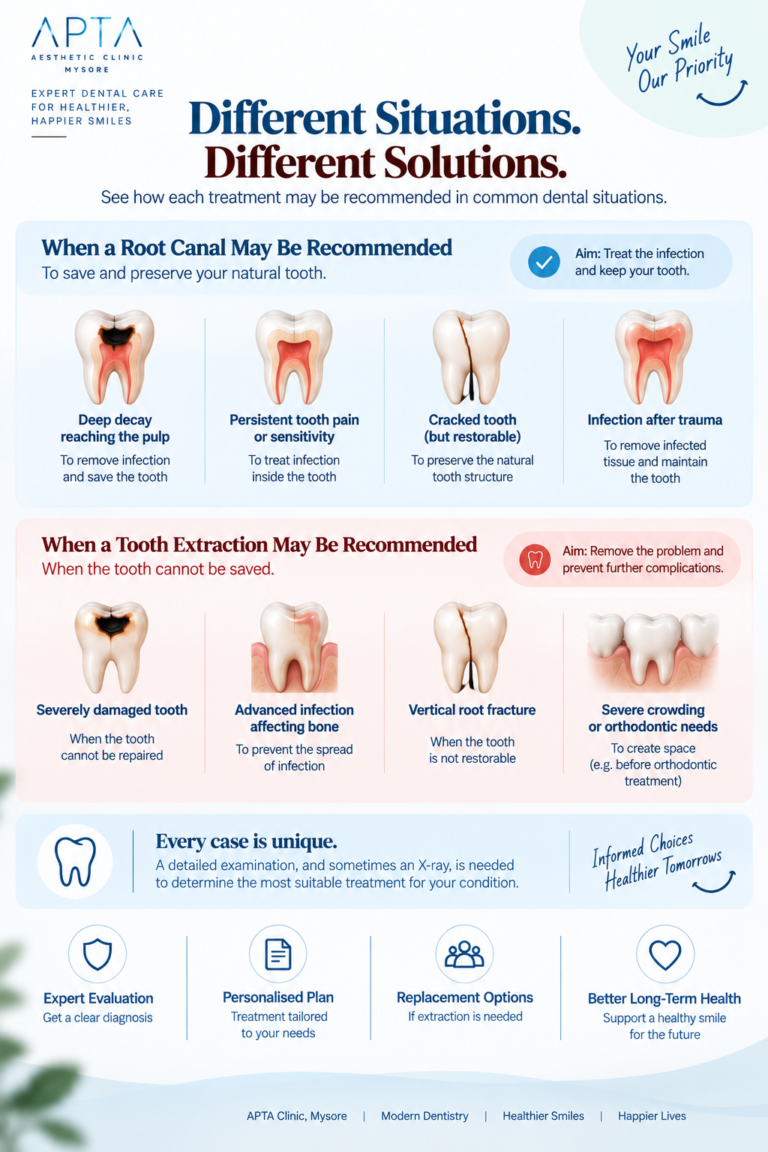
A tooth that is painful, infected or badly damaged may need more than a routine filling. Before recommending root canal treatment or extraction, a dentist examines the tooth and the surrounding tissues to understand the cause and extent of the problem.
The assessment may include:
- The amount of remaining tooth structure: The dentist considers whether enough healthy tooth remains to support a restoration.
- The condition of the tooth’s pulp: Infection or inflammation inside the tooth may make root canal treatment necessary.
- Cracks or fractures: The location and extent of a crack can affect whether the tooth can be retained.
- The supporting tissues: The health of the gums and bone around the tooth can influence the treatment plan.
- The tooth’s role in your bite: The dentist considers how the tooth contributes to chewing and how its removal may affect the surrounding teeth.
Dental examination and appropriate imaging help the dentist assess the available options. The recommendation should be based on the individual tooth rather than pain alone.
What Happens During Root Canal Treatment?
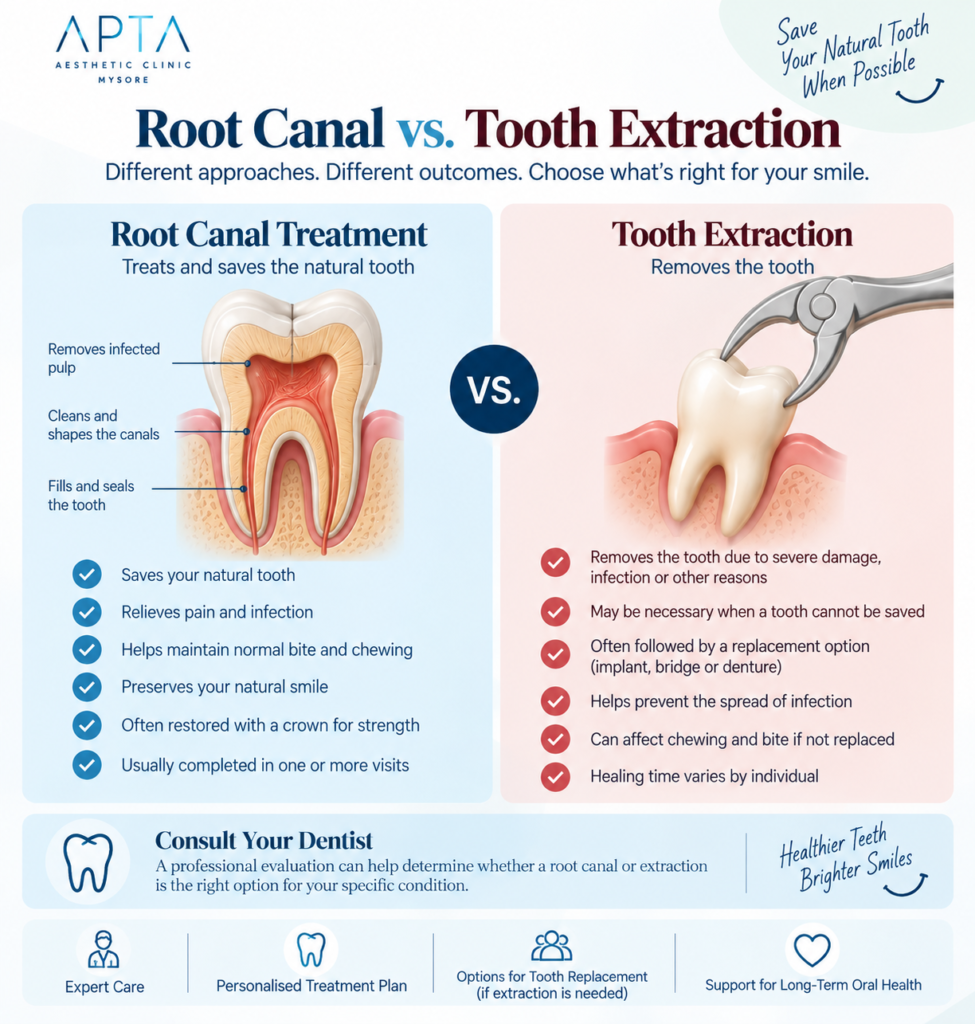
Root canal treatment is intended to treat infection or inflammation inside a tooth while retaining its natural structure.
During the procedure, the dentist accesses the inside of the tooth and removes the affected pulp tissue. The root canal system is then cleaned, disinfected, filled and sealed. The tooth may need a further restoration, such as a filling or crown, depending on how much tooth structure remains and the forces it must withstand.
The number of appointments and the type of final restoration depend on the tooth and the complexity of treatment. Your dentist can explain the expected steps, timeline and aftercare before treatment begins.
A root canal does not mean that the tooth needs no further attention. Completing the recommended restoration and attending follow-up appointments are important parts of the treatment plan.
What Should You Know About Tooth Extraction and Replacement?
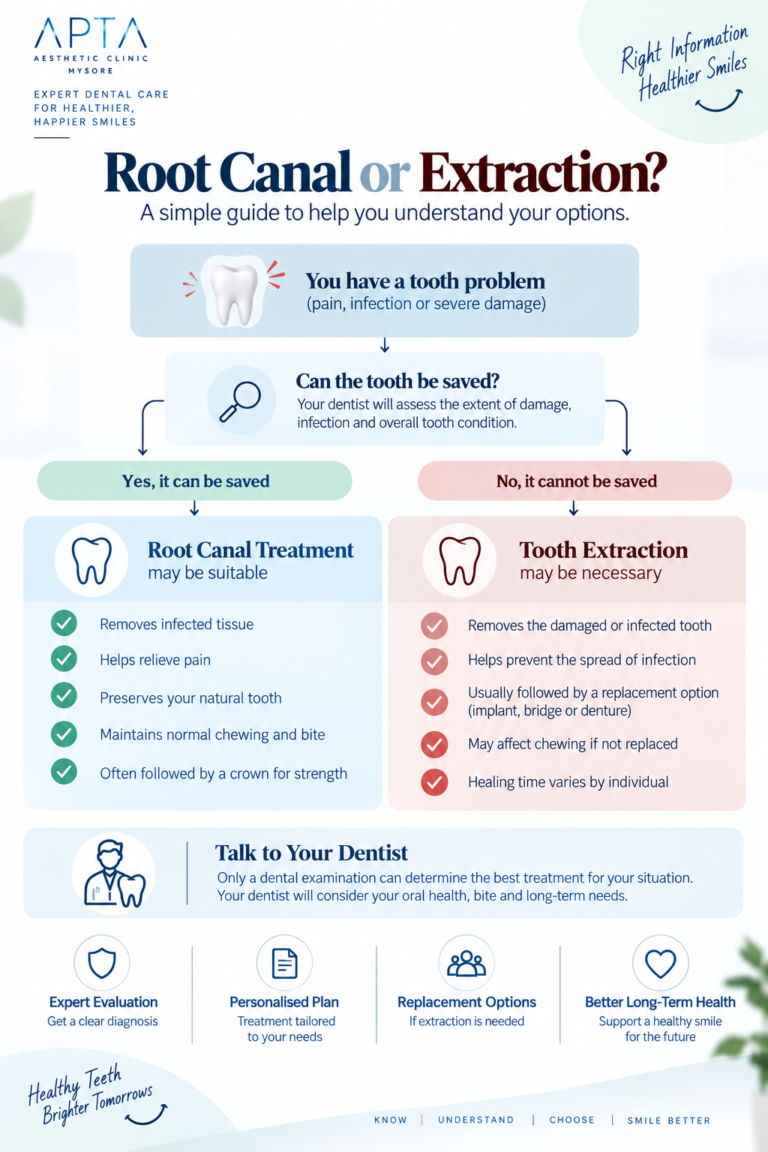
Tooth extraction involves removing a tooth from its socket. It may be recommended when the tooth cannot be predictably restored or when other clinical considerations make retaining it unsuitable.
After extraction, the space left by the missing tooth may need to be considered as part of your longer-term dental care. Depending on the location of the tooth and your individual needs, replacement options may include:
- Dental implant: A replacement tooth supported by an implant placed in the jawbone.
- Dental bridge: A fixed replacement that uses support from neighbouring teeth or other structures, depending on the treatment plan.
- Removable partial denture: A removable appliance designed to replace one or more missing teeth.
Not every missing tooth requires the same replacement approach. Your dentist can discuss whether replacement is recommended, which options may be suitable and whether additional procedures or appointments could be involved.
It is useful to discuss replacement before extraction so you understand the full treatment plan—not just the removal procedure.
Root Canal vs. Extraction: Understanding Recovery
Recovery varies according to the procedure, the condition of the tooth and the individual patient. Your dentist should give you instructions that match the treatment you receive.
After root canal treatment, the tooth or surrounding area may feel tender for a period while it settles. Follow the dentist’s advice about eating, oral hygiene, medication and completing the recommended restoration.
After an extraction, the socket needs time to heal. Your dentist will explain how to care for the area, what foods and activities to avoid temporarily, and how to manage discomfort. Follow the specific instructions provided rather than relying on general advice alone.
Contact your dental clinic if symptoms worsen, you develop significant swelling or you are concerned about your recovery. Seek urgent medical care if you experience difficulty breathing or swallowing, or rapidly spreading swelling.
What Factors Can Affect the Cost of Root Canal Treatment or Extraction?
The cost of dental treatment is individual, so it is not possible to determine which option will cost less without knowing the condition of the tooth and the treatment required.
Factors that may affect the overall cost include:
- Which tooth needs treatment and the complexity of the procedure.
- Whether root canal treatment is clinically suitable.
- Whether a filling, crown or another restoration is needed afterward.
- Whether extraction is straightforward or requires additional surgical care.
- Whether the extracted tooth should be replaced.
- Whether additional consultations, investigations or procedures are required.
When comparing estimates, ask for the complete treatment plan and clarify which stages are included. For extraction, ask whether the estimate covers only removal or also any recommended replacement. For root canal treatment, ask whether the final restoration is included.
A clear breakdown can help you compare the likely steps and costs without making a decision based on the initial procedure alone.
What Factors Can Affect the Outcome of Root Canal Treatment?
Root canal treatment is intended to remove infection from inside a tooth and help preserve it, but the result depends on the condition of the tooth and the treatment required. Before recommending this option, a dentist will consider whether the tooth can be restored and whether it has adequate support.
Factors that may influence the treatment plan include:
- Extent of damage: A tooth with extensive decay or a fracture may not have enough healthy structure remaining for a predictable restoration.
- Condition of the roots: The shape and condition of the root canals can affect how they can be cleaned, treated and sealed.
- Gum and bone support: The surrounding tissues need to provide suitable support for the tooth.
- Previous dental treatment: A tooth that has already undergone root canal treatment may need further assessment if symptoms or infection persist.
- Final restoration: After root canal treatment, the tooth needs an appropriate restoration to seal and protect it. Depending on the amount of remaining tooth structure, this may be a filling or a crown.
Your dentist can explain the expected benefits, limitations and possible need for additional treatment based on the examination findings.
Root Canal vs. Extraction: Understanding Recovery
Recovery varies according to the procedure, the condition of the tooth and the individual patient. Your dentist should give you instructions that match the treatment you receive.
After root canal treatment, the tooth or surrounding area may feel tender for a period while it settles. Follow the dentist’s advice about eating, oral hygiene, medication and completing the recommended restoration.
After an extraction, the socket needs time to heal. Your dentist will explain how to care for the area, what foods and activities to avoid temporarily, and how to manage discomfort. Follow the specific instructions provided rather than relying on general advice alone.
Contact your dental clinic if symptoms worsen, you develop significant swelling or you are concerned about your recovery. Seek urgent medical care if you experience difficulty breathing or swallowing, or rapidly spreading swelling.
What Are the Long-Term Considerations?
Choosing between root canal treatment and extraction involves more than the procedure itself. It is also important to consider how the tooth or the space left by its removal may affect your mouth over time.
If a tooth is retained after root canal treatment, it still needs routine oral hygiene and dental check-ups. The tooth can develop new decay or other problems, and the restoration may require maintenance or replacement.
If a tooth is extracted, you and your dentist can discuss whether the gap should be replaced. Options may include a dental implant, bridge or denture, depending on your oral health, the position of the missing tooth and your preferences. In some cases, leaving the space without replacement may also be discussed. Each option has its own requirements, benefits, limitations and costs.
Ask your dentist about the likely sequence of care, including any temporary restoration, follow-up visits or replacement treatment that may be relevant to your situation.
When Should You Seek Urgent Dental Advice?
Arrange a dental assessment promptly if you have persistent toothache, pain when biting, swelling around a tooth or a suspected dental infection. These symptoms can have different causes and need a professional examination.
Seek urgent care if you develop significant facial or neck swelling, difficulty swallowing or breathing, or swelling that is spreading rapidly. These may indicate a serious problem that requires immediate medical attention.
Avoid trying to decide between root canal treatment and extraction based only on pain intensity or advice from non-professional sources. A dentist can examine the tooth, assess the surrounding tissues and explain the options available.
Make an Informed Decision With Your Dentist
Before proceeding, consider asking:
- Can my tooth be restored, and what findings support that recommendation?
- What are the benefits and limitations of root canal treatment in my case?
- If extraction is recommended, why is saving the tooth not considered suitable?
- What restoration will be needed after root canal treatment?
- If the tooth is removed, what replacement options could be considered?
- How many appointments might be needed, and what follow-up care should I expect?
- What are the estimated costs of the treatment and any later restoration or replacement?
Understanding these points can help you compare the treatment pathways and make a decision with your dentist that takes your dental condition, priorities and preferences into account.
Can a Root Canal-Treated Tooth Become Infected Again?
Although root canal treatment is intended to remove infection from inside a tooth, problems can sometimes develop later. New decay, a damaged restoration or an inadequate seal may allow bacteria to reach the treated area. If you notice renewed pain, swelling, tenderness or discomfort when biting, arrange a dental assessment. Your dentist can examine the tooth and determine whether further treatment or a restoration repair may be needed.
After root canal treatment, the tooth still needs to be restored appropriately. The type of restoration depends on how much healthy tooth structure remains, the tooth’s location and the forces it experiences during chewing. Some teeth may be restored with a filling, while others may need a crown for additional coverage and support. Completing the recommended restoration and maintaining regular dental check-ups can help protect the treated tooth.
Does Tooth Extraction Always Mean You Need a Replacement?
Tooth pain alone cannot tell you whether root canal treatment or extraction is appropriate. A dentist may need to examine the tooth, assess the surrounding gums and supporting bone, and take dental X-rays when indicated. These findings help determine whether the tooth can be restored, whether infection or structural damage is present, and what treatment options may be available. A proper assessment helps you understand the reasoning behind the recommendation and discuss its benefits, limitations and alternatives.
Which Treatment May Be Suitable for You?
If the damage is limited and the tooth retains enough healthy structure, a filling may be sufficient. If the tooth is extensively damaged or weakened, a crown may be considered to cover and support it.
Your dentist may assess:
- The size, depth and location of the damaged area
- How much healthy tooth structure remains
- Whether the tooth is cracked or weakened
- The amount of pressure the tooth experiences during chewing
- Whether the tooth has previously received treatment
- Your oral health, symptoms and treatment preferences
Sometimes, other treatment may be needed before a filling or crown can be placed. For example, if decay has affected the inner pulp of the tooth, the dentist may discuss root canal treatment. A clinical examination is necessary to determine the appropriate approach.
Can You Eat Normally After Root Canal Treatment or Extraction?
Eating after dental treatment depends on the procedure, the healing process and your dentist’s instructions. After root canal treatment, your tooth may need a permanent restoration, so avoid putting excessive pressure on it until your dentist confirms it is ready for normal use. Following an extraction, choose foods that are easy to eat and avoid disturbing the healing socket. Your dentist can advise when to return to your usual diet and whether you should avoid particular foods temporarily.
How to Prepare for a Dental Consultation in Mysore
If you have tooth pain or have been advised to consider root canal treatment or extraction, preparing a few questions can make your consultation more useful.
Consider asking:
- What is causing the problem with my tooth?
- Can the tooth be restored, and what findings support that recommendation?
- Is root canal treatment an option in my case?
- If extraction is recommended, why is saving the tooth unsuitable?
- What restoration will be needed after root canal treatment?
- If the tooth is removed, should I consider replacing it?
- What are the expected stages, appointments and recovery instructions?
- What is included in the cost estimate, and could additional treatment be needed?
Bring any relevant dental records or previous X-rays if you have them. Tell the dentist about medications, allergies and relevant medical information so they can consider these when planning care.
Are Root Canal Treatment and Extraction the Only Options?
Not necessarily. The appropriate treatment depends on how deeply the tooth is affected and whether the pulp can still be preserved. In some cases of deep decay or pulp inflammation, a dentist may consider a pulp-preserving treatment rather than proceeding directly to a root canal. If the pulp is irreversibly damaged or infected, root canal treatment may be considered when the tooth is restorable. Extraction may be discussed if the tooth cannot be predictably repaired or has a poor prognosis. Your dentist can explain which options are relevant after examining the tooth.
What Happens If a Root Canal-Treated Tooth Needs Further Treatment?
A tooth that has received root canal treatment should still be monitored during routine dental visits. If symptoms return or the surrounding tissues do not heal as expected, your dentist may recommend further examination and imaging. Depending on the cause, options may include additional root canal treatment, a procedure involving the root tip, restoration repair or extraction. The right approach depends on the tooth’s condition and whether it can still be restored. Root canal treatment aims to treat infection and preserve the tooth, but no procedure can guarantee a particular outcome.
If You Choose Extraction, What Should You Discuss About Replacing the Tooth?
Before removing a tooth, ask whether leaving the space could affect your chewing, bite or plans for future dental treatment. If replacement is appropriate, your dentist may discuss options such as a dental implant, bridge or denture. Each has different treatment stages, maintenance requirements, suitability considerations and costs. For example, an implant involves treatment planning for placement in the jaw, while a bridge uses neighbouring teeth or other support according to its design. A denture is removable. Not every patient is suitable for every option, so the decision should be based on a clinical assessment and your preferences
Consult APTA Clinic in Mysore for Your Dental Concerns
Book a dental consultation with APTA Clinic in Mysore to discuss your tooth and understand which restorative treatment may be appropriate for your needs.
APTA Clinic contact details
- Krishnamurthy Puram, Mysore – 570004
- Vijayanagar, Mysore – 570030
- Phone: +91 7411 707 555
- Listed hours: Monday to Sunday, 10:30 AM–7:30 PM
Frequently Asked Questions (FAQs)
Neither option is automatically suitable for every tooth. Root canal treatment may be considered when the tooth can be treated and restored. Extraction may be recommended when the tooth cannot be predictably saved or other clinical factors make removal appropriate. A dentist can assess your tooth and explain the options.
Sometimes, but not always. The amount of remaining tooth structure, the presence and extent of fractures, and the condition of the supporting tissues can affect whether the tooth can be restored. An examination is needed to determine whether root canal treatment is a reasonable option.
Root canal treatment removes the affected pulp tissue from inside the tooth and cleans and seals the root canal system. It does not remove the tooth itself. The natural tooth remains in place and may need a suitable restoration afterward.
A crown may be recommended, particularly when the tooth has lost substantial structure or needs additional protection. Whether a crown or another restoration is appropriate depends on the tooth, the amount of remaining structure and the dentist’s assessment.
The effects depend on which tooth is missing and your individual dental situation. A gap can affect chewing or allow neighbouring teeth to shift in some cases. Ask your dentist whether replacement is recommended and what options may be appropriate for you.
Extraction removes the affected tooth, but it does not automatically address every possible issue in the surrounding area or replace the tooth’s function. Your dentist will assess the infection and explain any additional care or follow-up that may be needed.
A dentist needs to examine the tooth and may recommend imaging to identify the problem. Symptoms such as persistent pain or sensitivity can have different causes, so they do not confirm by themselves that a root canal is necessary.
APTA Clinic provides an appointment form and lists +91 7411 707 555 as its contact number. Its website lists dental services and locations in Mysore.
APTA Clinic lists locations in Krishnamurthy Puram and Vijayanagar, Mysore.