
Liposuction vs Tummy Tuck in Mysore: Which Procedure May Be Suitable for You?
- Home
- Blog
- About Us
If you are unhappy with the appearance of your abdomen, two procedures you may come across during your research are liposuction and tummy tuck surgery (abdominoplasty).
Although both can be used for abdominal body contouring, they address different concerns.
Liposuction primarily removes localized fat. A tummy tuck removes excess abdominal skin and, when appropriate, can also address separated or weakened abdominal muscles. The procedure considered during consultation depends on factors such as your anatomy, skin quality, amount of excess skin or fat, medical history and treatment goals.
For people researching liposuction vs tummy tuck in Mysore, the useful question is not which operation is better for everyone. It is which procedure, if any, addresses the particular concern you want treated.
The supplied APTA Clinic information identifies Dr. B. Akshata Kamath, MBBS, MS, MCh, as a Plastic & Reconstructive Surgeon and states that the clinic provides plastic surgery services in Mysuru.
Liposuction vs Tummy Tuck: What Is the Difference?
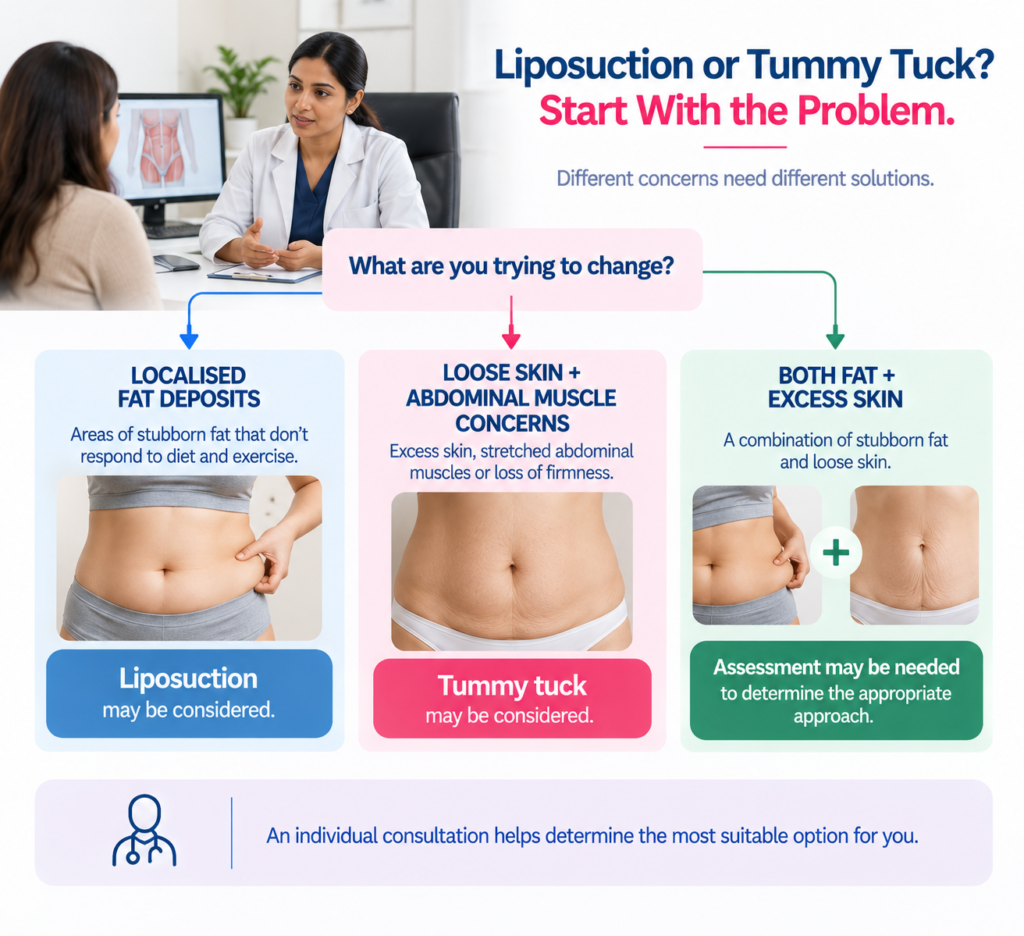
The basic difference comes down to what each operation is designed to address.
Liposuction removes localized fat deposits from selected areas.
Tummy tuck surgery, or abdominoplasty, removes excess abdominal skin and tissue and may address weakened or separated abdominal muscles when clinically appropriate.
ASPS describes liposuction as a procedure for removing localized fat deposits, while a tummy tuck can address excess skin and fat and restore weakened abdominal muscles.
This distinction matters because abdominal concerns can come from different things. A person may have localized fat, loose skin, changes in the abdominal wall, or several of these concerns together.
What Does Liposuction Do?
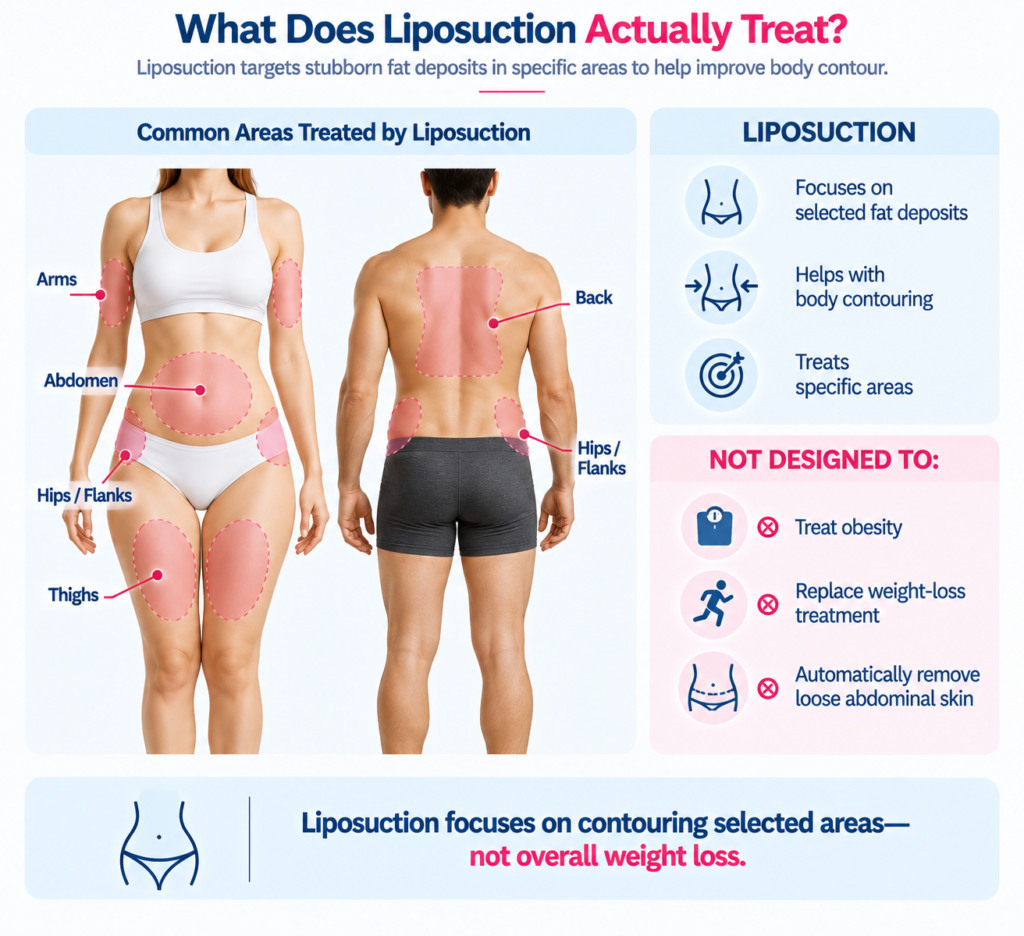
Liposuction uses suction to remove fat from specific areas.
It is a body-contouring procedure, not a general weight-loss treatment. The NHS describes it as a procedure for removing areas of fat that can be difficult to reduce through diet and exercise.
For abdominal contouring, liposuction may be discussed when localized fat is the main concern and the skin has enough elasticity to adapt after fat removal.
The supplied APTA information describes its liposuction service as targeting localized fat deposits and lists areas including the abdomen, thighs, arms, back and hips.
Liposuction may be considered when:
- Localized abdominal fat is the main concern
- There is fullness around the waist or hips
- The goal is body contouring
- The skin has reasonable elasticity
- There is no major amount of excess abdominal skin
These factors do not automatically make someone suitable for liposuction. An individual examination is still necessary.
What Does a Tummy Tuck Do?
A tummy tuck, or abdominoplasty, is a different type of abdominal body-contouring surgery.
It can remove excess abdominal skin and tissue. Depending on the patient’s anatomy and surgical plan, it may also involve repair or tightening of separated abdominal muscles.
A tummy tuck may therefore be discussed when the main concern includes:
- Excess abdominal skin
- Loose or stretched skin
- Changes in the abdominal wall
- Abdominal muscle separation when clinically present
- Excess skin combined with localized fat
A tummy tuck is not simply a more extensive version of liposuction. The two procedures address different anatomical concerns.
When May Liposuction Be Considered?
Liposuction may be discussed when localized fat is the main issue.
For example, someone may have a relatively stable weight but still have a localized area of abdominal fullness. If the skin has reasonable elasticity and there is little significant excess skin, the surgeon may consider liposuction as one possible approach.
The assessment also needs to consider:
- Skin quality
- Skin elasticity
- Fat distribution
- Abdominal anatomy
- Previous surgery
- Medical history
- Expectations
Liposuction does not remove significant loose skin. If excess skin is the main concern, another treatment may need to be considered. ASPS notes that liposuction does not address significant skin or muscle laxity.
When May a Tummy Tuck Be Considered?
A tummy tuck may be discussed when excess abdominal skin is a major part of the concern.
Loose skin can develop after significant weight loss, pregnancy or changes in body size. Some patients may also have abdominal muscle separation.
A tummy tuck can remove excess skin and may address weakened or separated abdominal muscles when appropriate.
Having loose skin does not automatically mean that a tummy tuck is necessary. Your surgeon needs to assess the extent of the concern and your overall health before recommending surgery.
What About Abdominal Muscle Separation?
This is an important distinction when comparing liposuction vs tummy tuck.
Liposuction removes fat beneath the skin. It does not repair separated abdominal muscles.
A tummy tuck may include tightening or repair of separated abdominal muscles when clinically appropriate.
If you notice abdominal bulging or changes after pregnancy or significant weight loss, an examination of the abdominal wall can help determine what is contributing to the appearance.
What Role Does Loose Skin Play?
Loose skin can change the treatment discussion considerably.
If the skin has good elasticity, it may adapt after localized fat is removed. When there is substantial excess skin, however, removing fat alone may leave the main concern unresolved.
A tummy tuck specifically involves removing excess abdominal skin.
During consultation, it is therefore useful to distinguish between fat that needs to be removed and skin that may need to be addressed.
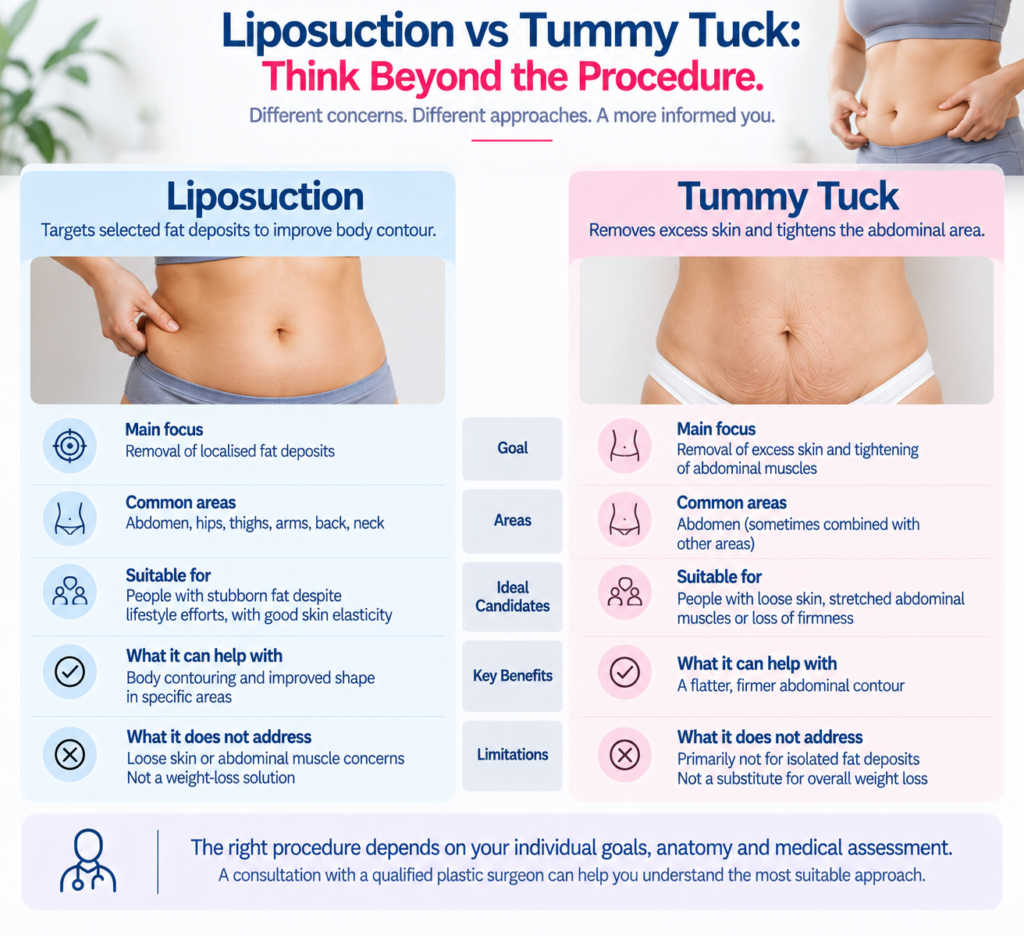
Liposuction vs Tummy Tuck: Key Differences
Consideration | Liposuction | Tummy Tuck |
Main purpose | Removes localized fat | Removes excess abdominal skin and tissue |
Localized fat | Directly targets selected fat deposits | May address some fat as part of the overall surgical plan |
Significant loose skin | Does not remove significant loose skin | Removes excess skin |
Abdominal muscle separation | Does not repair separated muscles | May include muscle repair when clinically appropriate |
Incisions | Usually uses smaller access points | Requires a larger abdominal incision |
Scarring | Small access scars may remain | A more extensive abdominal scar is expected |
Recovery | Depends on the extent and areas treated | Usually involves a more extensive surgical recovery |
Suitability | Depends on fat distribution, skin quality, health and goals | Depends on excess skin, abdominal anatomy, health and goals |
This is a general comparison. It is not a substitute for an examination or a patient-specific surgical recommendation.
What About Scarring?
Scarring is another difference to discuss.
Liposuction generally uses small access points through which the cannula is inserted. A tummy tuck requires a larger incision because excess skin needs to be removed.
The exact location, length and appearance of a scar depend on the surgical approach and individual healing.
Ask your surgeon:
- Where will the incision be?
- How long is the expected scar?
- What should I expect while it heals?
- How will the scar be managed after surgery?
Do not choose a procedure based solely on a promise about how a scar will look.
How Does Recovery Differ?
Recovery depends on the procedure, extent of treatment and individual healing.
Liposuction can involve swelling, bruising, discomfort and temporary changes in sensation. Activity is generally increased gradually according to the surgeon’s instructions.
A tummy tuck involves a larger surgical area and can require a more involved recovery. Swelling, discomfort and restrictions on physical activity are common during the early healing period.
There is no single recovery schedule that applies to every patient.
Before surgery, ask:
- How much time should I plan away from work?
- When can I drive?
- When can I walk normally?
- When can I exercise?
- What wound care will I need?
- How many follow-up appointments are expected?
- When should I expect swelling to reduce?
Your surgeon’s postoperative instructions should take priority over general recovery timelines found online.
What Are the Risks?
Both procedures involve surgery and therefore carry potential risks.
Possible liposuction risks
Depending on the procedure and patient, risks can include:
- Bleeding
- Infection
- Fluid accumulation
- Changes in sensation
- Irregular contours or asymmetry
- Blood clots
- Anaesthesia-related complications
- Poor wound healing
- Damage to deeper structures
- Need for revision surgery
ASPS lists these and other possible risks of liposuction and recommends discussing them directly with the plastic surgeon before consenting to treatment.
Possible tummy tuck risks
Potential complications can include:
- Bleeding
- Infection
- Fluid accumulation
- Wound-healing problems
- Changes in skin sensation
- Blood clots
- Anaesthesia-related complications
- Persistent pain
- Poor wound healing
- Unfavourable scarring
- Need for revision surgery
ASPS recommends discussing these risks and the possibility of complications before surgery.
Your individual risk profile may be different. During consultation, ask which risks are particularly relevant to you and what would happen if a complication occurred.
Can Liposuction and Tummy Tuck Be Combined?
In selected patients, liposuction and a tummy tuck may be performed as part of the same treatment plan.
Whether combining procedures is appropriate depends on factors such as:
- Overall health
- Abdominal anatomy
- Amount of excess skin
- Amount of fat
- Extent of surgery
- Treatment goals
- The surgeon’s assessment
ASPS notes that liposuction may sometimes be incorporated into a tummy tuck, depending on the patient’s needs.
The fact that two procedures can be combined does not mean that combining them is appropriate for every patient.
What If You Have Both Fat and Loose Skin?
This is where the decision becomes more individual.
A patient may have:
- Localized fat with good skin elasticity
- Localized fat with loose skin
- Excess skin with relatively little localized fat
- Excess skin, fat and abdominal muscle separation
These situations require different considerations.
Someone with localized fat and reasonable skin elasticity may be assessed for liposuction.
Someone with substantial excess skin may need to discuss abdominoplasty.
If abdominal muscle separation is present, the treatment plan may also need to address the abdominal wall.
Only an individual examination can determine which situation applies to you.
Does Weight Stability Matter?
Both procedures are forms of body contouring rather than substitutes for general weight management.
Significant changes in body weight after surgery can alter the body’s contour.
If you are planning substantial weight loss or your weight is still changing considerably, discuss the timing of surgery with your surgeon.
The appropriate timing depends on your individual circumstances.
How Does Pregnancy Affect the Decision?
Pregnancy can change abdominal skin, fat distribution and the abdominal wall.
Some people consider abdominal body-contouring surgery after pregnancy, particularly when concerns about loose skin or abdominal changes remain.
If you are planning another pregnancy, discuss this during your consultation. Future pregnancy can affect the abdominal tissues and the result of previous surgery.
Do not assume that a procedure marketed as a “mommy makeover” is appropriate simply because your concerns developed after pregnancy. The treatment plan should be based on your actual anatomy and goals.
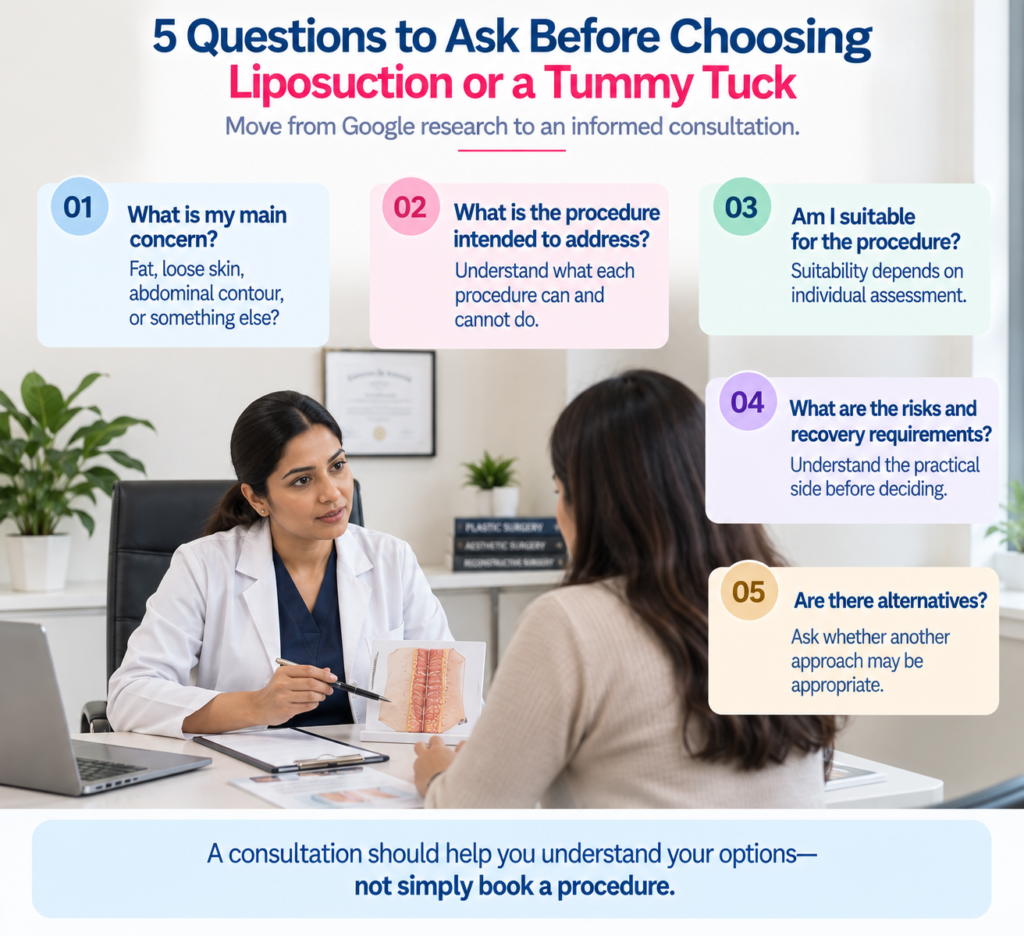
What Should You Discuss During a Consultation?
If you are comparing liposuction vs tummy tuck in Mysore, start by explaining the problem you want to address.
Useful questions include:
- Is my main concern fat, loose skin or both?
- How is my skin elasticity?
- Do I have abdominal muscle separation?
- Which procedure addresses my main concern?
- Are there alternatives?
- What can realistically be achieved?
- Where will the incisions be?
- What type of scarring should I expect?
- What risks apply to me?
- How long might recovery take?
- When can I return to work?
- When can I return to exercise?
- What follow-up care will I need?
- What does the quoted cost include?
- Could combining procedures be appropriate for me?
- What happens if I experience a complication?
A consultation should give you enough information to understand the proposed treatment rather than leaving you to choose based only on photographs or online advertisements.
Liposuction vs Tummy Tuck: Which Procedure May Be Suitable for You?
There is no universal answer.
Liposuction may be discussed when localized fat is the main concern and the skin has sufficient elasticity for the planned contour change.
A tummy tuck may be discussed when significant excess abdominal skin is a major concern and, where appropriate, abdominal muscle separation also needs to be addressed.
Some patients have more than one concern and may need a combination procedure or a different treatment approach.
The decision depends on your anatomy, medical history, skin quality, expectations and treatment goals.
Liposuction and Tummy Tuck at APTA Clinic in Mysore
The supplied APTA Clinic information describes the clinic as a multi-specialty clinic in Mysuru offering plastic surgery and other healthcare services. It identifies Dr. B. Akshata Kamath, MBBS, MS, MCh, as a Plastic & Reconstructive Surgeon.
The supplied information also states that the clinic has a dedicated liposuction service and lists body-contouring and mommy-makeover services among its plastic surgery pages.
If you are considering abdominal body contouring, a consultation can help determine whether your concern is mainly localized fat, excess skin, abdominal muscle separation or a combination of these factors.
Before You Decide
The starting point should be the concern you want to address.
If localized fat is the main concern, liposuction may be discussed.
If significant excess abdominal skin is the main concern, a tummy tuck may be considered.
If abdominal muscle separation is present, it needs to be assessed separately because liposuction does not repair separated muscles.
If you have several concerns, your surgeon may discuss a combined procedure or another treatment approach.
For patients researching liposuction vs tummy tuck in Mysore, an individual examination is more useful than selecting a procedure from an online comparison alone.
Medical Disclaimer
This article is intended for general educational purposes and does not replace an individual medical consultation. Suitability for liposuction, tummy tuck or combined procedures varies between patients. Risks, recovery and expected results also differ according to the individual and the procedure performed. A qualified plastic surgeon should assess your circumstances before treatment.
Frequently Asked Questions (FAQs)
Liposuction primarily removes localized fat deposits. A tummy tuck, or abdominoplasty, removes excess abdominal skin and tissue and may also involve tightening weakened or separated abdominal muscles when clinically appropriate.
A tummy tuck may be considered when excess abdominal skin is a significant concern. It can remove excess skin and may address weakened or separated abdominal muscles when clinically appropriate.
A tummy tuck removes excess skin and tissue and may include fat contouring as part of the overall surgical plan. The exact approach depends on the patient’s anatomy and treatment goals.
Pregnancy can change abdominal skin, fat distribution and the abdominal wall. If your concerns developed after pregnancy, discuss your pregnancy history and any plans for future pregnancy during consultation.
Potential risks can include bleeding, infection, fluid accumulation, wound-healing problems, changes in sensation, blood clots, anaesthesia-related complications, unfavourable scarring and possible revision surgery.
The supplied information lists Dr. B. Akshata Kamath, MBBS, MS, MCh, as a Plastic & Reconstructive Surgeon.
Ask what is causing the abdominal contour concern, which procedure is being recommended and why, whether alternatives exist, what results are realistic, what risks apply to you, how recovery will work, what scars to expect and what the complete treatment cost includes.
Insurance coverage depends on the reason for surgery and the terms of the individual policy. Elective cosmetic procedures are commonly treated differently from medically necessary or reconstructive procedures. Confirm coverage directly with your insurer.
There is no single price that applies to every patient. Cost depends on the procedure, extent of surgery, individual requirements, professional fees, anaesthesia, facility charges and other treatment-related factors. A patient-specific quotation should be discussed during consultation rather than assumed from an online price.
Start by identifying the concern you want treated. If localized fat is the main issue, liposuction may be discussed. If significant loose skin or abdominal muscle separation is present, a tummy tuck may be considered. An individual examination is needed before deciding.