Wart Removal in Mysore: Treatment Options, Recovery and Recurrence
- Home
- Blog
- About Us
A small, rough growth on your hand, foot or another part of your body may be a wart, but not every raised skin lesion is caused by a wart virus. Some warts disappear without treatment. Others persist, spread to nearby skin or become uncomfortable when walking or using your hands.
If you are considering wart removal in Mysore, the right treatment depends on the type of growth, its location, its size and whether previous treatments have worked. Options for confirmed warts may include topical medication, cryotherapy and selected minor procedures. Each has limitations, and no method guarantees that a wart will never return.
A skin assessment can help establish whether the growth is a wart and whether treatment is necessary. If you are considering APTA Clinic, confirm which wart assessment and treatment services are currently available before booking.
What Are Warts and Why Do They Develop?
Warts are non-cancerous skin growths associated with certain types of human papillomavirus (HPV). The virus can enter through small breaks in the skin and cause affected skin cells to grow more rapidly.
Warts commonly appear on the hands, fingers and feet, although they can develop elsewhere. Some spread through direct skin contact or contact with contaminated surfaces. Picking, scratching or shaving over a wart can also contribute to spreading it to nearby skin.
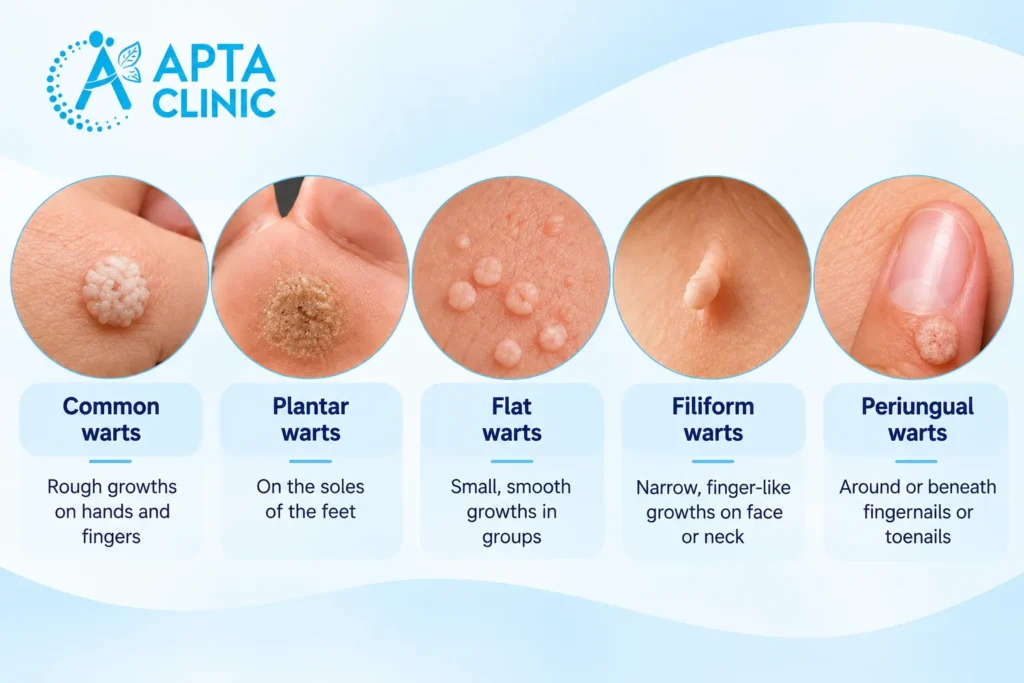
Common types of warts include:
- Common warts: Firm, rough growths that often appear on the hands and fingers.
- Plantar warts: Warts on the soles of the feet that may hurt when standing or walking.
- Flat warts: Smaller, flatter growths that can occur in groups.
- Filiform warts: Narrow, finger-like growths that often appear on the face or neck.
- Periungual warts: Growths around or beneath the fingernails or toenails.
The appearance of a growth alone may not be enough to identify it. Some other skin conditions can look similar to warts. If a lesion is changing, bleeding, painful or difficult to identify, seek a professional assessment rather than attempting to remove it yourself.
When Should You Seek Professional Wart Assessment?
Many warts are harmless, and treatment is not always necessary. Some disappear on their own, although this may take months or longer. Treatment may be considered when a wart is persistent, painful, spreading or causing concern about its appearance.
Arrange an assessment if a skin growth:
- Appears on your face or genital area.
- Is painful, itchy, burning or bleeding.
- Changes in size, colour, shape or appearance.
- Looks like an open sore or does not heal.
- Keeps returning after treatment.
- Spreads or appears in large numbers.
- Does not improve with appropriate treatment.
- Is difficult to distinguish from another skin condition.
People with diabetes, poor circulation, reduced sensation in the affected area or a weakened immune system should seek medical advice before trying home wart treatments. These factors can increase the risk of skin injury or complications.
Do not cut, burn or apply strong acids to an undiagnosed growth. A lesion that changes rapidly, repeatedly bleeds or fails to heal needs medical assessment.
Wart Removal Treatment Options Compared
Wart treatment is selected according to the type and location of the growth, its thickness and size, previous treatment results and the person’s health history.
The following options are used in general dermatological practice. Their inclusion here does not confirm that every procedure is available at APTA Clinic.
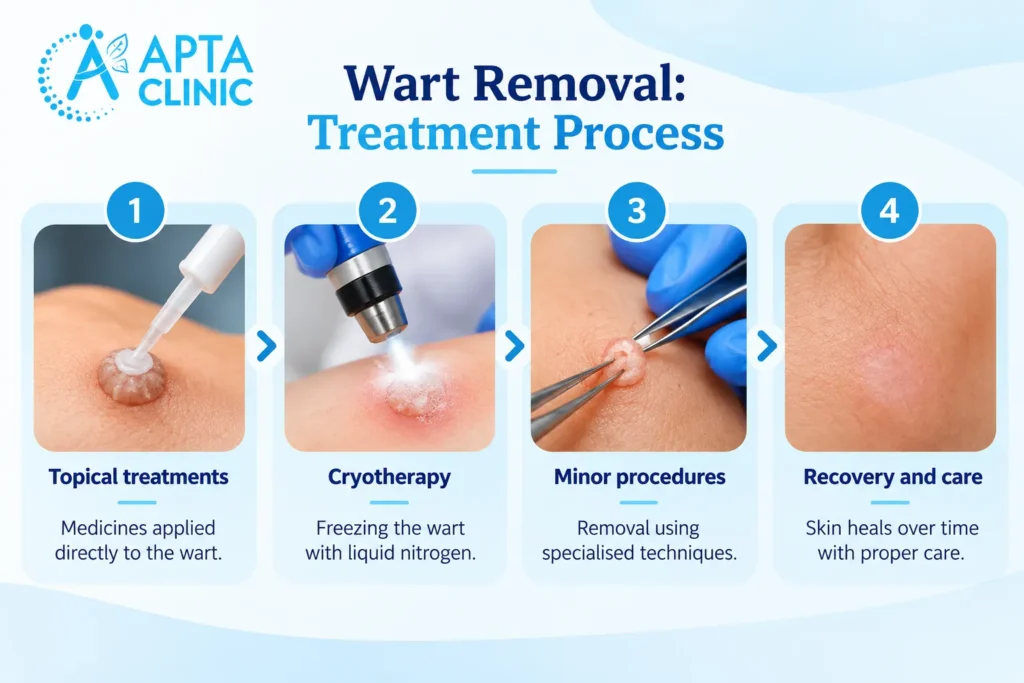
- Salicylic Acid and Other Topical Treatments
Salicylic acid is commonly used for selected non-genital warts. It gradually removes layers of thickened skin, so treatment usually requires consistent application over several weeks or longer.
Potential benefits
- May be suitable for certain common warts and plantar warts.
- Usually does not require a surgical procedure.
- Can be used at home when appropriate and according to product instructions or a clinician’s advice.
Limitations and precautions
- Improvement is gradual and may take weeks or longer.
- Surrounding skin can become irritated, sore or peel.
- It is not suitable for every wart or every body area.
- It should not be used on the face or genital area without specific professional guidance.
People with diabetes, poor circulation or reduced sensation should seek medical advice before starting acid-based wart treatment. Incorrect use can damage healthy skin.
- Cryotherapy (Freezing)
Cryotherapy uses extreme cold to destroy wart tissue. In a clinical setting, liquid nitrogen is commonly used. The treated area may blister or form a crust before healing.
Potential benefits
- May be considered for selected common, plantar and other non-genital warts.
- Is performed during a clinical visit.
- May be an option when topical treatment has not worked or is unsuitable.
Limitations and precautions
- The procedure can sting or hurt.
- Blistering, temporary changes in skin colour and occasional scarring may occur.
- More than one session may be needed.
- Suitability depends on the wart’s location and the patient’s skin and health history.
Cryotherapy does not guarantee permanent removal. Your clinician may recommend follow-up to assess the response and decide whether another session is appropriate.
- Electrosurgery and Curettage
Electrosurgery uses electrical energy to destroy tissue, while curettage involves scraping away the treated growth. A clinician may use these techniques together for selected warts.
Potential benefits
- May be considered for certain persistent or difficult-to-treat warts.
- Can remove visible wart tissue during a procedure.
Limitations and precautions
- Local anaesthesia may be needed.
- The treated area can become sore, swollen or discoloured.
- Bleeding, infection and scarring are possible.
- Appropriate wound care is necessary after treatment.
This approach is not automatically better than topical treatment or cryotherapy. A clinician should consider the location of the wart, the risk of scarring and previous treatment outcomes before recommending it.
- Surgical Excision
Excision means cutting out a growth after appropriate preparation and anaesthesia. It may be considered in selected cases when other approaches are unsuitable or further investigation is needed to establish the diagnosis.
Because excision creates a wound, it can leave a scar. Bleeding and infection are also possible. Removing the visible growth does not necessarily eliminate the virus from nearby skin, so recurrence can still occur.
Excision is not the first choice for every ordinary wart. A clinical assessment should guide the decision.
- Laser Treatment for Selected Warts
Laser treatment may be considered for certain persistent warts when other treatments have failed or are unsuitable. Its appropriateness depends on the lesion and the clinician’s assessment.
Possible side effects include discomfort, swelling, bleeding, changes in skin pigmentation and scarring. Some cases may require more than one session, and recovery depends on the treatment used.
Laser treatment is not necessary for every wart and cannot guarantee that it will not return. Confirm availability with the clinic before assuming it is an option.
Which Wart Treatment May Be Appropriate for You?
Different treatments suit different situations. The table below summarises some factors a clinician may consider.
Treatment | When it may be considered | Important limitation |
Topical salicylic acid | Selected common or plantar warts | Requires consistent use and can irritate surrounding skin |
Cryotherapy | Warts suitable for freezing | May cause blisters, discomfort or pigment changes |
Electrosurgery and curettage | Selected persistent warts | Requires a procedure and may leave a scar |
Excision | Selected lesions requiring removal or further assessment | Creates a wound and carries a risk of scarring |
Laser treatment | Selected difficult-to-treat warts | Suitability, availability, cost and recovery vary |
For example, a wart on the sole of the foot may need a different approach from a growth near the eye or around a fingernail. A clinician may also recommend observation when treatment is unnecessary.
During your consultation, ask why a particular treatment is being recommended, what alternatives are available, what side effects to expect and whether follow-up visits may be needed.
What Happens During a Wart Consultation?
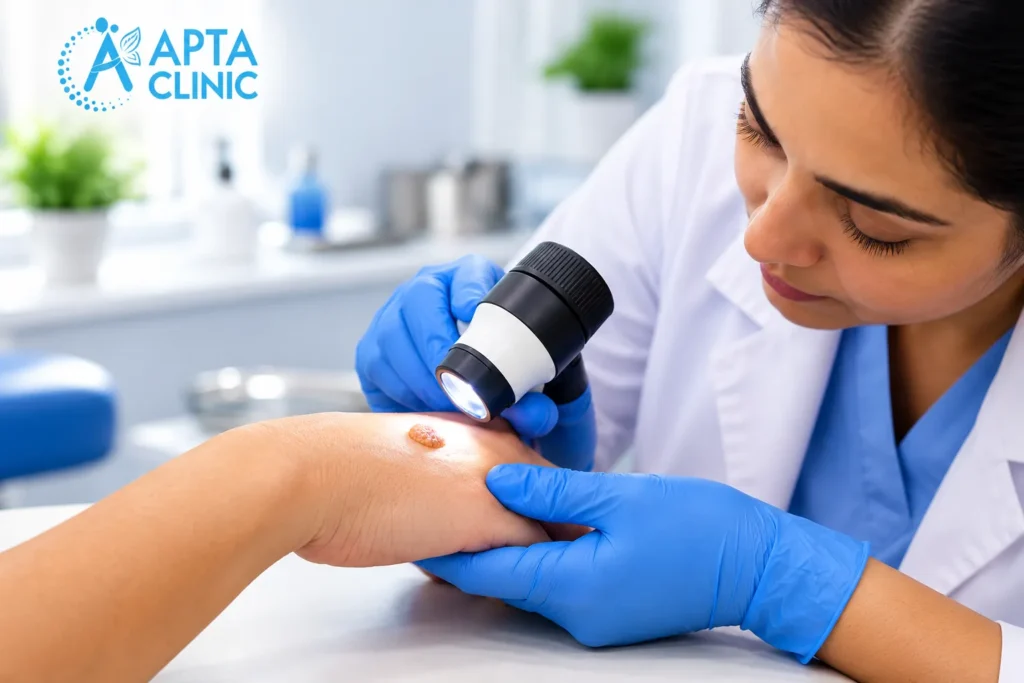
A consultation generally involves discussing the growth, examining the affected skin and deciding whether treatment or further evaluation is appropriate.
Step 1: Discuss your symptoms and history
Explain when you first noticed the growth, whether it has changed, whether it hurts or bleeds, and whether you have already tried any treatments. Mention relevant medical conditions, allergies and medicines.
Step 2: Examine the growth
The clinician assesses the lesion’s appearance, location, size and surrounding skin. Typical warts can often be identified through examination. If the growth looks unusual or the diagnosis remains uncertain, further assessment or a biopsy may be considered.
Step 3: Review the treatment options
If treatment is appropriate, ask about the expected benefits, limitations, risks, recovery and possibility of recurrence. The clinician should explain which options suit your particular situation.
Step 4: Plan treatment and follow-up
Some treatments require repeated sessions or ongoing topical care. Before proceeding, understand how to care for the area, when to return and which symptoms should prompt medical advice.
If you plan to contact APTA Clinic, ask whether it can assess your particular skin concern and which treatment options are currently available.
Recovery After Wart Removal
Recovery depends on the treatment used, the size and location of the wart and your overall health. Topical treatments may cause gradual peeling or irritation. Procedures can produce temporary soreness, blistering, crusting or swelling.
After treatment:
- Follow the clinician’s wound-care or medication instructions.
- Keep the treated area clean and protected as directed.
- Do not pick blisters, scabs or healing skin.
- Avoid applying unapproved acids, creams or home remedies to the treated area.
- Ask when it is safe to resume activities that put pressure or friction on the area.
- Attend follow-up appointments if advised.
Seek medical advice if you develop increasing pain, spreading redness, pus, fever, persistent bleeding or other concerning symptoms. Severe or rapidly worsening symptoms require prompt medical attention.
Some blistering or changes in skin colour can occur during healing, depending on the treatment. Your clinician can explain which changes are expected for your particular procedure.
Why Can Warts Come Back After Treatment?
A wart may recur because treatment removed the visible growth without completely clearing the infected skin cells. The virus may remain in nearby skin, or a new wart may develop after another exposure to HPV.
Recurrence does not necessarily mean that treatment was performed incorrectly. Some warts are more persistent than others, and additional treatment may be needed.
You can reduce opportunities for spreading warts by taking a few precautions:
- Avoid picking, scratching or biting a wart.
- Wash your hands after touching the affected area.
- Do not share nail clippers, files, towels or other personal items that contact the wart.
- Avoid shaving directly over a wart.
- Cover the wart when appropriate, especially during activities where it may contact shared surfaces.
- Wear footwear in communal showers and changing areas if you have a plantar wart.
- Follow the treatment and review instructions provided by your clinician.
These steps can reduce opportunities for spread, but they cannot guarantee that a wart will not recur.
Wart Removal Cost in Mysore
The cost of wart removal in Mysore depends on the number, size and location of the growths, the treatment selected, the complexity of the case and whether repeat sessions are needed.
Topical treatment and a clinic-based procedure may involve different expenses. Additional assessment and follow-up appointments can also affect the total cost.
A verified current price for wart removal at APTA Clinic was not provided in the source information for this article. Contact the clinic to ask about the consultation charge, available treatment options, procedure costs and any follow-up fees before proceeding.
If you have health insurance, confirm directly with your insurer whether the consultation or proposed treatment is covered. Coverage depends on your policy and the medical circumstances.
Consulting APTA Clinic in Mysore
APTA Clinic is described in the supplied information as an aesthetic clinic in Mysore with a dermatology department. If you are concerned about a possible wart, a skin consultation may help establish whether the growth needs treatment or further evaluation.
Before booking, confirm that the clinic can assess your particular concern and whether wart treatment is available. You can also ask about the clinician who will conduct the assessment, possible treatment choices, expected recovery, potential risks and current charges.
APTA Clinic contact details
- Phone: +91 7411 707 555
- Krishnamurthy Puram: Mysuru, Karnataka 570004
- Vijayanagar: Mysuru, Karnataka 570030
- Website: https://aptaclinic.com/
If a skin growth is painful, changing, recurring or difficult to identify, avoid trying to cut or burn it off at home. A professional assessment can help distinguish a wart from other skin conditions and clarify which options may be suitable.
Contact APTA Clinic in Mysore to enquire about a skin consultation and confirm the services currently available for your concern.
Medical information note: This article is for general educational purposes and does not replace an examination or individual medical advice. Treatment decisions should be made with a qualified healthcare professional.
Frequently Asked Questions (FAQs)
There is no single best treatment for every wart. Topical salicylic acid, cryotherapy and selected procedures may be considered depending on the growth’s location, type, size, previous treatment and your medical history. A clinician can help determine which option is appropriate.
The cost depends on the number, size and location of the warts, the treatment selected and whether repeat sessions are required. Contact APTA Clinic for current consultation and treatment charges.
Yes. Some warts disappear on their own, although this can take months or longer. Treatment may be considered if a wart is painful, persistent, spreading or causing concern.
Discomfort depends on the treatment and the location of the wart. Cryotherapy may sting, while procedures such as electrosurgery or excision may require local anaesthesia. Ask the clinician what to expect for your proposed treatment.
Some typical warts may respond to suitable over-the-counter treatments, but home treatment is not appropriate for every growth. Avoid self-treatment on the face or genital area, and seek medical advice if the growth is changing, bleeding, painful or uncertain. People with diabetes, poor circulation or reduced sensation should seek advice before using wart-removal products.
Arrange an assessment if a growth changes, bleeds, hurts, looks like an open sore, keeps returning, spreads widely or is difficult to identify. Growths on the face or genital area and suspected warts in people with weakened immunity also warrant professional evaluation.
Neither option is best in every case. Salicylic acid is a topical treatment that usually takes time, while cryotherapy freezes the wart and may require repeated clinical sessions. The appropriate choice depends on the wart and the patient’s health.
The supplied information describes APTA Clinic as having a dermatology department, but specific wart-removal procedures have not been independently verified. Call +91 7411 707 555 to confirm whether the clinic assesses your concern and which treatments are currently available.