
What Are Jaw Cysts? Symptoms, Causes and When Should You Consult a Facial Surgeon?
- Home
- Blog
- About Us
Tongue-tie, medically known as ankyloglossia, is a condition in which the band of tissue beneath the tongue (the lingual frenulum) restricts its movement. Some people have a tight or short frenulum without experiencing any difficulty. Others may have problems with breastfeeding, tongue movement or certain everyday oral activities.
At APTA Clinic, Mysore, tongue-tie release is listed under facial surgery services. If you or your child has restricted tongue movement, a clinical assessment can help determine whether the frenulum is affecting normal function and whether treatment should be considered.
Looking for tongue-tie treatment in Mysore? Contact APTA Clinic to enquire about an assessment and available treatment options.
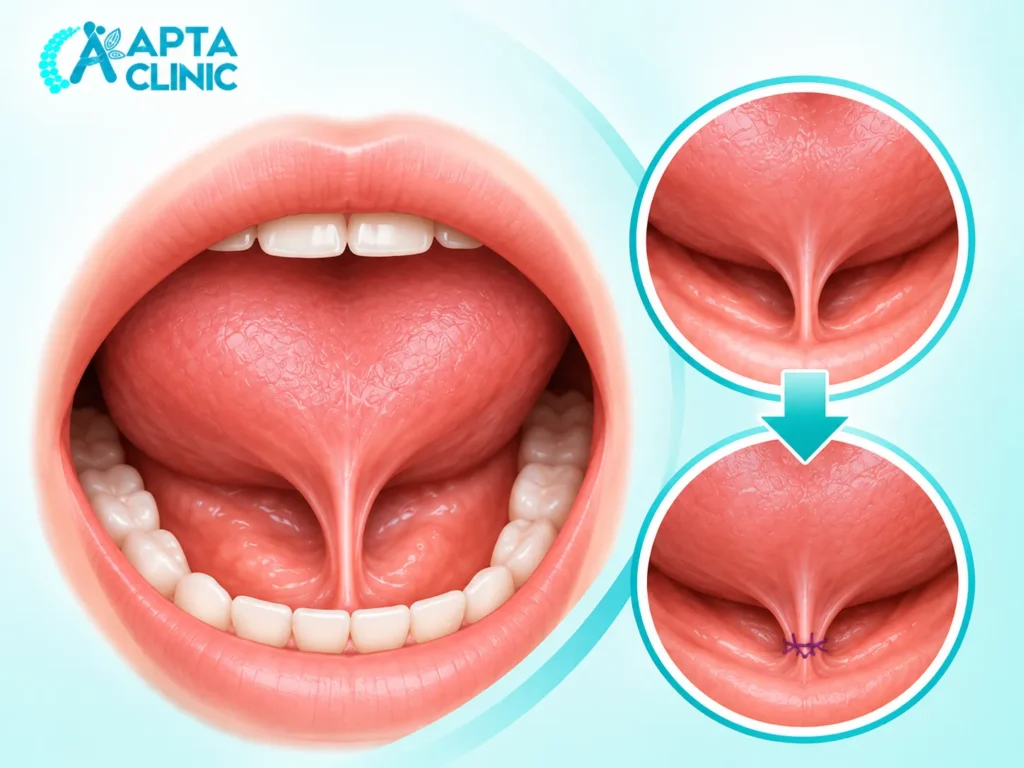
What Is Tongue-Tie (Ankyloglossia)?
Tongue-tie is a condition present from birth in which the lingual frenulum is unusually short, tight or restrictive. The lingual frenulum is the thin band of tissue connecting the underside of the tongue to the floor of the mouth.
When this tissue limits tongue movement, a person may find it difficult to lift the tongue, extend it beyond the lower front teeth or move it freely from side to side.
The condition varies from person to person. Some individuals have a visible frenulum but no functional limitation. Others experience difficulties with feeding or specific tongue movements.
A visible band of tissue alone does not mean that surgery is necessary. Treatment decisions should consider the person’s symptoms, tongue mobility and the effect on everyday function.
Signs and Symptoms of Tongue-Tie
The signs of ankyloglossia can differ depending on age and the degree of movement restriction.
Signs of Tongue-Tie in Infants
Some babies with a restrictive lingual frenulum may experience:
- Difficulty attaching to the breast during feeding
- Trouble maintaining a latch
- Prolonged or tiring feeds
- Clicking sounds while feeding
- Difficulty transferring milk effectively
- Repeated breaks during feeding
These signs can also occur for reasons unrelated to tongue-tie. A feeding assessment is important before attributing the problem to the frenulum.
Signs of Tongue-Tie in Children
Parents may notice:
- Difficulty lifting or extending the tongue
- Trouble moving the tongue from side to side
- Difficulty licking food from the lips
- Difficulty clearing food from certain areas of the mouth
- Restricted movement during specific oral activities
- Concerns about pronunciation or particular speech sounds
Speech difficulties should be assessed separately. Tongue-tie does not explain every articulation or language-development concern.
Signs of Tongue-Tie in Adults
Adults may notice:
- Limited tongue movement
- Difficulty reaching certain areas of the mouth with the tongue
- Challenges with specific tongue movements
- Difficulty maintaining oral hygiene in some areas
- Discomfort associated with restricted movement
A clinical examination can help establish whether the frenulum is responsible for the functional limitation.
Can Tongue-Tie Affect Breastfeeding?
Tongue movement helps a baby latch onto the breast and transfer milk. In some infants, a restrictive frenulum may interfere with these movements and contribute to feeding difficulties.
However, breastfeeding problems can have several causes. Positioning, latch technique, milk supply, oral anatomy and other maternal or infant health factors may also be involved.
For this reason, a baby should not be recommended for tongue-tie release based only on the appearance of the frenulum. A complete feeding assessment, including appropriate lactation support, should be considered before deciding on a procedure.
If significant tongue restriction is confirmed and feeding difficulties continue despite appropriate support, a healthcare professional may discuss whether release is suitable.
Can Tongue-Tie Cause Speech Difficulties?
Parents sometimes seek an assessment because their child has difficulty pronouncing particular sounds. Restricted tongue movement may affect certain movements needed for speech, but tongue-tie does not automatically cause a speech disorder.
Speech development involves several factors, and articulation difficulties can have causes unrelated to the lingual frenulum.
A speech-language pathologist can assess pronunciation and determine whether restricted tongue movement is affecting specific sounds. This assessment is particularly useful before considering surgery for speech-related concerns.
Tongue-tie release should not be presented as a guaranteed treatment for speech delay or articulation problems. The expected benefit depends on whether the restriction is actually contributing to the difficulty.

When Should Tongue-Tie Be Evaluated?
Consider arranging a professional assessment when:
- An infant has persistent feeding or latching difficulties.
- A child has noticeably restricted tongue movement.
- Specific oral movements are difficult to perform.
- A child has persistent articulation concerns that may involve tongue mobility.
- An adult experiences ongoing functional limitations related to tongue movement.
Not everyone with ankyloglossia requires treatment. The decision should be based on functional findings rather than appearance alone.
How Is Tongue-Tie Diagnosed?
Tongue-tie is generally assessed through a clinical examination and a review of the person’s symptoms.
The clinician may examine:
- The appearance and attachment of the lingual frenulum
- How far the tongue can extend
- Whether the tongue can lift towards the roof of the mouth
- Side-to-side tongue movement
- Whether the tongue can reach the upper teeth or palate
- Relevant feeding or oral-function concerns
For infants, the feeding history and latch should also be considered. If speech is the main concern, a speech-language assessment may help identify the underlying difficulty.
The assessment should establish whether the frenulum is restricting movement and whether that restriction is causing a meaningful problem.
Tongue-Tie Treatment Options
Treatment depends on the degree of restriction, symptoms, age and functional impact. Some people do not need a procedure.
Observation and Support
If tongue movement is adequate and there are no significant functional problems, monitoring may be appropriate.
For infants with feeding difficulties, lactation support and a complete feeding assessment may help identify problems that do not require surgery.
For children with speech concerns, assessment by a speech-language pathologist can help determine whether therapy or another intervention is appropriate.
Frenotomy
A frenotomy is a procedure in which the restrictive lingual frenulum is divided to allow greater tongue movement. It is generally considered for selected patients when a restrictive frenulum is associated with a functional problem.
The procedure and anaesthesia requirements depend on the patient’s age, clinical findings and the treating clinician’s assessment.
Frenuloplasty
Frenuloplasty is a more extensive procedure that releases and may reposition the tissue beneath the tongue. It may be considered when the restriction requires a more involved surgical correction.
The choice between frenotomy and frenuloplasty should be made after an individual examination. Not every patient needs the same procedure.
What Happens During Tongue-Tie Release?
The process depends on the patient’s age, anatomy and the procedure recommended.
A typical care pathway may involve:
- Initial consultation: Discuss symptoms, medical history and the difficulties associated with tongue movement.
- Clinical assessment: Examine the frenulum and assess tongue mobility.
- Treatment discussion: Review whether observation, supportive care or a release procedure is appropriate.
- Procedure planning: Discuss the selected technique, anaesthesia, possible risks and aftercare.
- Follow-up: Review healing and address any ongoing functional concerns.
The treating clinician should explain what to expect before the procedure. Specific details, including the technique and anaesthesia, depend on the individual treatment plan.

Recovery After Tongue-Tie Release
Recovery varies depending on the procedure, age and individual healing response. Some patients may experience temporary tenderness, swelling or discomfort.
Aftercare instructions may cover:
- Oral hygiene
- Food and fluid intake
- Medication, if prescribed
- Wound care
- Follow-up appointments
- Appropriate tongue movement
Some patients may be advised to perform specific movement exercises or receive feeding or speech support. Follow the treating clinician’s instructions. Do not attempt forceful or aggressive stretching without professional guidance.
If bleeding persists, pain becomes severe, fever develops or the patient has difficulty swallowing or breathing, seek prompt medical attention. Breathing difficulty requires emergency care.
Tongue-Tie Assessment at APTA Clinic, Mysore
APTA Clinic lists tongue-tie release as part of its facial surgery services in Mysore. The existing service information describes the clinic’s offering of tongue-tie release for people with concerns about restricted tongue movement.
A consultation is an opportunity to discuss the symptoms, understand the assessment process and find out whether treatment is appropriate.
Before arranging a procedure, ask about the clinician who will perform the assessment, their relevant qualifications, the proposed technique, anaesthesia arrangements and follow-up care.
Contact APTA Clinic
- Phone: +91 7411 707 555
- Krishnamurthy Puram: Mysore – 570004
- Vijayanagar: Mysore – 570030
- Working hours: Monday to Sunday, 10:30 AM to 7:30 PM
To enquire about tongue-tie assessment or release, contact the clinic and confirm service availability at your preferred branch.
Frequently Asked Questions (FAQs)
Tongue-tie is a condition in which a short or restrictive lingual frenulum limits the movement of the tongue. It may cause functional difficulties in some people, although others have no symptoms.
Possible signs include difficulty latching, prolonged feeding, clicking sounds during feeding and difficulty transferring milk. These symptoms can have other causes, so a feeding assessment is important.
Tongue-tie does not typically cause speech problems in every child. Some children may have difficulty with particular tongue movements, but a speech-language assessment is useful to identify the actual cause.
No. Treatment is considered when restricted tongue movement causes a meaningful functional problem. Some people may only need observation or supportive care.
Frenotomy involves dividing the restrictive frenulum. Frenuloplasty is a more extensive procedure that may involve releasing and repositioning the tissue. The appropriate technique depends on clinical findings.
Yes. Adults may be assessed for release if a restrictive frenulum causes persistent functional limitations. Treatment suitability depends on an individual examination.
It may help selected infants when tongue restriction contributes to breastfeeding difficulties. A complete feeding assessment and appropriate support should be considered before surgery.
Recovery varies with age and procedure. Temporary tenderness or swelling may occur. Follow the treating clinician’s instructions for oral care and follow-up.