Liposuction vs Non-Surgical Fat Reduction: Which Is Better? in Mysore
- Home
- Blog
- About Us
If you have stubborn fat around your abdomen, waist, thighs or arms, you may be wondering whether liposuction or non-surgical fat reduction is the better choice. Both treatments aim to change the appearance of selected areas, but they differ in how they work, the results they may achieve and the recovery involved.
Liposuction is a surgical procedure that removes fat through small incisions. Non-surgical fat reduction uses technologies such as controlled cooling, radiofrequency or ultrasound, depending on the treatment, to target localised fat without conventional surgical removal.
The right option depends on the area you want to treat, your health, skin elasticity and the degree of change you expect. If you are comparing liposuction vs non-surgical fat reduction in Mysore, a consultation with a qualified clinician can help you understand which options are suitable for you.
What Is the Difference Between Liposuction and Non-Surgical Fat Reduction?
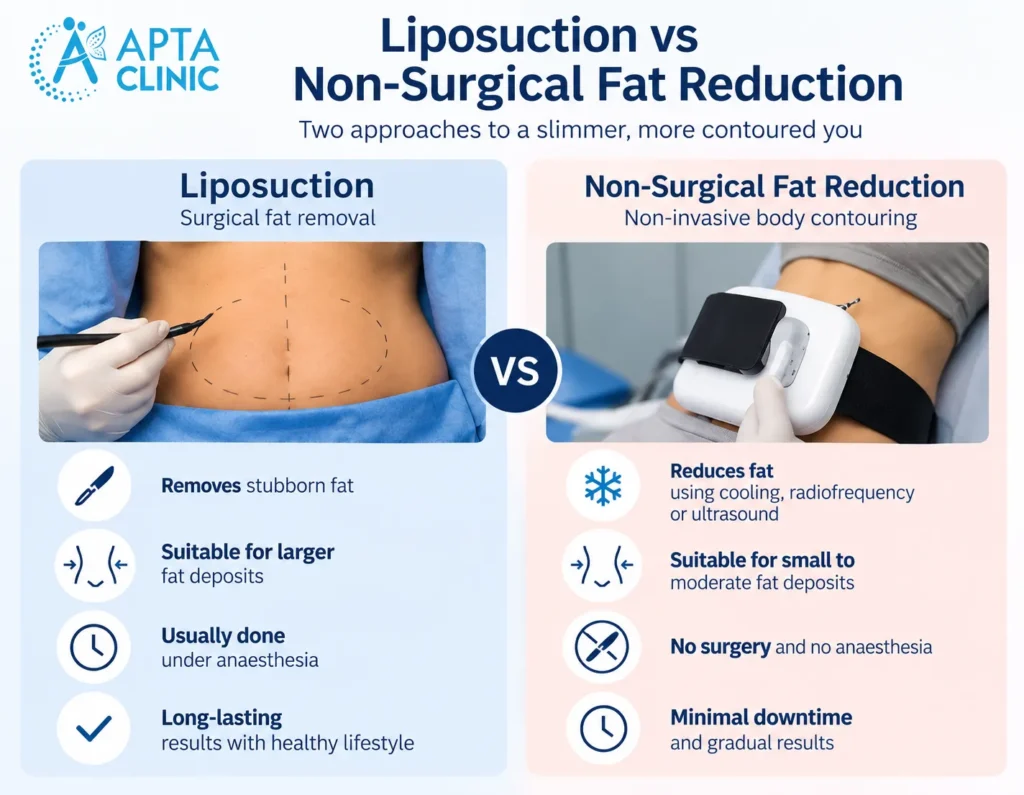
The main difference is how each treatment addresses fat beneath the skin.
Liposuction involves a surgeon removing selected fat deposits using a thin tube called a cannula. The procedure can produce a more noticeable change in body contours for suitable patients, although the outcome depends on the treatment plan and individual anatomy.
Non-surgical fat reduction uses a particular device or technique to target a localised area. Depending on the technology, the treatment may use cooling, radiofrequency or ultrasound energy. Results tend to be more modest, and some methods require multiple sessions.
Neither treatment is intended to replace weight management. They are designed to address specific body-contouring concerns, and neither guarantees a particular shape or result.
How Does Liposuction Work?
Liposuction is a surgical procedure used to remove selected fat deposits from beneath the skin. The surgeon makes small incisions and inserts a cannula to remove fat from the planned treatment area.
Depending on the patient’s anatomy and suitability, liposuction may be considered for areas such as:
- Abdomen and waist
- Hips and thighs
- Upper arms
- Back
The areas treated and the amount of fat removed depend on the surgeon’s assessment and the agreed surgical plan.
Benefits and limitations of liposuction
Liposuction directly removes fat from the treated area. It may offer a more noticeable change in contour than many non-surgical methods, making it an option for people who want a greater change in a localised area.
However, liposuction is surgery. It involves healing time, temporary swelling and bruising, activity restrictions and possible complications. The final contour may take time to become apparent as swelling settles.
Liposuction also does not reliably correct significant loose skin. If skin laxity is the main concern, removing fat alone may not achieve the result you want.
Before proceeding, the surgeon should review your medical history, medications, skin elasticity, fat distribution and expectations.
What Is Non-Surgical Fat Reduction?
Non-surgical fat reduction refers to treatments that target localised fat without conventional surgical removal. The term covers different technologies, and their results and risks are not the same.
Fat freezing (cryolipolysis)
Cryolipolysis uses controlled cooling to target fat in a selected area. Changes develop gradually as the body processes the affected cells.
The treatment has specific contraindications and possible complications. One uncommon complication is paradoxical adipose hyperplasia, in which the treated area becomes larger instead of smaller.
Radiofrequency-based treatments
Radiofrequency devices deliver energy that heats tissue. Depending on the device and its intended use, treatment may target localised fat, affect body circumference or improve the appearance of skin.
The expected outcome depends on the specific technology and treatment protocol.
Ultrasound-based treatments
Some devices use ultrasound energy to target tissue beneath the skin. Results and safety precautions vary according to the device, treatment area and patient’s suitability.
Before choosing any non-surgical fat reduction treatment, ask the provider which device will be used, what it is intended to achieve, what evidence supports its use and which side effects are possible.
Non-surgical treatment does not mean risk-free treatment. The US Food and Drug Administration explains that non-invasive body contouring does not treat obesity or provide the general health benefits associated with weight loss.
Liposuction vs Non-Surgical Fat Reduction: Key Differences
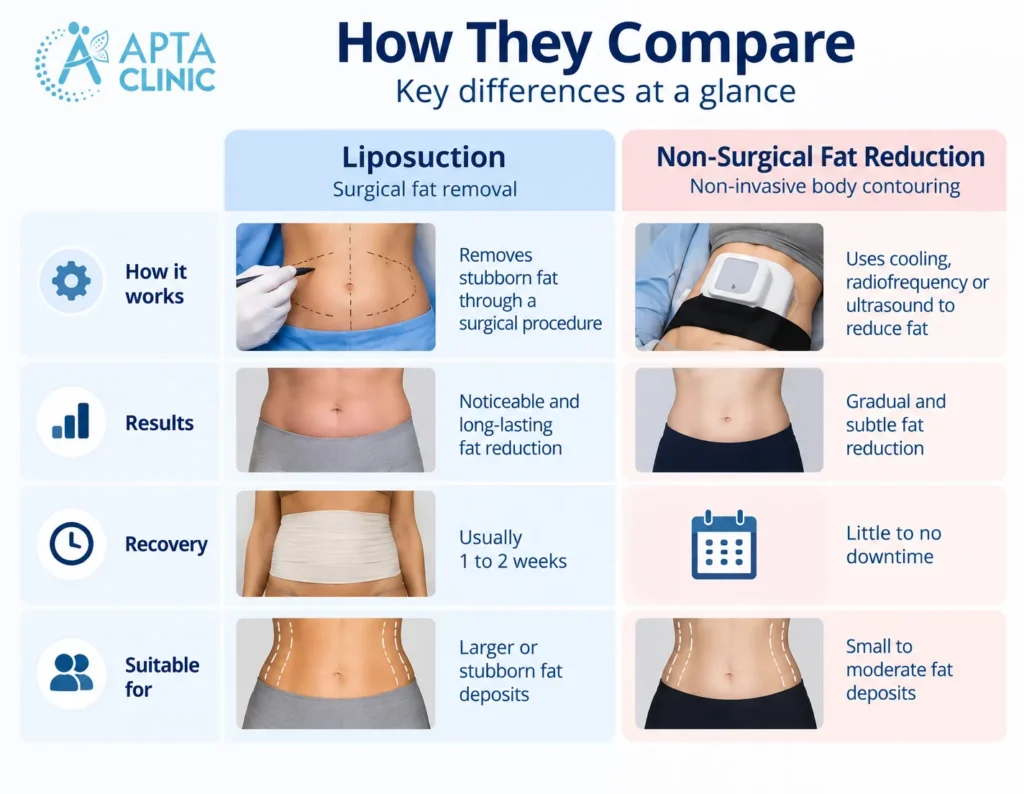
Factor | Liposuction | Non-surgical fat reduction |
How it works | Surgically removes selected fat deposits | Uses a specific technology to target localised fat |
Treatment goal | May produce a more noticeable change in selected contours | Usually aims for a more modest change |
Incisions | Small surgical incisions are used | Non-invasive device treatments do not require incisions |
Anaesthesia | Depends on the procedure and surgical plan | Depends on the treatment; many device-based methods do not require surgical anaesthesia |
Number of sessions | May be completed in one operation, depending on the plan | Multiple sessions may be needed |
Recovery | Requires post-operative care and activity guidance | Often involves less downtime, although side effects can occur |
Results | The contour becomes clearer as swelling settles | Changes usually develop gradually |
Risks | Includes surgical and anaesthesia-related risks | Depends on the technology and may include burns, pain, swelling or other complications |
Cost | Depends on the surgical plan, facility and related care | Depends on the technology, treatment area and number of sessions |
These are general comparisons. Your clinician should explain the likely benefits, limitations and risks of the specific procedure being considered.
Who May Be Suitable for Liposuction?
Liposuction may be considered for adults who have localised fat deposits, are medically suitable for surgery and have realistic expectations about the outcome.
During an assessment, the surgeon may consider:
- Whether your weight is relatively stable
- The location and amount of fat
- Your skin elasticity
- Medical conditions and medications
- Smoking or nicotine use
- Previous operations
- The change you hope to achieve
Liposuction is not designed for major weight loss. If your main concern is significant loose skin or overall body weight, another approach may be more appropriate.
There is no universal checklist that confirms suitability. The decision requires an individual assessment by a qualified surgeon.
Who May Consider Non-Surgical Fat Reduction?
A non-surgical treatment may be worth discussing if you want a modest change in a small, localised area and prefer to avoid surgery.
Suitability depends on the particular technology. A clinician should assess the area being treated, your medical history, skin condition, medications and any device-specific contraindications.
Ask about possible side effects before agreeing to treatment. Depending on the method, these may include pain, swelling, bruising, numbness, burns or changes in skin appearance.
The provider should also explain what happens if a complication develops and what follow-up care is available.
Results and Recovery: What Should You Expect?
How noticeable are the results?
Liposuction may produce a more noticeable change in selected body contours than many non-surgical treatments. The outcome depends on the area treated, the surgical plan, skin quality and healing.
Non-surgical fat reduction generally aims for a smaller change in a targeted area. Results may take weeks or months to develop, and some treatments require repeat sessions.
Neither option guarantees a perfectly smooth contour. Your clinician should explain what is realistic for your individual circumstances.
How long does recovery take after liposuction?
Recovery varies according to the extent of surgery and the areas treated. Swelling, bruising, tenderness and temporary changes in sensation may occur.
Your surgeon will explain when you can return to work, exercise and other daily activities. Follow the instructions provided for wound care, any recommended compression garments and follow-up appointments.
Is recovery easier with non-surgical treatment?
Many non-surgical treatments involve less downtime than surgery. However, you may still experience temporary discomfort, swelling, bruising or skin changes.
Some methods also require several visits before the expected result becomes visible. Ask the provider about the likely treatment schedule and any restrictions after each session.
Are Liposuction Results Permanent?
Fat removed during liposuction is removed from the treated area, but remaining fat cells can enlarge if you gain weight. Ageing and changes in body weight may affect your contours over time.
Some non-surgical methods can produce lasting changes in treated areas. The duration and extent of those changes depend on the technology used, and weight gain can still affect your appearance.
Before treatment, ask the clinician what is known about the long-term results of the specific procedure being offered.
Risks and Safety Considerations
Both liposuction and non-surgical fat reduction carry risks. The type and likelihood of complications depend on the treatment, your health and the experience of the provider.
Possible risks of liposuction
Complications may include infection, bleeding, fluid accumulation, contour irregularities, asymmetry, scarring, changes in sensation and anaesthesia-related problems. Serious complications are also possible.
Discuss your medical history, medicines and supplements with the surgeon. Make sure you understand the planned procedure and the care required after surgery.
Possible risks of non-surgical fat reduction
Side effects vary by technology and may include redness, swelling, bruising, discomfort, numbness, burns or skin changes. Some methods have additional contraindications or uncommon but serious complications.
Before treatment, ask these questions:
- What side effects are associated with this specific method?
- Are any of my medical conditions or medications relevant?
- Is the device intended for the area I want to treat?
- What follow-up care is available if a problem occurs?
Do not choose a treatment solely because it is described as non-invasive. Make sure you understand the benefits, limitations and risks before deciding.
What Affects the Cost of Fat Reduction in Mysore?
The cost of liposuction or non-surgical fat reduction depends on the proposed treatment plan. There is no single price that applies to every patient.
For liposuction, the estimate may depend on the number of areas treated, surgical technique, anaesthesia, facility charges, pre-operative assessment and follow-up care.
For non-surgical treatment, the cost may depend on the device, size of the treatment area, number of sessions and follow-up requirements.
When comparing estimates, ask what is included. Additional sessions, medicines, investigations, garments or follow-up visits may affect the final amount.
Request a current, itemised estimate from the clinic rather than assuming that one treatment will always cost less than the other.
How to Choose the Right Treatment in Mysore
Start by identifying the change you want to make. A small pocket of fat may require a different discussion from significant loose skin or concerns about overall weight.
During your consultation, discuss:
- Your treatment goal: Which area concerns you, and what change are you hoping for?
- Your health: Which medical conditions, medications, allergies or previous procedures need to be considered?
- Your options: Is surgery appropriate, or could a non-surgical approach be considered?
- Expected results: How much change is realistic, and when might you see it?
- Risks and recovery: What complications are possible, and what aftercare will you need?
- Total cost: What is included in the estimate, and might further treatment be required?
- The provider: What are the clinician’s qualifications, and what facilities and follow-up care are available?
Take time to understand the proposed treatment before making a decision. A qualified clinician should explain the options relevant to your needs without promising a particular outcome.
Discuss Liposuction Options at APTA Clinic in Mysore
If you are researching liposuction in Mysore, APTA Clinic is one place to enquire about a consultation. The clinic’s website lists plastic surgery services and a dedicated liposuction treatment page.
During an enquiry, ask about the consultation process, your suitability for treatment, the expected results, recovery requirements and the total cost.
If you are interested in non-surgical fat reduction, confirm directly with the clinic whether the specific technology you are considering is currently available. Do not assume that every method discussed in this article is offered at the clinic.
Contact APTA Clinic
- Phone: +91 7411 707 555
- Website: https://aptaclinic.com/
- Location: The supplied draft lists locations in Krishnamurthy Puram and Vijayanagar, Mysuru. Confirm the preferred branch and appointment availability with the clinic.
A consultation can help you understand the available options and decide what questions to ask before proceeding.
Medical disclaimer: This article is for general educational purposes. It does not replace an individual medical assessment or treatment advice from a qualified healthcare professional.
Frequently Asked Questions (FAQs)
Liposuction surgically removes selected fat deposits through small incisions. Non-surgical fat reduction uses technologies such as controlled cooling or certain energy-based treatments to target localised fat. The results, recovery and risks depend on the specific method.
Liposuction can produce a more noticeable change in selected body contours. Non-surgical treatments generally aim for a more modest change. The suitable option depends on your health, skin quality, treatment area and expectations.
Non-surgical fat reduction can be suitable for selected patients, but it is not risk-free. Side effects vary by technology and may include pain, swelling, bruising, burns or skin changes. A qualified clinician should assess your suitability before treatment.
No. Non-surgical body contouring targets specific areas and is not a treatment for obesity or general weight loss. If your primary goal is weight management, discuss suitable options with a healthcare professional.
Liposuction primarily removes fat and does not reliably correct significant loose skin. If skin laxity is your main concern, your surgeon can assess whether another body-contouring procedure may be appropriate.
Fat removed during liposuction is removed from the treated area, but remaining fat cells can enlarge with weight gain. Changes in weight and ageing can affect body contours over time.
The cost depends on the treatment area, procedure, facility requirements and number of sessions. Non-surgical treatment may involve repeated visits, while liposuction has surgical and related care costs. Request an itemised estimate before comparing options.
The supplied draft identifies a dedicated liposuction page on APTA Clinic’s website. The availability of specific non-surgical technologies has not been established here. Contact the clinic directly to confirm its current treatment options.