Scar Revision Surgery in Mysore: Options & Recovery
- Home
- Blog
- About Us
A scar can remain visible long after an injury, burn or surgical wound has healed. Some scars gradually fade, while others become raised, stretched, uneven or tight enough to affect movement. If a scar continues to bother you, scar revision surgery may be worth discussing with a qualified clinician.
Scar revision aims to improve the appearance or function of an existing scar. The procedure does not remove every trace of the original injury. The outcome depends on the scar’s characteristics, its location, your skin and how your body heals.
If you are considering scar revision surgery in Mysore, understanding the available treatments, recovery process and possible limitations can help you prepare for a consultation at APTA Clinic or another qualified medical facility.
What Is Scar Revision Surgery?
Scar revision surgery is a procedure that changes the appearance or position of an existing scar. Depending on the problem, a surgeon may remove part of the scar tissue, reshape the area or close the wound in a way intended to produce a less noticeable scar.
Treatment may be considered for selected scars following surgery, an accident, a burn or another injury. In some cases, the main concern is appearance. In others, tight scar tissue can cause discomfort or restrict movement.
The aim is to improve the scar, not to restore the skin to its original condition. Every surgical revision creates a new wound, and the resulting scar will need time to mature.
Surgery is also not necessary for every scar. Silicone products, injections, laser-based procedures and other treatments may be suitable for certain scar types. A clinical assessment helps determine which approach is appropriate.
Which Types of Scars Can Be Treated?
The treatment plan depends on how the scar formed, how it has healed and what you want to improve.
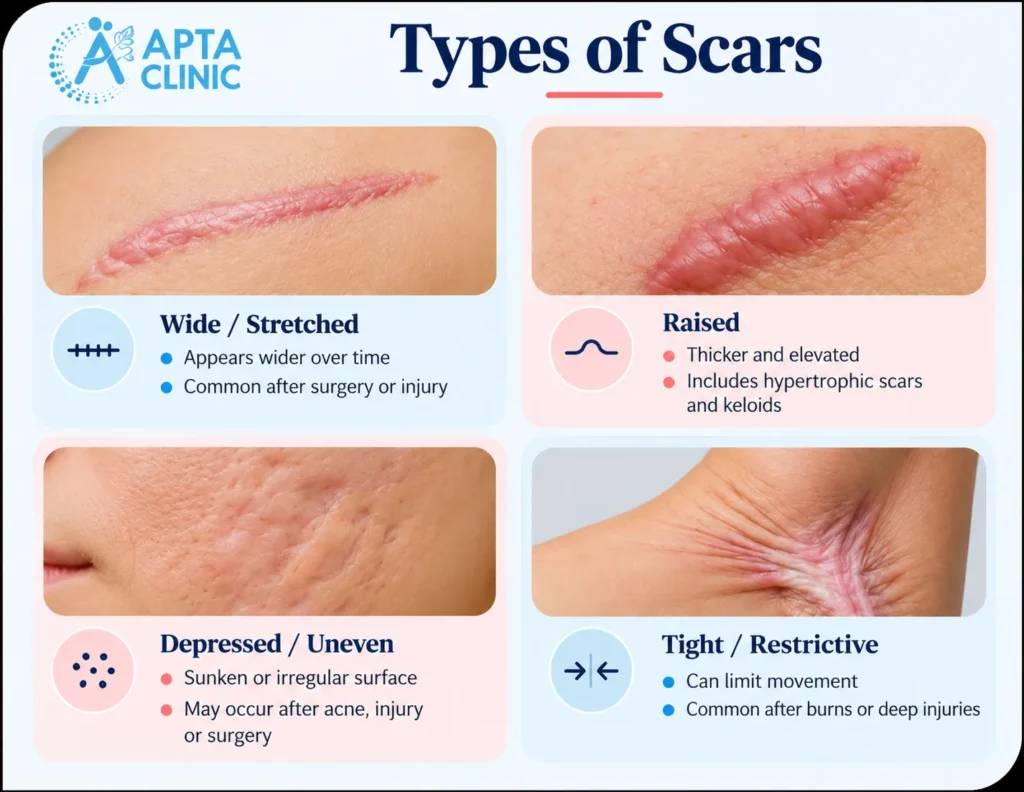
- Wide or stretched scars
A scar can become wider as a wound heals, particularly when the surrounding skin is under tension. This can happen after an operation or injury.
In selected cases, surgical revision may help narrow or reshape the scar. The result depends on the location, skin tension and healing characteristics. The revised area will still form a scar, so complete removal is not a realistic expectation.
- Raised scars and keloids
Raised scars develop when excess scar tissue forms during healing. Two types that need to be distinguished are hypertrophic scars and keloids.
A hypertrophic scar remains within the boundaries of the original wound. A keloid extends beyond those boundaries and may continue to grow.
The distinction matters because these scars do not always respond to the same treatment. Surgery alone can lead to keloid recurrence, sometimes with more prominent scar tissue. A clinician may recommend injections, silicone-based care, other treatments or a combination of approaches.
Anyone with a history of keloids should mention it during the consultation.
- Depressed or uneven scars
Some scars appear sunken or leave an uneven skin surface. The cause may involve changes in the tissue beneath the skin.
Treatment depends on the depth, location and structure of the scar. Surgical revision may help selected scars, while laser-based procedures or other approaches may be considered in different cases.
A clinician should assess the scar before recommending treatment.
- Contracture scars
A contracture scar develops when scar tissue tightens the surrounding skin. This can restrict movement, particularly when a scar crosses a joint or forms after a burn.
Treatment may aim to improve both movement and appearance. The appropriate procedure depends on the extent of the tightness, the location and the condition of the surrounding tissue.
If a scar interferes with everyday activities, explain the limitation during your consultation.
- Scars after surgery or an injury
A surgical incision or traumatic wound may heal with an irregular shape, an unfavourable position or a widened appearance. Revision may be considered when the scar has matured and the likely improvement justifies treatment.
Some scars continue to change naturally for months after an injury. A clinician may recommend waiting before considering surgery, depending on the scar and the reason for treatment.
Scar Revision Surgery vs Non-Surgical Scar Treatments
Surgery is one option for scar management, but it is not always the first choice.
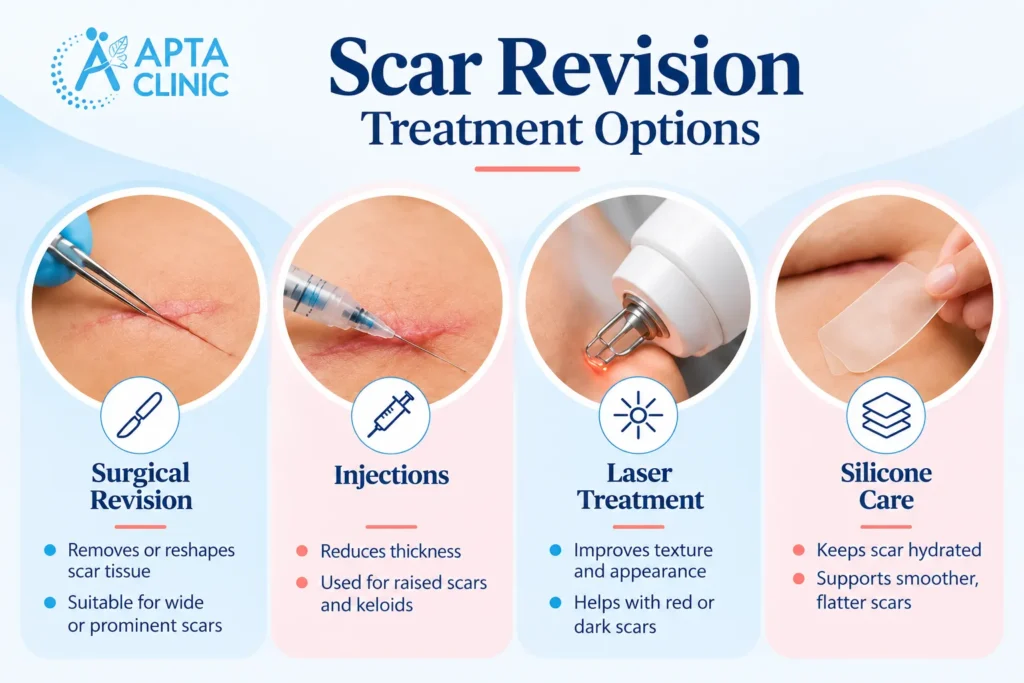
Treatment | When it may be considered |
Surgical scar revision | Selected wide, irregular, poorly positioned or restrictive scars |
Silicone gel or sheets | Certain raised scars and scar-care plans after a wound has closed |
Scar injections | Selected hypertrophic scars and keloids |
Laser-based treatment | Certain scars with redness, colour or texture concerns |
Other clinician-recommended treatments | Scars that need an individual approach based on their characteristics |
These treatments have different purposes and limitations. A keloid may need a plan that addresses recurrence, while a scar restricting movement may require a different assessment from one that mainly affects appearance.
Availability also varies between providers. APTA Clinic has a scar reduction service page describing surgical and non-surgical approaches. Contact the clinic to confirm which treatments are currently offered and whether one is suitable for your scar.
Who May Be Suitable for Scar Revision Surgery?
Scar revision may be considered when a scar has healed but continues to cause an appearance-related concern, discomfort or functional restriction.
During an assessment, a clinician may consider:
- The scar’s age, size, depth and location.
- Whether it is raised, wide, depressed or restrictive.
- Whether its appearance is still changing.
- A personal history of keloids or hypertrophic scars.
- The condition of the surrounding skin.
- Any active infection or skin condition in the treatment area.
- Medical history, medicines and previous procedures.
- The improvement you expect from treatment.
People who develop keloids need particular care when considering surgery because the revised wound may form another raised scar.
There is no single checklist that determines whether someone is suitable. The decision depends on the individual scar, the person’s healing history and the expected benefits and risks.
What Happens During a Scar Revision Consultation?
A consultation gives the clinician an opportunity to examine the scar, understand your concerns and explain the available options.
Reviewing the scar’s history
You may be asked how the scar developed, how long it has been present and whether it has changed. Tell the clinician if you experience itching, pain, tightness or restricted movement.
Mention any previous scar treatments, unsuccessful procedures or history of keloids.
Examining the scar
The clinician may assess its width, height, colour, texture, direction and flexibility. Its position near a joint or an area that moves frequently can also influence the treatment plan.
Discussing treatment options
Depending on the findings, the clinician may discuss continued scar care, a non-surgical procedure or surgical revision.
Ask why a particular approach is recommended and what alternatives are available. The discussion should include realistic expectations rather than a promise that the scar will disappear.
Reviewing risks and recovery
Before agreeing to treatment, ask about possible complications, wound care, activity restrictions, recovery time and whether additional treatment may be required.
If surgery is planned, the clinician will explain any preparation needed and arrange appropriate follow-up.
Recovery After Scar Revision Surgery
Recovery varies according to the procedure, the scar’s location and size, and your individual healing process.
After surgery, the treated area may have swelling, bruising, tenderness or temporary changes in skin colour. Your clinician will explain how to care for the wound and when to return for review.
The initial healing period
Some surgical scar revisions have an initial healing period of around one to two weeks, although this varies by procedure. Healing may take longer when the area is larger, under tension or affected by other medical factors.
Follow the instructions you receive about dressings, wound care and prescribed medicines. You may need to avoid activities that stretch or rub the healing area.
Do not use a general recovery timeline to decide when to resume exercise or physically demanding work. Follow your treating clinician’s advice.
How the scar changes over time
A newly revised scar may initially look red, firm or more noticeable than expected. Its appearance can gradually change over several months. Scar maturation may take a year or longer in some cases.
Scar revision is not an instant cosmetic change. The new wound needs time to heal, and the final appearance cannot be predicted with certainty.
Caring for the treated area
Follow your clinician’s instructions about wound care, sun protection and the use of silicone products if recommended. Do not apply products to an open wound unless your clinician advises you to do so.
Contact your treating clinician promptly if you develop increasing pain, spreading redness, warmth, pus, fever or wound separation. Seek urgent medical attention for severe or rapidly worsening symptoms.
Risks and Limitations of Scar Revision
Scar revision is a medical procedure, and the amount of improvement varies between patients.
Possible complications include:
- Infection or bleeding.
- Delayed wound healing.
- Changes in skin sensation.
- Persistent swelling or discomfort.
- Uneven skin contour or colour changes.
- A scar that remains visible.
- Recurrence of a raised scar or keloid.
- The need for additional treatment or another procedure.
The risks depend on the technique, the location of the scar, your health and your previous healing experience.
A revision may improve the scar’s shape or function while leaving a visible mark. In some cases, the likely benefit may be too limited to justify surgery.
Ask your clinician how your particular scar may respond to treatment and what steps can help reduce the risk of complications or recurrence.
What Affects the Cost of Scar Revision Surgery in Mysore?
The cost of scar revision depends on the treatment plan. There is no single price that applies to every scar.
Factors that may affect the estimate include:
- The scar’s size, location and complexity.
- Whether surgical or non-surgical treatment is recommended.
- The type of anaesthesia and facility required.
- Whether more than one procedure is needed.
- The number of visits or treatment sessions.
- Dressings, medicines and follow-up care.
Before proceeding, request an itemised estimate and ask what is included. If a combination of treatments is recommended, clarify whether each treatment has a separate charge.
For current pricing and appointment availability, contact APTA Clinic directly. A cost estimate should reflect the clinician’s assessment and proposed treatment.
How to Choose a Scar Treatment in Mysore
Start by identifying what concerns you most about the scar. You may want to improve its width or colour, reduce raised tissue, address discomfort or regain movement.
During your consultation, discuss the following:
- Your main concern: Explain what you want to improve and whether the scar causes symptoms.
- The scar’s history: Describe how it formed, how long it has been present and whether it has changed.
- Suitable treatments: Ask whether surgery is appropriate or if a non-surgical approach may be more suitable.
- Expected results: Find out what degree of improvement is realistic for your scar.
- Risks and recovery: Discuss complications, wound care, activity restrictions and follow-up.
- Cost: Request a clear estimate, including any additional treatments that may be required.
- The treating professional: Ask about the clinician’s qualifications, experience with your type of scar and the facilities available for treatment.
Take time to understand the options before making a decision. The best approach is the one that addresses your particular concern while taking account of the possible risks and limitations.
Scar Revision Treatment at APTA Clinic in Mysore
If a healed scar remains wide, raised, uneven, uncomfortable or restrictive, an assessment can help you understand which treatments may be appropriate.
APTA Clinic has a dedicated scar reduction service page that discusses scar treatment options, including surgical revision. If you are considering treatment, contact the clinic to ask about the consultation process and the procedures currently available.
During your enquiry, ask what improvement may be realistic, how long healing could take, whether the scar might recur and what follow-up care is provided.
Contact APTA Clinic
- Phone: +91 7411 707 555
- Website: https://aptaclinic.com/
- Locations listed in the supplied information: Krishnamurthy Puram and Vijayanagar, Mysuru. Confirm the preferred branch and appointment availability directly with the clinic.
Scar revision aims to improve the appearance or function of a scar, not guarantee its complete removal. Understanding the treatment plan and recovery requirements can help you make an informed decision.
Medical disclaimer: This article provides general educational information and does not replace an individual assessment or treatment advice from a qualified healthcare professional.
Frequently Asked Questions (FAQs)
No. Scar revision aims to make a scar less noticeable, improve its shape or position, or address functional problems. The procedure creates a new scar, and the final appearance depends on the scar type, location and individual healing.
Selected wide, irregular, poorly positioned, traumatic and restrictive scars may benefit from surgery. Keloids and other raised scars need careful assessment because surgery can lead to recurrence. The appropriate treatment depends on the individual scar.
Initial healing may take around one to two weeks for some procedures, but the scar continues to mature over several months. In some cases, the final appearance may take a year or longer to develop. Your clinician can provide a timeline based on the procedure.
Tenderness, swelling and some discomfort may occur after surgery. The level of discomfort depends on the procedure and the location of the scar. Your treating clinician can explain how to manage discomfort and which symptoms require medical review.
Consider a consultation if a healed scar continues to concern you because of its appearance, discomfort or effect on movement. Some scars improve naturally over time, so a clinician may recommend waiting if the scar is still maturing.
Possible risks include infection, bleeding, delayed healing, changes in skin sensation, uneven appearance and recurrence of the scar. Your individual risk depends on your health, scar type and the proposed procedure.
APTA Clinic has a dedicated scar reduction service page that discusses surgical revision and other treatment approaches. Contact the clinic to confirm which procedures are currently available and whether one may be appropriate for your scar.
Some old surgical scars can be revised if their width, shape, position or symptoms make treatment worthwhile. Suitability depends on scar maturity, surrounding skin, healing history and the improvement expected. A clinician should assess the scar before recommending treatment.